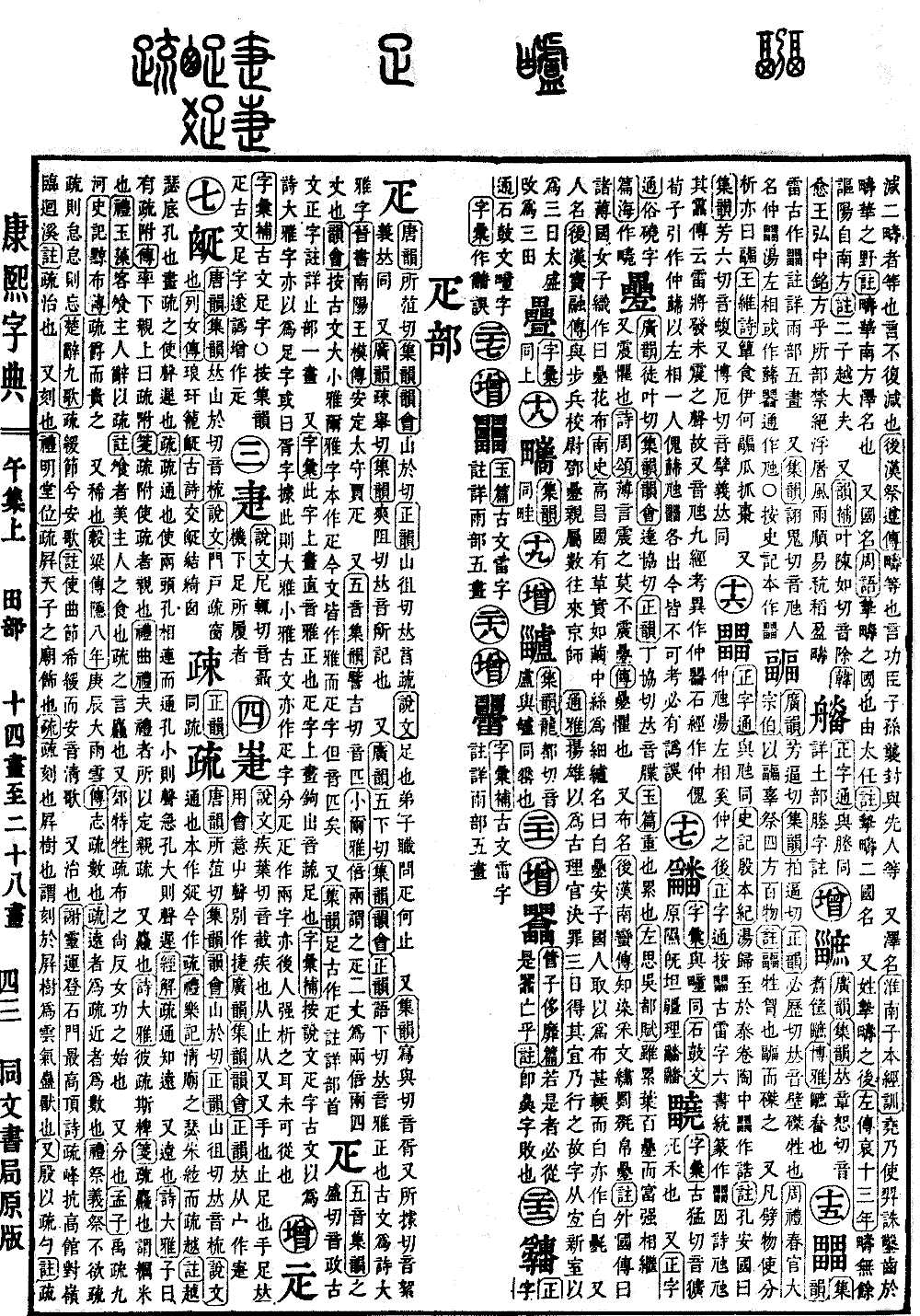
Wu Collection, Upper Volume
Radical: Bolt (pǐ)
Kangxi Strokes: 12
Page 767, Entry 23
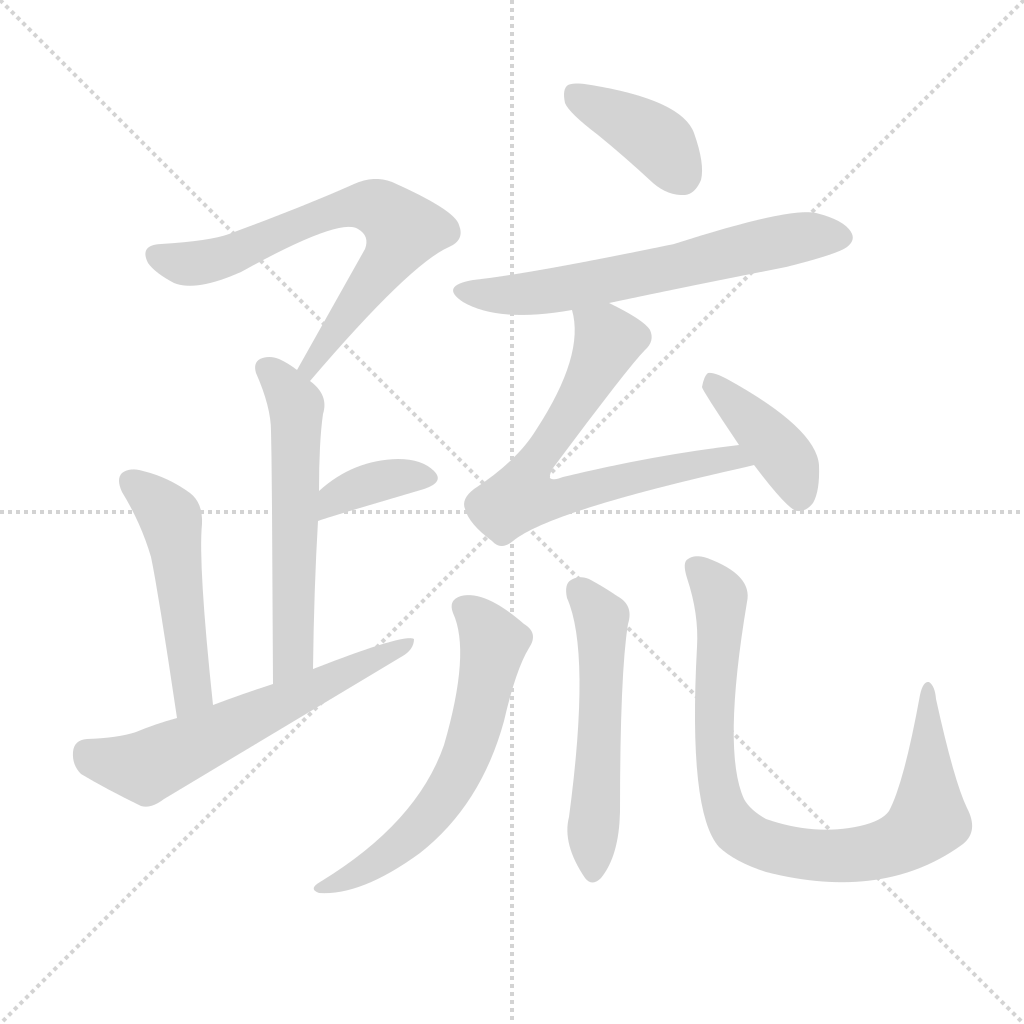
Pronounced shu.
Classic of Etymology (Shuowen): To connect or open. Originally written as a different character, now written as this.
Book of Rites (Liji), Record of Music (Yueji): The zither in the temple has red strings and wide bridge apertures. Commentary: The apertures are at the base of the zither, carved wide to make the sound slow. Commentary: It means to connect. By making the apertures at both ends connect, a small aperture creates a rapid sound, while a large one creates a slow sound.
Classic of Rites (Liji), Explanation of Classics (Jingjie): To be clear, communicative, and farsighted.
Also means distant.
Book of Odes (Shijing), Greater Odes (Daya): I say there is a distant attachment. Commentary: To lead those below and be close to those above is called distant attachment. Commentary: Distant attachment means making those who are distant feel close.
Book of Rites (Liji), Pattern of Conduct (Quli): Ritual is the means by which one determines kinship and distance.
Also means coarse.
Book of Odes (Shijing), Greater Odes (Daya): That which is coarse and that which is fine. Commentary: It means coarse, referring to unpolished rice.
Book of Rites (Liji), Jade Pattern (Yuzao): When a guest is served a meal, the host apologizes for its coarseness. Commentary: Serving a meal expresses the host's humility; it means the food is coarse.
Also, Rites and Customs of Suburban Sacrifices (Jiao Tesheng): Using coarse cloth to honor the origins of female labor.
Also means to divide.
Works of Mencius (Mengzi): Yu divided the nine rivers.
Records of the Grand Historian (Shiji), Biography of Qing Bu: To divide the fiefs and honor them.
Also means sparse.
Commentary of Guliang (Guliang Zhuan), Eighth Year of Duke Yin: On the gengchen day, there was heavy snow. Commentary: It records the scarcity and frequency. Commentary: Distant is called sparse, close is called frequent.
Book of Rites (Liji), Meaning of Sacrifice (Jiyi): Sacrifice should not be infrequent; if it is infrequent, one becomes negligent, and if negligent, one forgets.
Songs of the South (Chuci), Nine Songs (Jiuge): Let the melody be sparse and leisurely as I sing peacefully. Commentary: To make the musical intervals sparse and leisurely, creating a clear tone.
Also means to manage or govern.
Xie Lingyun, Poem on Climbing the Highest Peak of Stone Gate: Managed peaks stand against high halls, facing ridges overlooking winding streams. Commentary: It means to govern.
Also means to engrave.
Book of Rites (Liji), Royal Regulations (Mingtangwei): Engraved screens were the decoration of the Son of Heaven's temple. Commentary: It means to carve. Screens are partitions. It refers to carving cloud patterns and strange beasts onto the screen partitions.
Also, they used wide-carved ladles in the Yin dynasty. Commentary: It means to carve through the handle.
History of the Later Han (Houhan Shu), Biography of Liang Ji: Windows were all adorned with engraved blue latticework. Commentary: Carved into intricate patterns.
Also means to paint or adorn.
Guanzi, Questions (Wenpian): The high official adorned his vessels. Commentary: It means decorative painting.
He Yan, Rhapsody on the Hall of Auspicious Fortune (Jingfu Dian Fu): Rows of painted pillars reach upward. Commentary: Painted pillars.
Also means to remove.
Discourses of the States (Jin Yu): The Duke attacked Yuan and gave orders to take three days of rations; if Yuan did not surrender in three days, he ordered the army to remove its supplies and leave. Commentary: It means to clear away.
Also means to spread out.
Songs of the South (Chuci), Nine Songs (Jiuge): Spread out the orchids to make a fragrance. Commentary: It means to spread out.
Also means large.
Yang Xiong, Grand Mystery (Taijing): The divisions of the state are large and complete. Commentary: It means large.
Also means vegetables, synonymous with another character (shu).
Book of Rites (Zhouli), Offices of Heaven (Tianguan), Grand Administrator: With nine duties to employ the people, the eighth is to gather vegetable materials. Commentary: Materials from the earth, the roots and fruits of all plants that can be eaten; when the harvest is not ripe, it is called famine. Exegesis: Means vegetables.
Also, Earth Offices (Diguan), Collector of Supplies: All vegetable materials and wood materials.
Also, Huainanzi, Principles of the Way (Dao Ying Xun): He wore his sash and stood barefoot under the hall. Commentary: It means to be barefoot.
Also, lush, referring to the appearance of abundant branches and leaves.
Yang Xiong, Grand Mystery (Taijing): Do not use what is small, rely on my lushness. Commentary: Autumn trees are lush and large, hence they can be used.
Also, pronounced qu-shu (a type of rake).
Also, to scatter or leap.
Huainanzi, The Meaning of Truth (Chuzhen Xun): Now the scattering and leaping of all things, the stems and leaves of a hundred affairs, all originate from one root, yet the branches follow in the thousands.
Also, the appearance of flowing robes.
Han's Illustrations of the Book of Odes (Han Shi Waizhuan): Zilu met Confucius in grand attire; Confucius said: "Zilu, what is this grand attire?"
Also, Yang Xiong, Grand Mystery (Taijing): The grain is not grain; it loses its balance. Commentary: It refers to a lack of equilibrium.
Also, a surname. Han dynasty figures Shu Guang and Shu Shou.
Also, a country name. Qianfulun: The Xi-Shu branch of the Yi clan. Lushui: A feudal lord during the Xia dynasty.
Also, a mountain name. Classic of Mountains and Seas (Shanhaijing): The minister of Erfu, named Wei, killed Yayu with Erfu, so the Emperor shackled him to the mountain of Shushu. Commentary: According to the text, the south of Shushu and the bend of the Fen River refer to this mountain.
Also, a bird name. Book of Rites (Liji), Pattern of Conduct (Quli): A pheasant is called one with splayed toes. Commentary: When a pheasant is fat, its feet spread open, and its toes are widely separated.
Also, a beast name. Classic of Mountains and Seas (Shanhaijing): On Dai Mountain there is a beast; its shape is like a horse, with one horn that is jagged, its name is Shu.
Also, synonymous with the character for "comb." Yang Xiong, his hair was messy and he had no time to comb.
Also, pronounced su. Coarse.
Also, pronounced shu (rising tone). To itemize.
Yang Xiong, Ridiculing Oneself (Jiechao): Only then can one submit a memorial to discuss right and wrong.
Also, to record.
Also, pronounced shi (to rhyme).
Liu Zhang, Song of Tilling the Fields: Plow deeply and plant densely, but the emerging shoots should be spaced out. If it is not the right crop, hoe it and remove it.