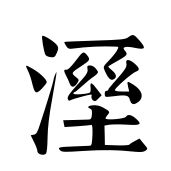
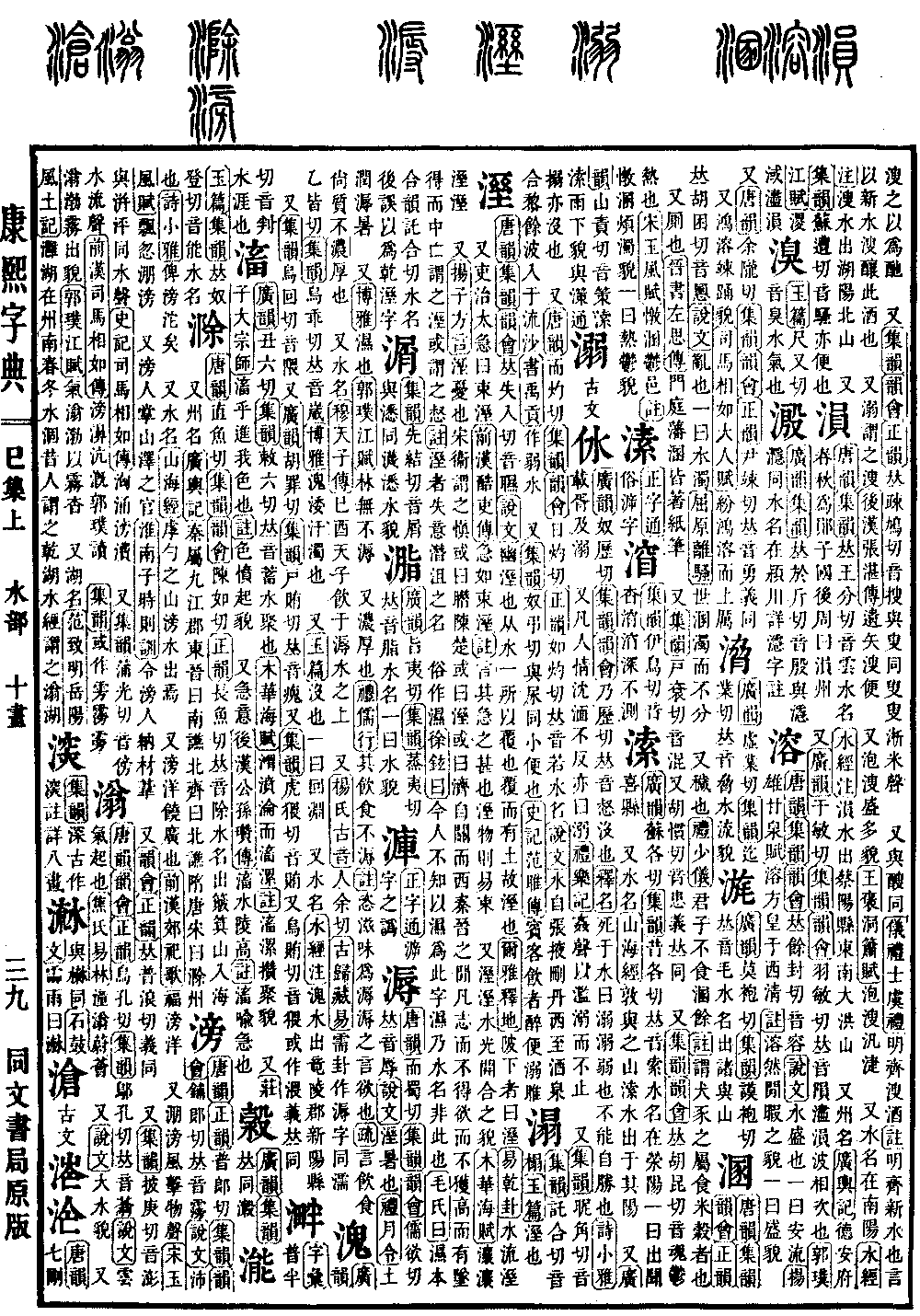
Si Collection, Upper Volume
Radical: Water (shuǐ)
Kangxi Strokes: 14
Page 641, Entry 14
Pronounced shi (entering tone).
Explanation from Explanation of Simple and Compound Characters (Shuowen Jiezi): Dark and damp. The character is formed with the radical for water, with the horizontal stroke above representing a covering. Where earth is covered and water is present, the meaning is damp.
Book of Master Er (Erya), Interpretation of Earth: Low-lying land is called shi.
Book of Changes (Yijing), Hexagram Qian: Water flows toward damp places.
Also refers to officials governing with excessive harshness, described as binding the damp.
History of the Former Han (Qian Hanshu), Biography of Harsh Officials: As urgent as binding something damp. Commentary: Describes extreme urgency. Damp objects are easily bundled.
Also, shi-shi describes the appearance of water light opening and closing.
Mu Hua, Sea Rhapsody: Describes the grand scale of water and the flickering of light on waves.
Also, Yangzi, Dialectics: Shi expresses sorrow. In the regions of Song and Wei, it is called shen, or occasionally by another variant. In the regions of Chen and Chu, it is sometimes called shi, sometimes ji. From west of the Hangu Pass, in the Qin and Jin territories, whenever aspirations are not realized, desires remain unsatisfied, one falls from a high position, or gains something only to lose it midway, it is all called shi. It is also called ni. Commentary: Shi is a term for frustration and depression.
The common form is written as shi.
Xu Xuan says: People today do not understand and use the common form for this character. That character is originally the name of a river and does not carry this meaning.
Master Mao says: The river name is properly pronounced tuo he, and refers to a body of water. Later, it was mistakenly used for the character meaning damp.
Textual Research: Explanation of Simple and Compound Characters states: Dark and damp. Formed with the radical for water; the horizontal line above represents a covering. Where soil is covered and water is present, the meaning is damp. Following the original text of the System Commentary of the Explanation of Simple and Compound Characters (Shuowen Jiezi Xichuan), the phrasing has been corrected to reflect that the soil is covered and water is present.
Book of Master Er (Erya), Interpretation of Earth: Low-lying land is called shi. In accordance with the original text, the word for slope has been omitted.