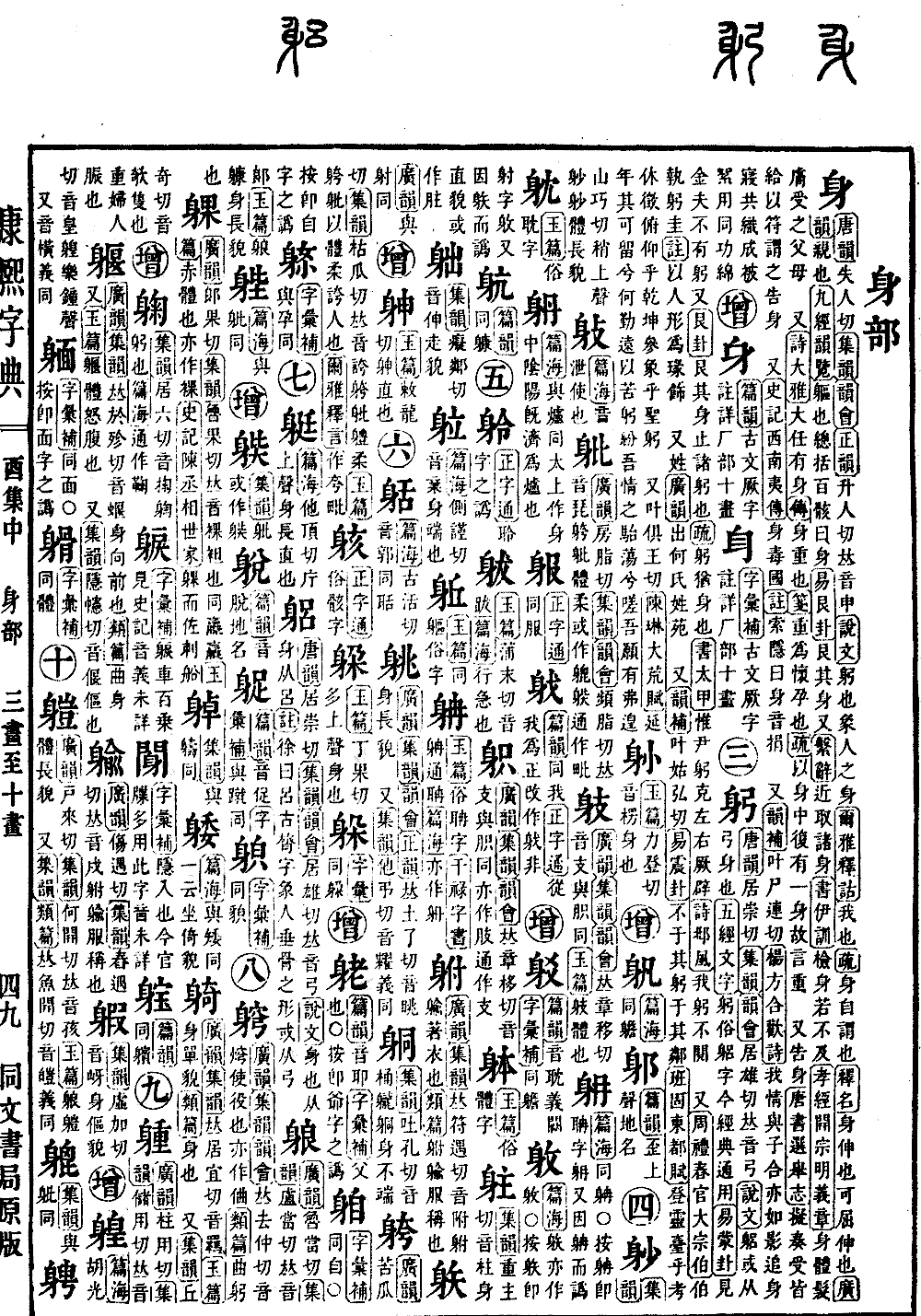
You Collection, Middle Volume
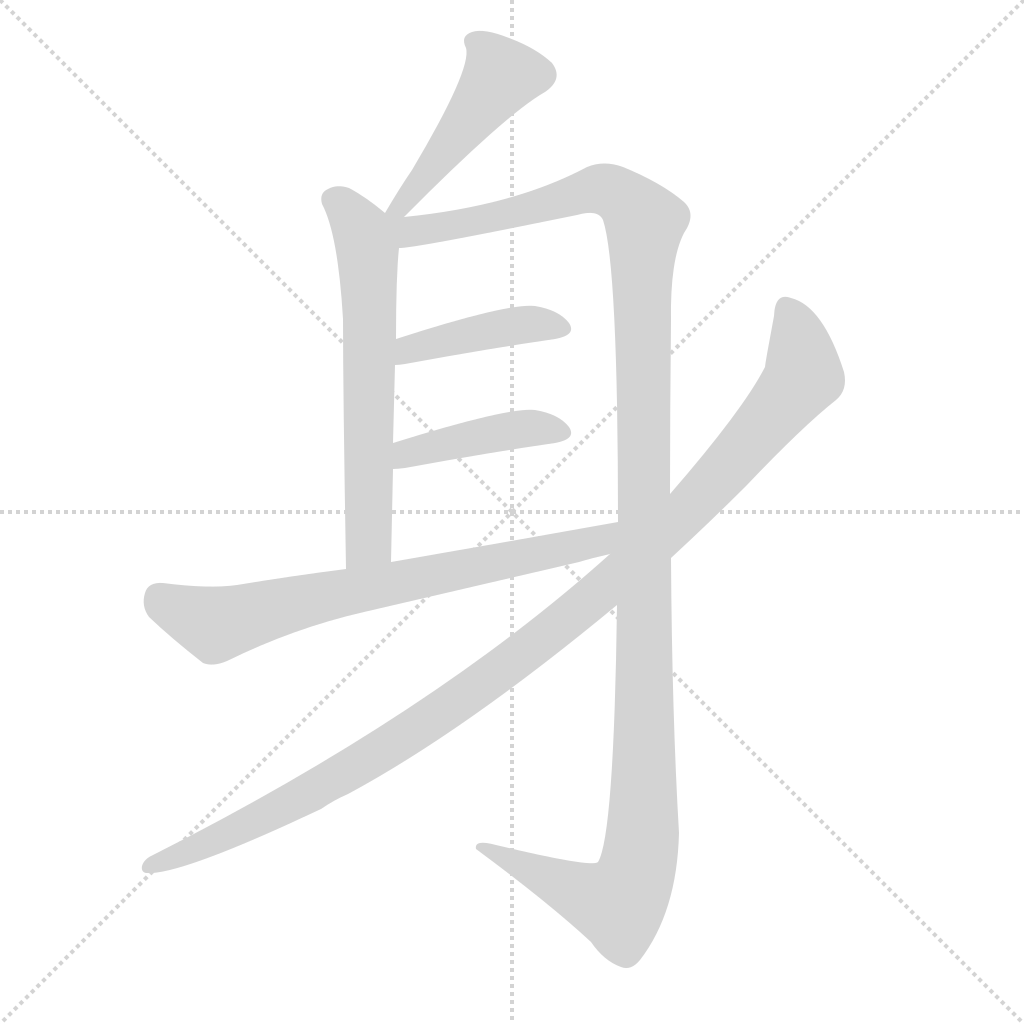
Radical: Body (shēn)
Kangxi Strokes: 7
Page 1237, Entry 01
Tang Rhymes (Tangyun): Pronounced shēn. Collected Rhymes (Jiyun), Rhyme Meetings (Yunhui), Correct Rhymes (Zhengyun): Pronounced shēn.
Explication of Writing (Shuowen): The body. It represents the form of a human body.
Approaching Elegance (Erya), Explanation of Ancient Words (Shigu): Refers to the self.
Commentary: Body, refers to oneself.
Explanation of Names (Shiming): Body means to extend. It is that which can be bent and extended.
Broad Rhymes (Guangyun): Refers to the self.
Overview of the Nine Classics (Jiujing Yunlan): The physical frame. The totality of the hundred bones is called the body.
Book of Changes (Yijing), Gen Hexagram: Stillness of the body.
Appended Remarks (Xici): Take things near to oneself from one's own body.
Book of Documents (Shujing), Instructions of Yi (Yixun): Examine oneself as if one were not yet sufficient.
Classic of Filial Piety (Xiaojing), Chapter on Opening the Theme: Body, hair, and skin, are received from one's parents.
Book of Odes (Shijing), Greater Odes (Daya): Great Ren was with child.
Commentary: Body means heavy.
Note: Heavy means pregnant.
Sub-commentary: Because there is another body within the body, it is called heavy.
Also refers to an official appointment certificate.
History of Tang (Tangshu), Treatise on Selection and Appointment: Proposals for appointments were issued with tallies, which were called appointment certificates.
Records of the Grand Historian (Shiji), Account of the Southwest Barbarians: The country of Shendu.
Note: Suoyin commentary says: Shendu is pronounced juan.
Also, in Rhyme Supplements (Yunbu): Rhymes with lian.
Yang Fang, Poem of Joyful Union: My feelings and yours are united, just like a shadow following the body. Sleeping together under a woven quilt, the padding made of identical silk.