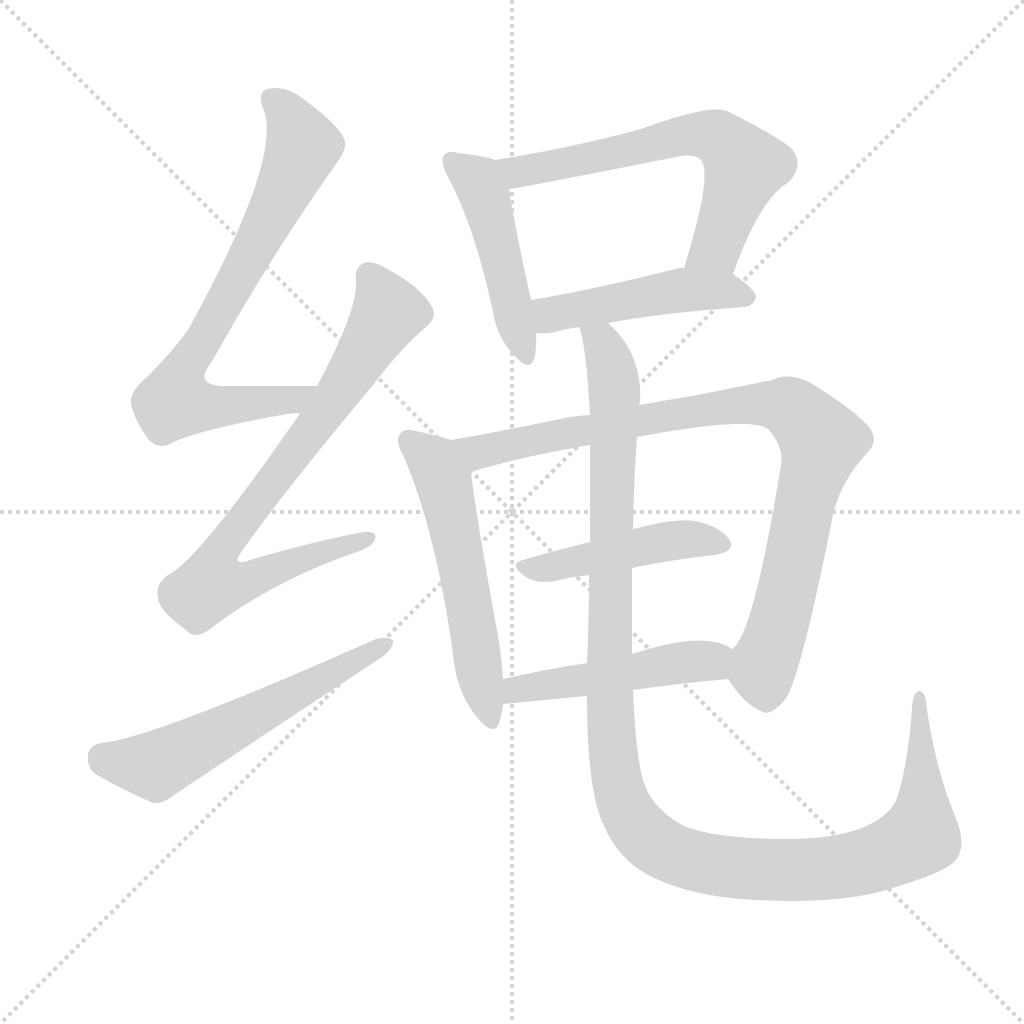
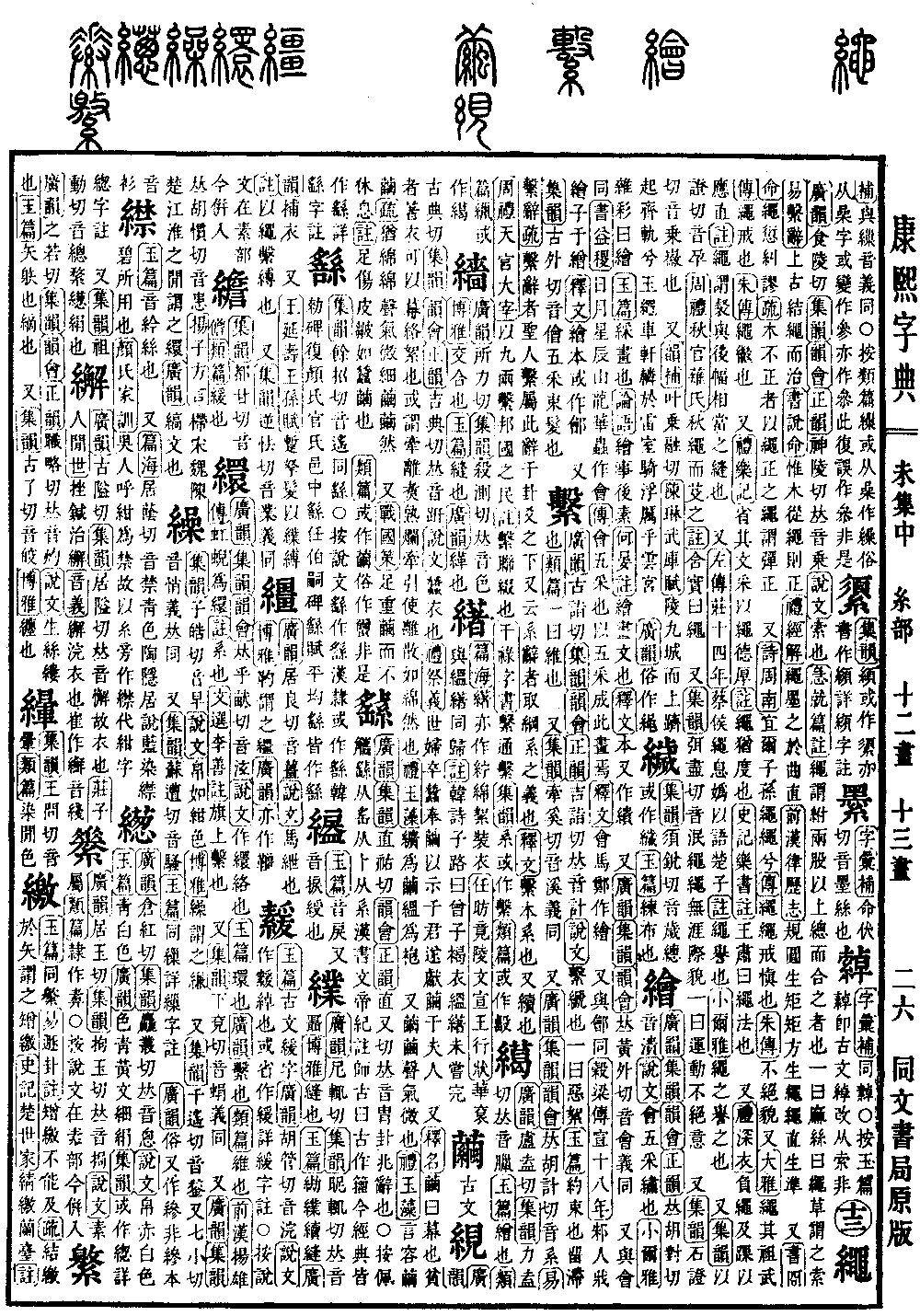
Wei Collection, Middle Volume
Radical: Silk (mì)
Sheng; 19 Kangxi strokes; Page 940, Entry 01
Pronounced cheng
According to the Explaining Graphs and Analyzing Characters (Shuowen Jiezi), it refers to a cord.
The Commentary on the Urgent Learning Chapter (Jijiupian Zhu) states that a sheng is formed by twisting two or more strands together. It is also said that a cord of hemp or silk is called a sheng, while one of grass is called a suo.
Book of Changes (Yi Jing), Appended Judgments: In high antiquity, knots were tied in cords to govern.
Book of Documents (Shujing), Charge to Yue: Only when wood follows the marking line does it become straight.
Book of Rites (Liji), Explanations of the Classics: The marking line in relation to curvature and straightness.
History of the Former Han Dynasty (Qian Hanshu), Treatise on Harmonics and Calendars: The compass produces the square, the square produces the marking line, and the marking line produces the level.
Also, Book of Documents (Shujing), Charge to Jiong: To correct faults and straighten errors.
Commentary: That which is not straight in wood is corrected by the marking line. The sheng refers to an ink line used for calibration.
Also, Book of Odes (Shijing), Zhou Nan: May your descendants be continuous.
Commentary: Continuous, meaning cautious.
Zhu Xi’s Commentary: The appearance of being unbroken.
Also, Book of Odes (Shijing), Greater Odes: To follow in the footsteps of one’s ancestors.
Commentary: To warn.
Zhu Xi’s Commentary: To succeed.
Also, Book of Rites (Liji), Record of Music: Examine its ornamentation to measure the depth of virtue.
Note: To measure, equivalent to to evaluate.
Records of the Grand Historian (Shiji), Record of Music Note: Wang Su says: A marking line, meaning a standard.
Also, Book of Rites (Liji), Deep Robe: The rear seam reaches the ankles to correspond with the straightness.
Note: The sheng refers to the back seam of the garment that aligns with the rear panel.
Also, Zuo Tradition (Zuo Zhuan), 14th Year of Duke Zhuang: The Marquis of Cai praised Lady Xi to the Viscount of Chu.
Note: To praise.
Minor Encyclopedia (Xiao Erya): To praise someone.
Also, Collected Rhymes (Jiyun): Pronounced yun.
Rites of Zhou (Zhou Li), Office of Autumn, Ti Shi: In autumn, clear and mow them.
Note: Containing seeds is called sheng.
Also, Collected Rhymes (Jiyun): Pronounced min.
Continuous, meaning without boundaries. Also refers to movement that does not cease.
Also, Collected Rhymes (Jiyun): Pronounced cheng.
Also, Rhyme Supplements (Yunbu): Rhymes with cheng, rong.
Lin’s Rhapsody on the Arsenal (Wuku Fu): Ascending over the nine cities, rising in sequence is the Jade Line. The carriage wheels rumble in the thunder chamber, the riders float and gallop in the cloud palace.
Broad Rhymes (Guangyun): Commonly written as the variant form.