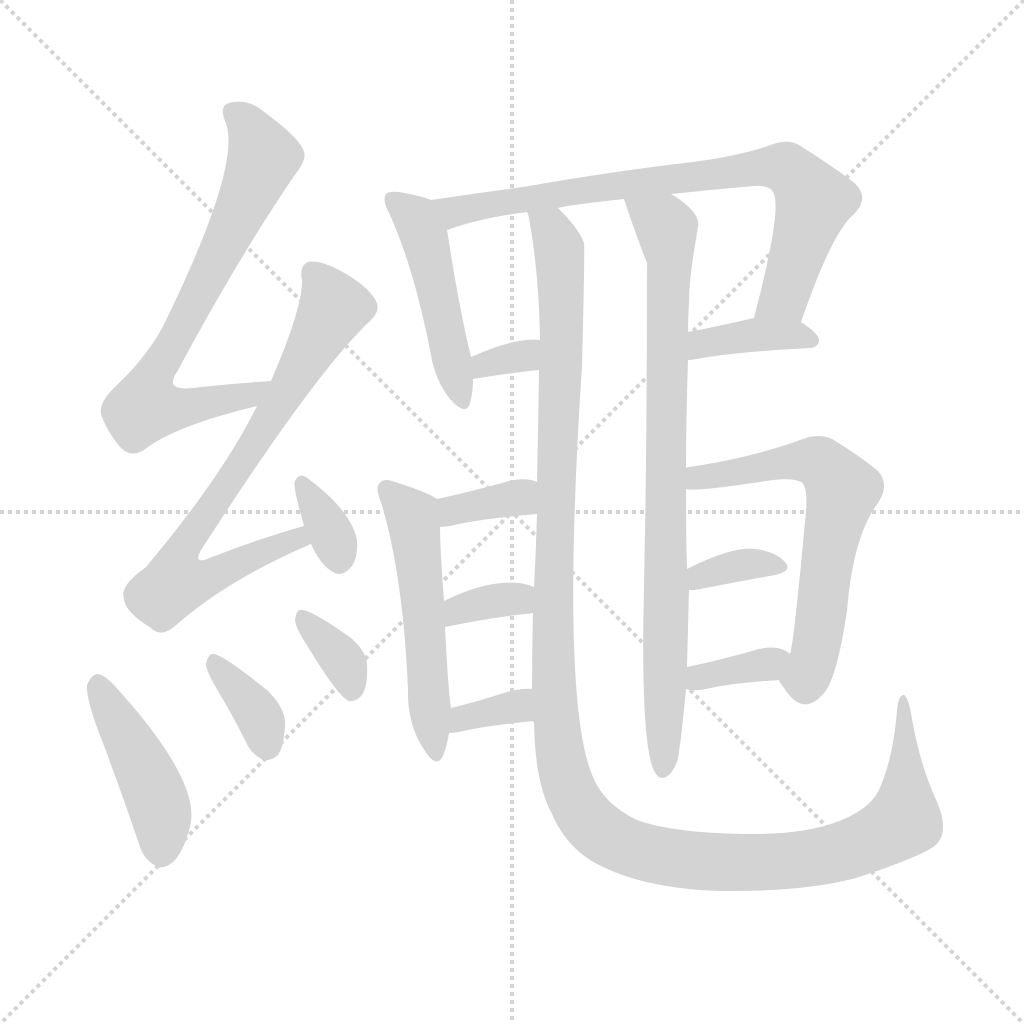
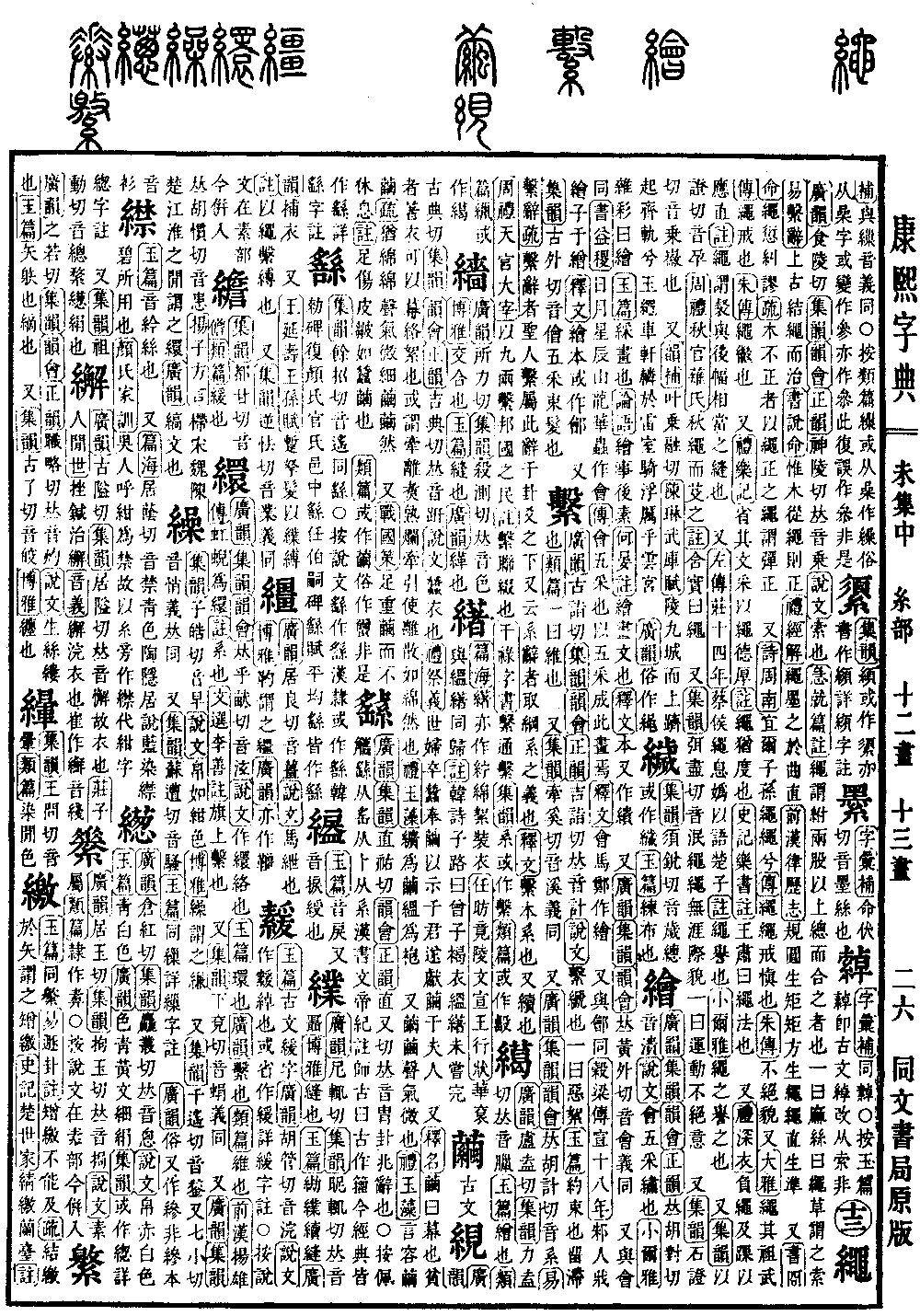
Wei Collection, Middle Volume
Radical: Silk (mì)
Kangxi Strokes: 19
Page 940, Entry 04
Pronounced chéng
According to the Explaining Graphs and Analyzing Characters (Shuowen Jiezi), it refers to a cord. According to the commentary on the Urgent Primer (Jijiupian), a rope refers to two or more strands of thread twisted together. Generally speaking, it is something made by twisting strands together. Another opinion states that those made of hemp or silk are called ropes, while those made of grass are called cords.
Book of Changes (Yijing): In ancient times, knotted ropes were used for governance.
Book of Documents (Shangshu): Wood can be made straight by following the ink line.
Book of Rites (Liji): The function of the ink-marker rope in determining curvature or straightness.
History of the Former Han (Qian Hanshu): The compass produces the square, the square produces the ink-marker rope, the ink-marker rope produces the level.
Also, Book of Documents (Shangshu): To correct errors and rectify mistakes.
Commentary: For wood that is not straight, one uses the ink-marker rope to straighten it. The rope refers to snapping an ink line to make corrections.
Also, Book of Odes (Shijing): Wishing that your descendants may be cautious and never-ending.
Commentary: The repeated use of the word denotes a sense of vigilance and caution.
Zhu Xi Commentary: It means continuous and unbroken.
Also, Book of Odes (Shijing): To inherit the accomplishments of ancestors.
Commentary: It means to warn and exhort.
Zhu Xi Commentary: It means to inherit.
Also, Book of Rites (Liji): Examining the literary patterns of music to measure the depth of virtue.
Note: It functions as a standard of measurement.
Records of the Grand Historian (Shiji): Wang Su said that it refers to laws and regulations.
Also, Book of Rites (Liji): The central seam on the back reaching to the ankle symbolizes uprightness.
Note: It refers to the back seam of the garment, the seam corresponding to the back panel.
Also, Zuo Tradition (Zuo Zhuan): The Marquis of Cai praised Xigui to the King of Chu.
Note: It means to praise or commend.
Little Er-ya (Xiao Erya): To use this word toward someone is to praise them.
Also, Collected Rhymes (Jiyun): Pronounced yùn.
Rites of Zhou (Zhouli): In autumn, when the seeds mature, cut them away.
Note: The forming of seeds is called this.
Also, Collected Rhymes (Jiyun): Pronounced mǐn.
The term used repeatedly describes something vast and boundless. Another opinion suggests it means movement without cessation.
Also, Collected Rhymes (Jiyun): Pronounced chéng.
Meaning to restrain or bind.
Also, Rhyme Supplements (Yunbu): Rhyming with chéng and róng.
Rhapsody on the Armory by Lu Ji: Striding over the nine-layered city walls to climb upward, level with the Jade Rope star. War chariots roar like a trembling chamber, cavalry gallop as if threading through the palace of clouds.
Broad Rhymes (Guangyun): Commonly written as this character.