Wu Collection, Lower Volume
Radical: Spirit (shì)
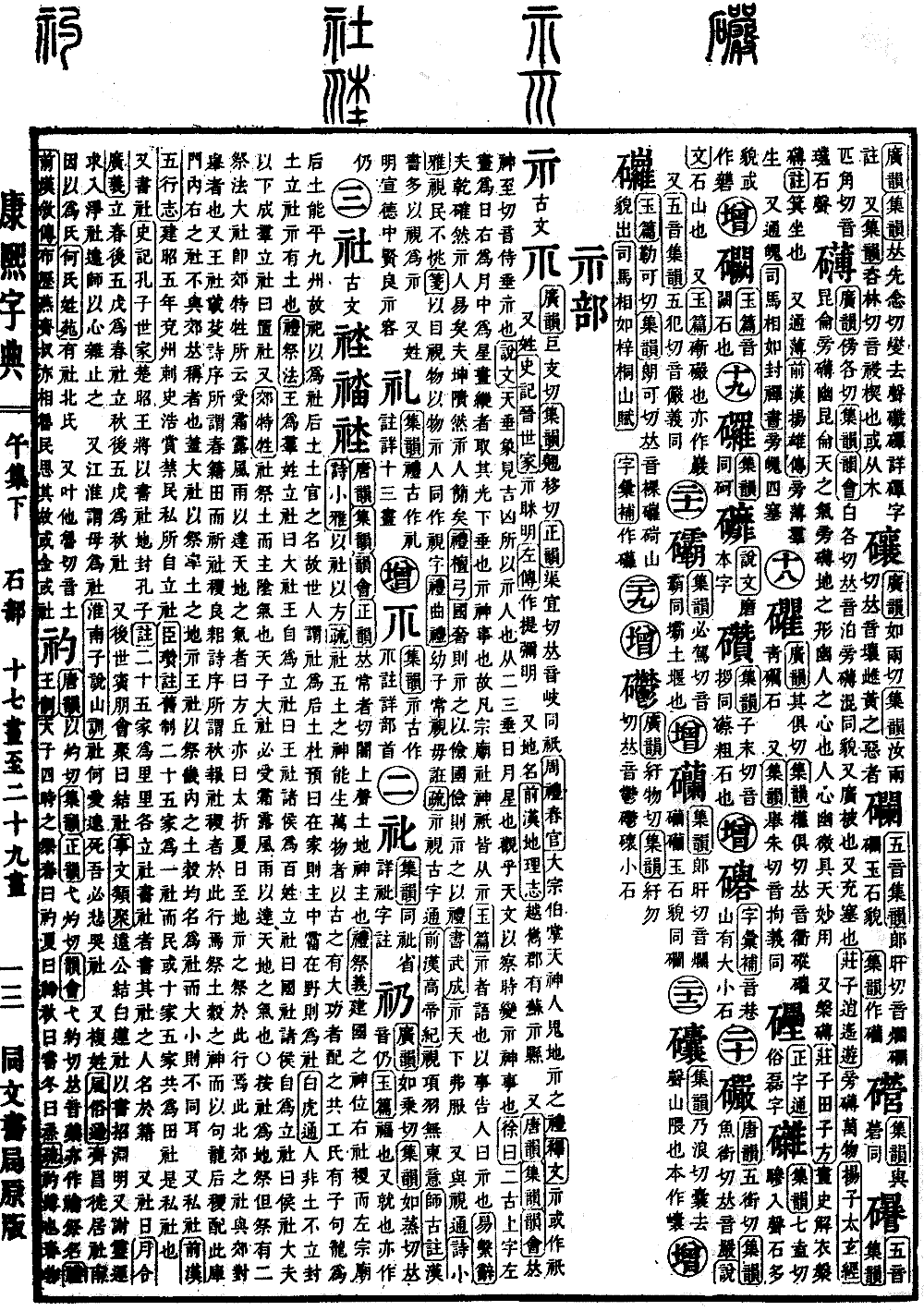
Page 839, Entry 26
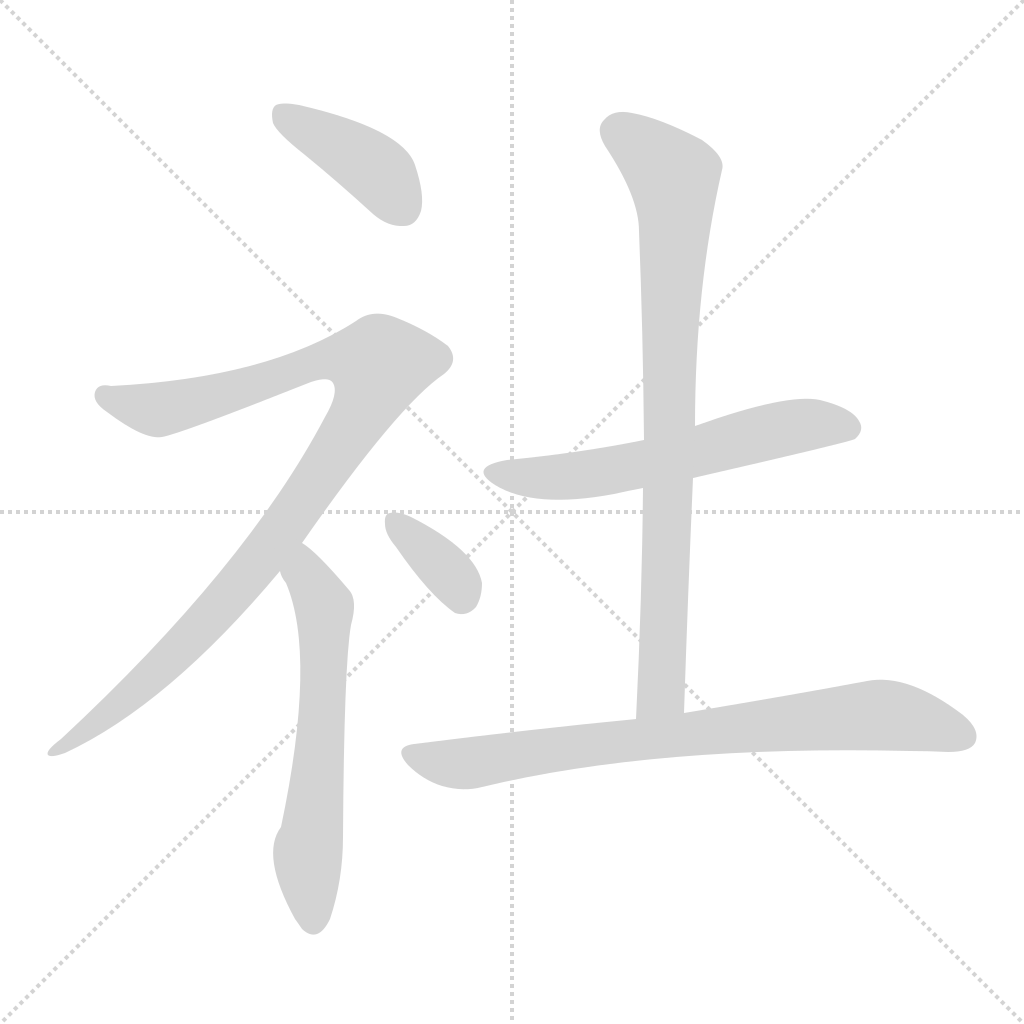
Pronounced she (rising tone). Refers to the spirit tablet of the Earth deity.
Book of Rites (Liji), Sacrificial Meanings: When establishing the state altars, the altar for the spirits of the land and grain (sheji) is placed on the right, and the ancestral temple on the left.
Book of Odes (Shijing), Minor Odes: Conducting the communal sacrifice (she) and the sacrifice to the four directions.
Commentary: The she represents the deities of the soil in the five directions; they are the divine forces that allow all things to grow. Ancient individuals who performed great services are enshrined to share in these sacrifices. The Gonggong clan had a son named Goulong who served as the official of the Earth (Houtu); he was able to pacify the nine provinces, and thus he is worshipped as the Earth deity. Houtu is the title of the earth official, hence the world refers to the Earth deity as Houtu. Du Yu states: In the residential home, the central hearth deity (zhongliu) is primary; in the open wilderness, the Earth deity (she) is primary.
White Tiger Hall Discussions (Baihu Tong): Man cannot survive without land; piling up earth to build a sacrificial altar is a symbol representing the possession of land.
Book of Rites (Liji), Sacrificial Laws: The altar built by the Son of Heaven for the people of the world is called the Great Altar (dashe); the altar built by the Son of Heaven for himself is called the Royal Altar (wangshe). The altar built by a feudal lord for the people of his domain is called the State Altar (guoshe); the altar built by a feudal lord for himself is called the Lord's Altar (houshe); the altar established by a group of households from the rank of high official downwards is called the Local Altar (zhushe).
Also, Book of Rites (Liji), Suburban Sacrifices: The she sacrifice is a sacrifice to the soil, dominated by the yin energy. The Great Altar of the Son of Heaven must be exposed to frost, dew, wind, and rain, in order to communicate with the breath of Heaven and Earth.
Note: The she is a ceremony for sacrificing to the soil, but there are two different systems for these sacrifices. The Great Altar is what the Suburban Sacrifices chapter describes as an altar capable of enduring frost, dew, wind, and rain to communicate with the breath of Heaven and Earth; it is also called the Square Mound (fangqiu) and the Great Collapse (taizhe). On the day of the summer solstice, the ceremony to sacrifice to the Earth deity is held here. This is the northern suburban altar, a sacrifice paired with and corresponding to the southern suburban sacrifice to Heaven.
Furthermore, the Royal Altar is the place where the ceremonies described in the prefaces to the Book of Odes poems "Zaisai" and "Liangsi" take place—specifically, the spring plowing ceremony where prayers are offered for the blessing of the spirits of the land and grain, and the autumn ceremony where gratitude is expressed for their grace. Here, the Earth deity and the Grain deity are sacrificed to, with Goulong and Houji sharing in the offerings. This altar is located to the right inside the storehouse gate and is not ranked with the suburban sacrifices.
In general, the Great Altar is used to sacrifice to the Earth deity of the entire world, while the Royal Altar is used to sacrifice to the Earth and Grain deities within the imperial capital region. Both are called she, but they differ in scale.
There is also the "private altar" (sishe).
Book of Han (Hanshu), Records of the Five Phases: In the fifth year of the Jianzhao era, the Governor of Yanzhou, Hao Shang, banned the private altars established by the common people.
Chen Zan’s Commentary: The old system stipulated that twenty-five households constituted one she, but commoners sometimes joined ten or five households together to establish a field altar; this is what is meant by a private altar.
There is also the "registered altar" (shushe).
Records of the Grand Historian (Shiji), Hereditary House of Confucius: King Zhao of Chu intended to grant the land of the registered altars to Confucius.
Commentary: Twenty-five households constitute one li (neighborhood), and each neighborhood establishes its own altar. "Registered altar" means that the names of the residents of that altar have been recorded in the official registers.
There is also the "altar day" (sherì).
Broad Records of the Monthly Ordinances (Yueling Guangyi): The fifth wuday after the beginning of spring is the Spring Altar Day; the fifth wuday after the beginning of autumn is the Autumn Altar Day.
In later generations, gatherings and alliances between friends are called "forming an altar" (jieshe).
Classified Collection of Matters (Shiwen Leiju): Master Huiyuan organized the White Lotus Altar and once wrote a letter inviting Tao Yuanming to join. Xie Lingyun requested to join the Pure Land Altar, but Master Huiyuan blocked him because his intentions were not pure.
In the Jiang-Huai region, "she" is used to refer to a mother.
Huainanzi, Discourses on the Mountains: Why must a mother cling to imminent death? I will certainly mourn and weep for my mother.
There is also a double surname.
Customs and Traditions (Fengsutong): A man from the State of Qi named Chang moved to the south of a sacrificial altar, and thus took "Shenan" as his surname.
He’s Garden of Surnames (Heshi Xingyuan): There is also the surname "Shebei."
Also, read as tu (level tone).
Book of Han (Hanshu), Biographical Narrative: Peng Yue and Han Xin passed through the lands of Yan and Qi, and Cao Shen also served as the Chancellor of Lu. The common people missed their former virtue; some used gold statues, and others established altars to sacrifice to them in their memory.