Wei Collection, Middle Volume
Radical: Silk (mì)
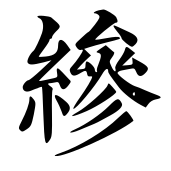
Shan
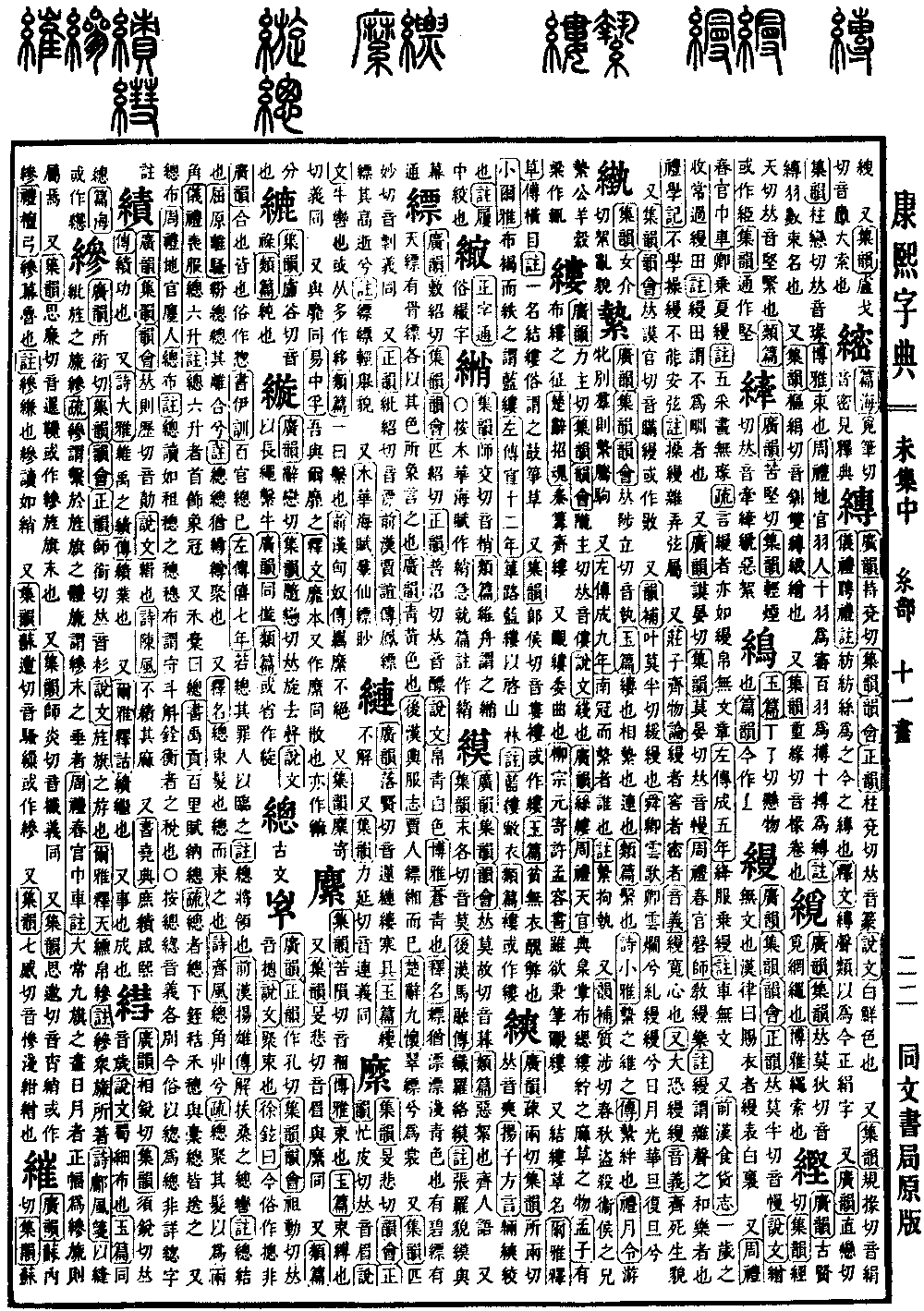
Page 936, Entry 25
According to the Extensive Dictionary of Sounds and Meanings (Guangyun), pronounced shan. According to the Collected Rhymes (Jiyun), the Rhyme Assembly (Yunhui), and the Correct Rhymes (Zhengyun), pronounced shan.
According to the Explaining Graphs and Analyzing Characters (Shuowen), it refers to the fluttering ribbons of a banner.
According to the Literary Expositor (Erya), specifically the section on Heaven (Shitian), it is a cloth made of light red silk. The commentary states that this is the part where numerous fluttering ribbons are attached.
In the commentary to the Odes of Yong (Yongfeng Jian) from the Classic of Poetry (Shijing), it is used to describe the ribbons sewn onto banners. The sub-commentary explains that this term refers to the part attached to the main body of a banner, while the term for the ribbons hanging from the ends is different.
In the Rites of Zhou (Zhouli), specifically the section on the Spring Officials (Chunguan), the commentary on the Carriage Master (Jinche) notes that among the nine banners of the Great Standard (Dachang) decorated with the sun and moon, the main width is the banner cloth, and the ribbons are attached to it.
Additionally, according to the Collected Rhymes (Jiyun), pronounced xian. It is sometimes written in a variant form. It refers to the end of a banner.
According to the Collected Rhymes (Jiyun), pronounced xian. The meaning is the same.
According to the Collected Rhymes (Jiyun), pronounced xiao. Silk (xiao) is sometimes written as this character.
In the Book of Rites (Liji), specifically the section on the Bow String (Tangong), it mentions that the curtain was a product of the State of Lu. The commentary notes that this refers to fine double-threaded silk, and the pronunciation is the same as that of the term for silk (xiao).
According to the Collected Rhymes (Jiyun), pronounced sao. Silk reeling (sao) is sometimes written as this character.
According to the Collected Rhymes (Jiyun), pronounced can. It refers to a light blue-red silk fabric. The character for silk reeling (sao) was originally written with the element for mortar (jiu).