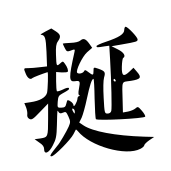
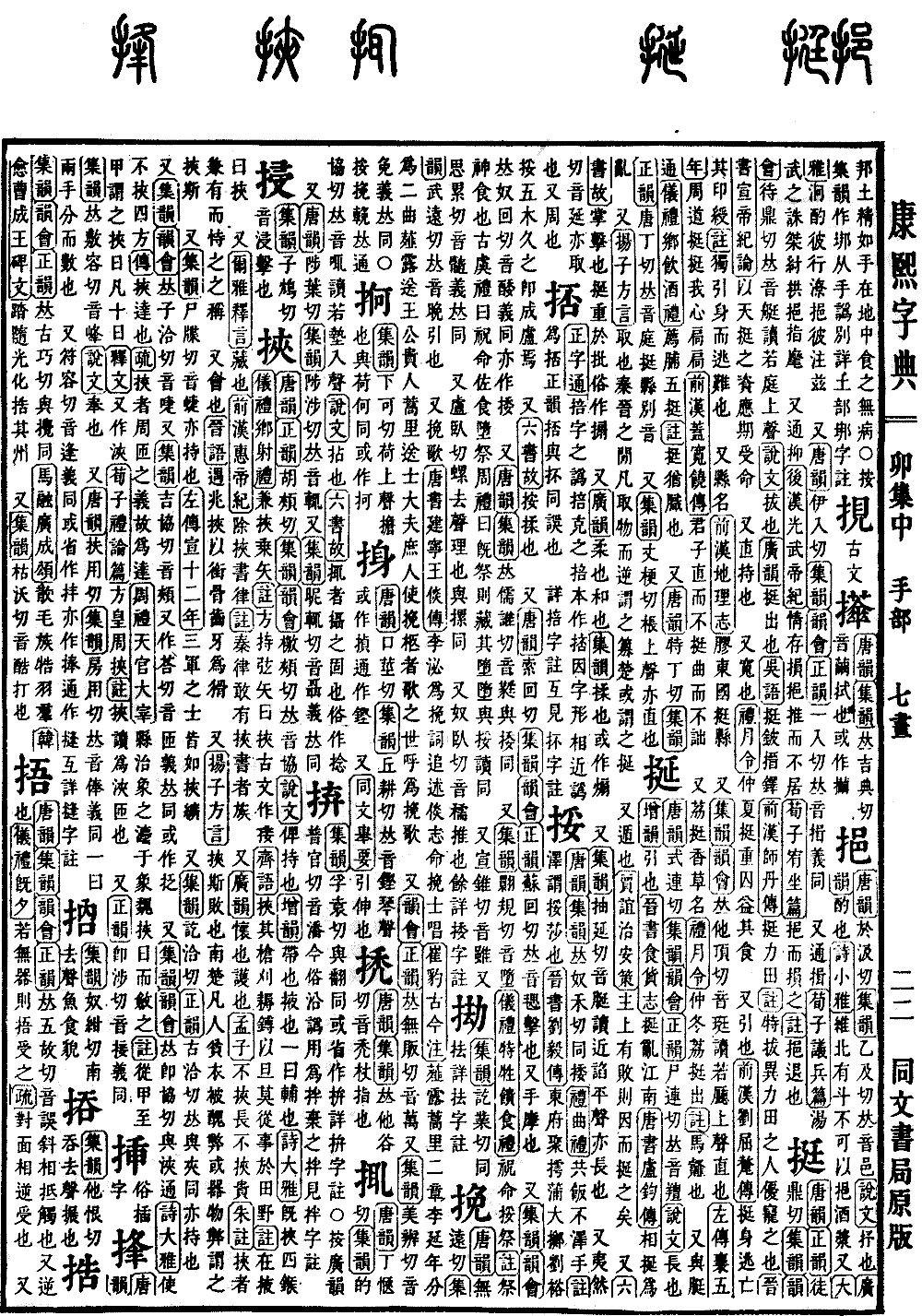
Mao Collection, Middle Volume
Radical: Hand (shǒu)
Kangxi strokes: 11
Page 432, Entry 05
Pronounced shian (level tone).
Pronounced shian (level tone).
Sound is the same as the character for mutton-like (shan).
According to the Explanation of Simple and Compound Characters (Shuowen), it means long.
According to the Revised Rhymes (Zengyun), it means to pull or lead.
According to the Book of Jin (Jinshu), in the section on Food and Money, it refers to inciting turmoil in the Jiangnan region.
According to the Book of Tang (Tangshu), in the biography of Lu Jun, it refers to mutually inciting trouble and rebellion.
Also, according to the Regional Expressions (Fangyan) by Yang Xiong, it means to take. In the regions of Qin and Jin, taking something in a contrary or illicit manner is called usurpation, while in the Chu region, it is sometimes called shian.
It also means to evade or escape.
According to the Policy on Peace and Order by Jia Yi, when the ruler has a failure, one takes the opportunity to evade or flee.
Also, according to the Six Scripts (Liushugu), it means to strike with the palm of the hand. Shian is a heavier action than to slap. It is commonly written in the variant form (shan).
According to the Broad Rhymes (Guangyun), it means soft or pliant, and also to harmonize or temper.
According to the Collection of Rhymes (Jiyun), it means to rub or knead. It is sometimes written in the variant form (shan).
According to the Collection of Rhymes (Jiyun), pronounced chian (level tone), the sound is the same as the character for membrane (chan). The pronunciation is close to the level tone of the character for flatter (chan). It also means long.
Also pronounced ian (level tone), the sound is the same as the character for extend (yan). It also means to take. It also means to be all-encompassing or everywhere.