Chou Collection, Lower Volume
Radical: Woman (nǚ)
Kangxi strokes: 6
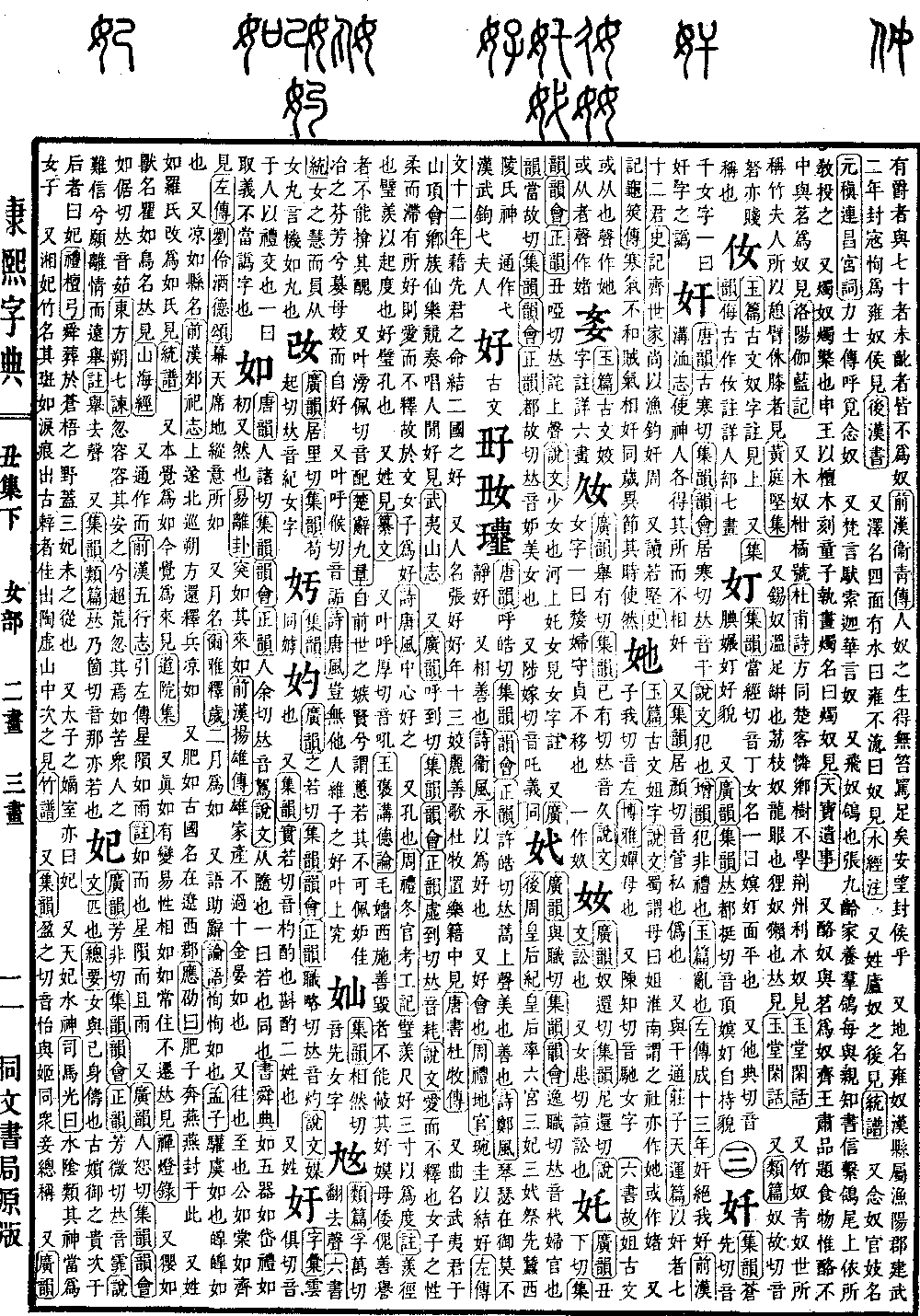
Page 255, Entry 21
Pronounced ru. According to the Explanation of Writing (Shuowen Jiezi), it means to rely upon, follow, or accompany. Another interpretation is to indicate similarity, such as, or alike. In the Book of Documents (Shujing), specifically the Canon of Shun, it refers to equivalence among the five ritual vessels, the rites of Mount Tai, and original intentions. It also serves as a descriptive term for appearance. In the Book of Changes (Yijing), within the Li hexagram, it describes an abrupt arrival. In the History of the Former Han (Qianhan Shu), in the Biography of Yang Xiong, it describes his state of possessing no more than ten pieces of gold yet remaining calm and composed.
It also denotes going to or reaching a destination. For example, to travel to Tang, or to travel to the state of Qi, as seen in the Zuo Commentary (Zuo Zhuan). In the Eulogy on the Virtue of Wine (Jiude Song) by Liu Ling, it describes using the sky as a canopy and the earth as a mat, going wherever one wishes at will.
It also denotes a month name. In the Er Ya, specifically the chapter on years, the second month is called ru. It also acts as a modal particle. In the Analects (Lunyu), it describes a respectful and cautious appearance. In the Mencius (Mengzi), it describes a joyous, relaxed, and contented appearance.
It is also used in the name Liangru, a county name. In the History of the Former Han (Qianhan Shu), specifically the chapter on Suburban Sacrifices, the Emperor traveled north to the Shuo region and, upon his return, decommissioned his weapons at Liangru.
It also refers to Feiru, an ancient state name in Liaoxi Commandery. Ying Shao notes that the Viscount of Fei fled to the state of Yan, where Yan enfeoffed him.
It is also a surname. For example, the Luo clan changed their name to the Ru clan, as recorded in the Genealogies (Tongpu).
Original enlightenment is called ru, while current enlightenment is called lai, as recorded in the Record of the Transmission of the Lamp (Chandeng Lu).
It also refers to zhenru (true suchness), describing a nature that possesses changeability and form, or eternal existence without alteration, as recorded in the Record of the Transmission of the Lamp (Chandeng Lu).
It is the name of a beast. Quru is the name of a bird, as recorded in the Classic of Mountains and Seas (Shanhaijing).
It is also used as a variant for the particle er (and). In the History of the Former Han (Qianhan Shu), specifically the chapter on Five Phases, it cites the Zuo Commentary regarding stars falling like rain. The commentary notes that ru here means er (and), indicating that stars fell and it was also raining.
Pronounced ru (falling tone). In the Seven Remonstrances (Qi Jian) by Dongfang Shuo, it describes the bewilderment and aimlessness of not knowing where to settle, or the vast distance of not knowing where to go. It reflects the suffering caused by the difficulty in trusting others and the desire to sever emotional ties and fly far away. The commentary notes that this is read with a falling tone.
Pronounced na. It also indicates similarity.