Yin Collection, Upper Volume
Radical: Corpse (shī)
Page 301, Entry 07
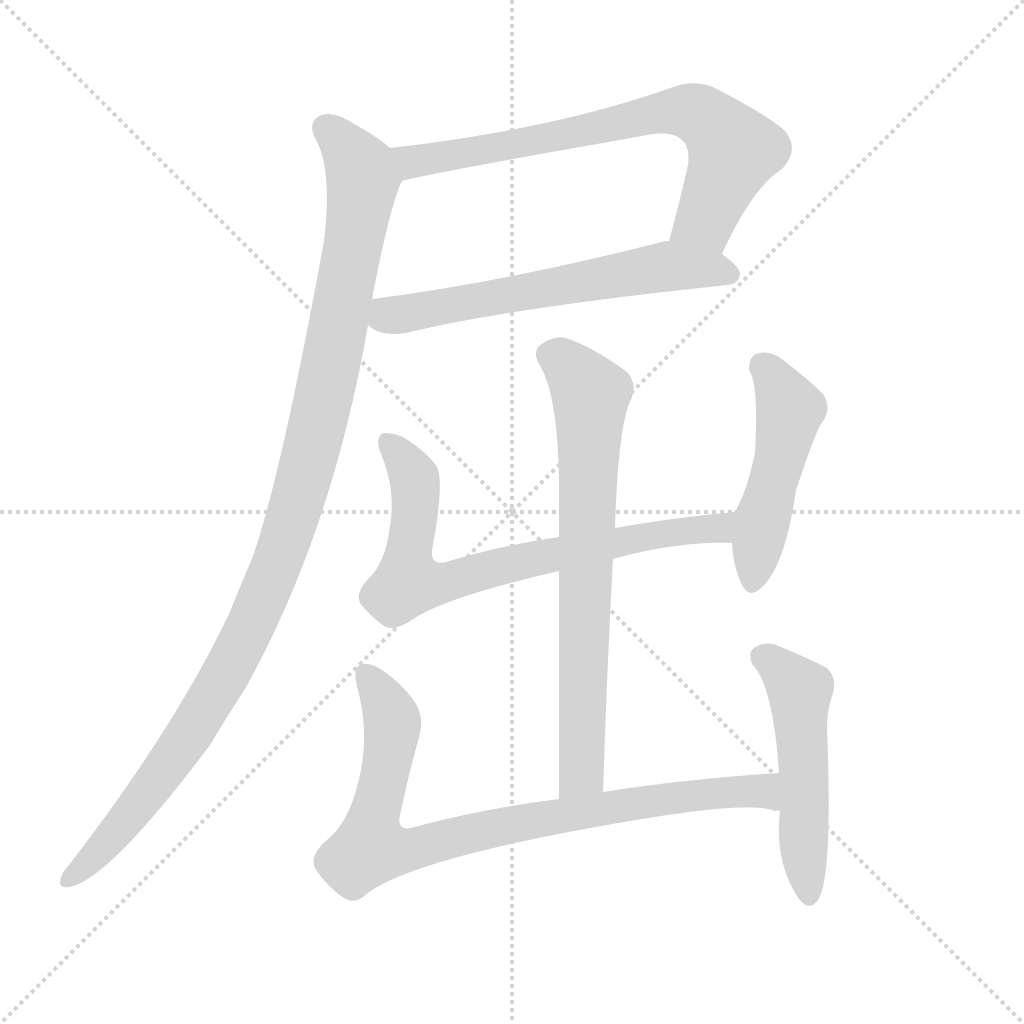
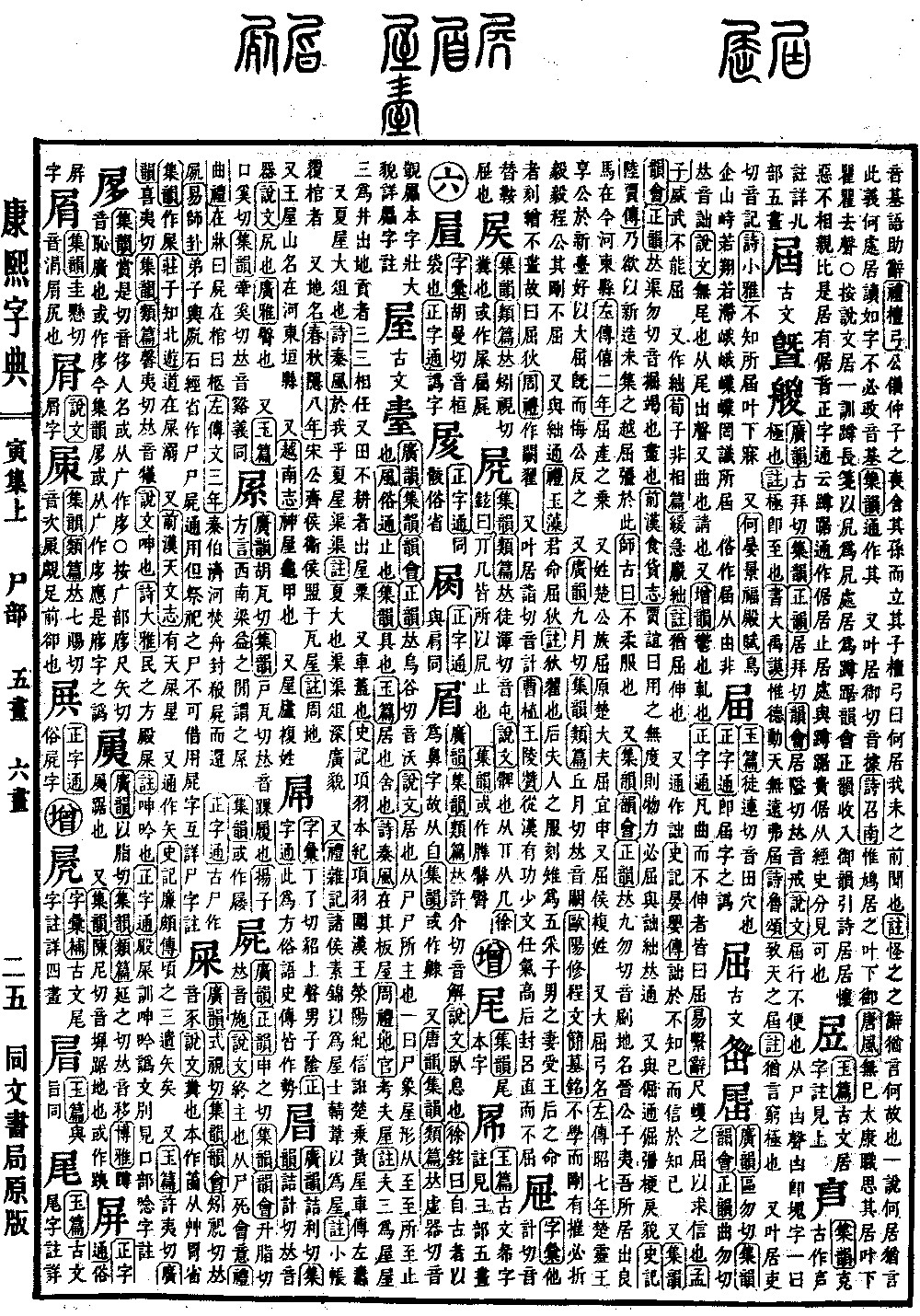
In the Broad Rhymes (Guangyun), pronounced qu. In the Collected Rhymes (Jiyun), Rhyme Meetings (Yunhui), and Orthodox Rhymes (Zhengyun), pronounced qu. The sound is identical to the character meaning to bend. The Analytical Dictionary of Characters (Shuowen Jiezi) defines it as lacking a tail. The character structure is derived from the character for exit, which provides the sound. It also carries the meanings of bending or requesting. The Expanded Rhymes (Zengyun) defines it as repressed or depressed. The Orthodox Character Guide (Zhengzitong) states that anything bent or unable to stretch is called qu. The Book of Changes (Yijing), Commentary on the Appended Phrases (Xici) states: The geometer moth bends its body in order to seek extension. The Book of Mencius (Mengzi) states: Great power cannot force him to submit. It is also written as a variant form (chu). The Book of Xunzi (Xunzi), Chapter on Non-Physiognomy (Feixiang) mentions slow, urgent, weak, and bent. The commentary explains the meaning is identical to extending and bending. It is also used as a loan character for the character meaning to bend. The Records of the Grand Historian (Shiji), Biography of Yan Ying mentions: To suffer wrongs before those who do not understand one, and to be fulfilled before those who do. Also, in the Collected Rhymes (Jiyun), Rhyme Meetings (Yunhui), and Orthodox Rhymes (Zhengyun), pronounced jue. It means to exhaust or terminate. The History of the Former Han (Qianhan Shu), Treatise on Food and Money (Shihuozhi) records that Jia Yi said: If usage has no limits, then material resources will surely be exhausted. It is interchangeable with characters for bending and shrinking. It is also used as a loan character for the character meaning stubborn or unruly. Stubbornness refers to a fixed, violent, and perverse appearance. The Records of the Grand Historian (Shiji), Biography of Lu Jia records: One actually wishes to rely upon the newly established and unsettled Yue state to be stubborn and disobedient here. Master Gu says: The meaning is to be not yielding or submissive. Also, in the Collected Rhymes (Jiyun), Rhyme Meetings (Yunhui), and Orthodox Rhymes (Zhengyun), pronounced jiu. This is a place name. It is the location where the Jin prince Yiwu resided, which produced fine horses. It is in the present-day Hedong County. The Zuo Commentary (Zuo Zhuan), Second Year of Duke Xi records: The horses from the Qu region were used for drawing carriages. It is also a surname. Examples include the Chu nobility Qu Yuan and the Chu official Qu Yishen. There is also the compound surname Quhou. There is also Daqu, which is the name of a bow. The Zuo Commentary (Zuo Zhuan), Seventh Year of Duke Zhao records: King Ling of Chu hosted Duke Zhao of Lu to a banquet at Xintai and was pleased to present him with the Daqu bow, but soon regretted it, and Duke Zhao of Lu returned it. Also, in the Broad Rhymes (Guangyun), pronounced que. In the Collected Rhymes (Jiyun) and Classified Characters (Leipian), pronounced que. The sound is identical to the character for a gate or missing. The Tomb Inscription for Cheng Wen by Ouyang Xiu states: Without study and yet unyielding, when meeting destruction one will surely break. The resolute Master Cheng, his firmness does not submit. It is also used as a loan character for the character meaning to shrink. The Book of Rites (Liji), Jade Precepts (Yuzao) mentions: The mandates of the state ruler govern the Qu-di ritual garments. The commentary explains: Di refers to a pheasant. These are the ritual garments for the queen and the wives of nobles. They feature pheasants carved or embroidered to form five-colored patterns. The wives of viscounts and barons, upon receiving the queen's mandate, wear garments with silk patterns without added coloring, hence they are called Qu-di. In the Rites of Zhou (Zhouli), it is written as the character for gate and the character for pheasant. Also, used as a rhyme word and pronounced ji. Cao Zhi’s Eulogy for Wang Ling states: Following the Han dynasty and establishing merit, lacking literary refinement yet following one's own nature. Empress Lu enfeoffed the Lu family, and he remained upright and did not submit.