Si Collection, Upper Volume
Radical: Water (shuǐ)
Kangxi strokes: 12
Page 629, Entry 10
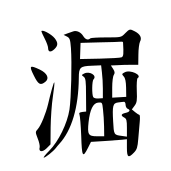
Pronounced gǔ.
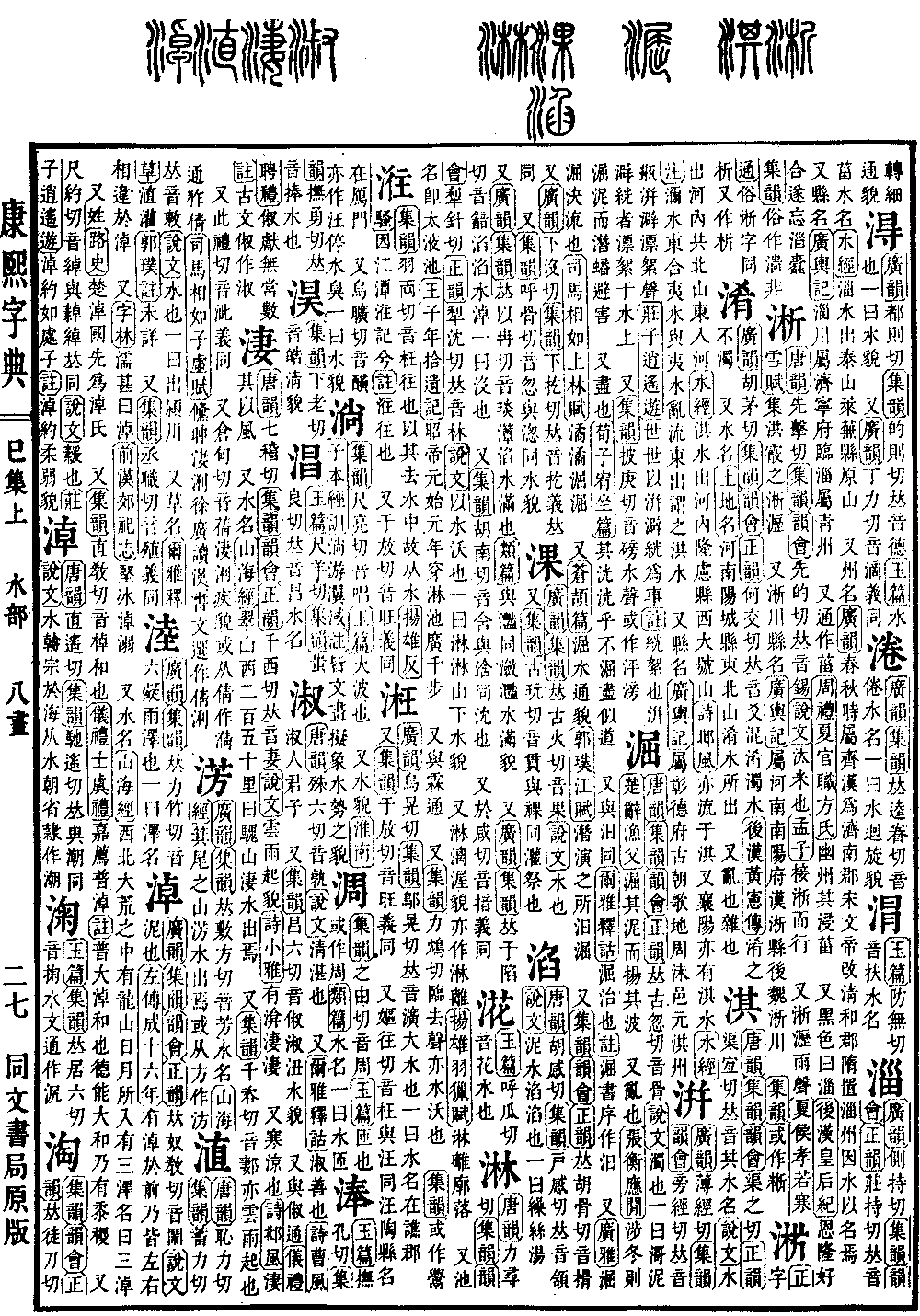
According to the Analytical Dictionary of Characters (Shuowen Jiezi), it means turbid. Another definition is thick mud. As noted in the Elegies of Chu (Chucí), stirring up the muddy water and raising waves. It also means to stir into chaos. As stated in the work by Zhang Heng, upon the arrival of winter, one stirs the muddy water and coils in hiding to avoid calamity. It also means to reach the end or to exhaust. As written in the Xunzi, the vast and mighty appearance is not exhausted, much like the Great Way. It is also interchangeable with the character pronounced mì. According to the Literary Expositor (Erya), it means to regulate or govern. The commentary notes that this character is written as mì in the preface to the Book of Documents (Shangshu).
Also, according to the Expanded Literary Expositor (Guangya), it describes the appearance of water flowing and surging. As described in the Shanglin Rhapsody by Sima Xiangru, it describes the appearance of water gushing forth and flowing rapidly. According to the Cangjie Pian, it describes the appearance of water flowing freely and unobstructed. As noted in the River Rhapsody by Guo Pu, it describes the appearance of underground currents flowing through and gushing out.
Additionally, pronounced hú. Also pronounced gě. The meaning is the same.
Also, pronounced hū. Interchangeable with the character pronounced hū. It describes the appearance of water flowing.