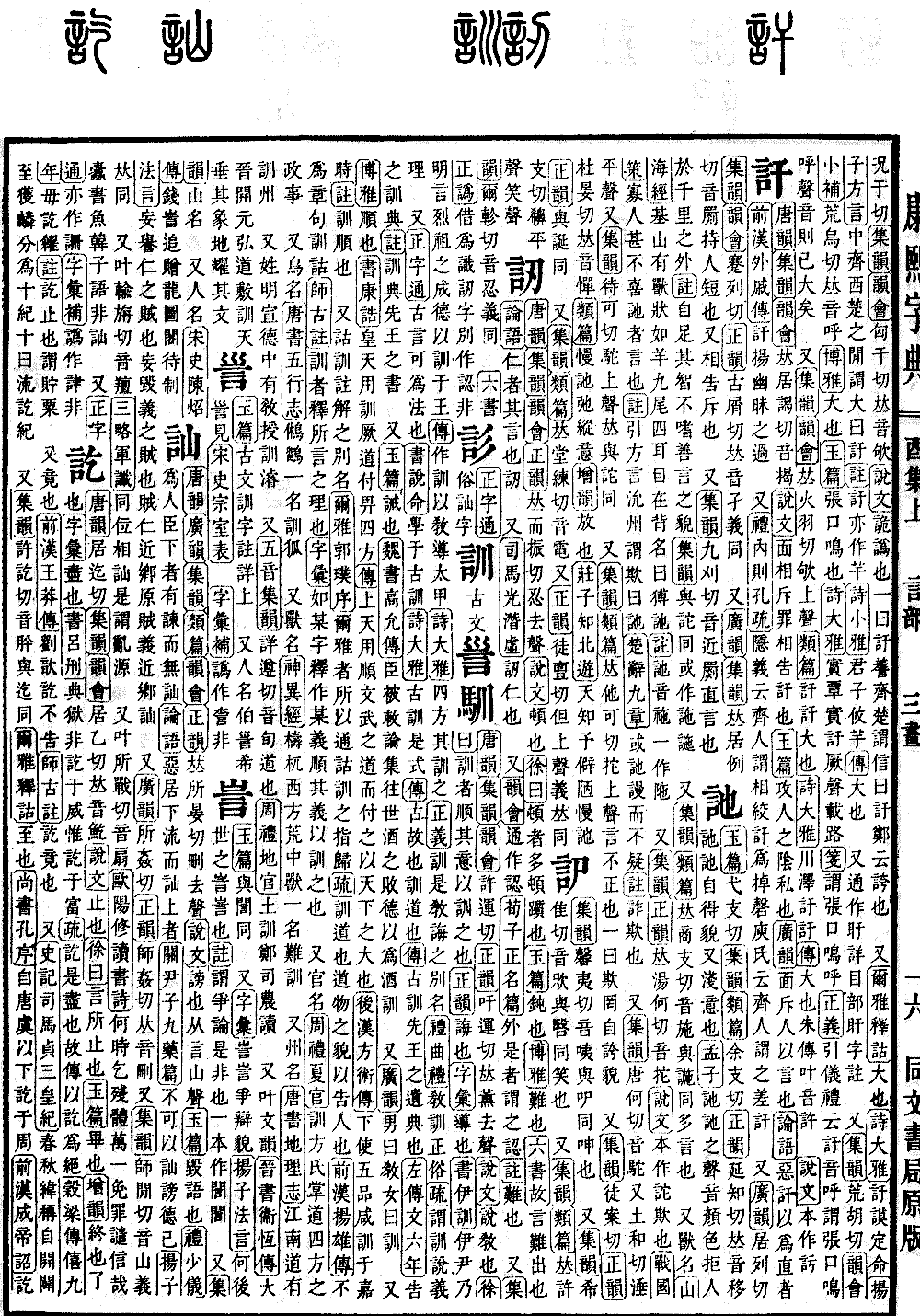
You Collection, Upper Volume
Radical: Speech (yán)
Kangxi stroke count: 10
Page 1148, Entry 12
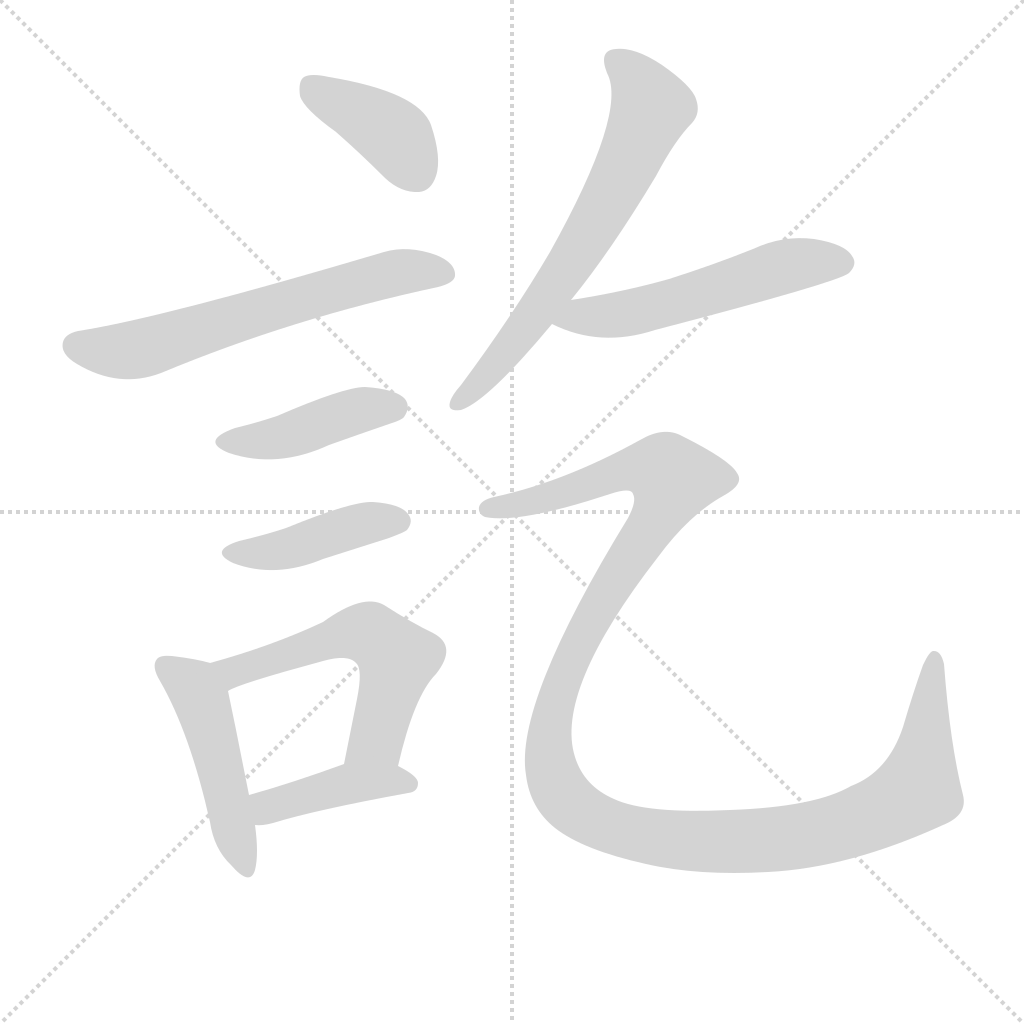
Pronounced qi.
In the Explanation of Characters (Shuowen), it means to stop.
Xu states it refers to where speech stops.
In the Jade Chapters (Yupian), it means to finish.
In the Amplified Rhymes (Zengyun), it means to end or to complete.
In the Collection of Characters (Zihui), it means to exhaust.
Book of Documents (Shujing), Lu on Punishments: Do not let the administration of law end in intimidation, but rather end in wealth.
The commentary explains that here, the term signifies an ending, and thus it is glossed as finish.
Guliang Commentary (Guliang Zhuan), Ninth Year of Duke Xi: Do not stop the buying of grain.
The annotation explains that here, it means to cease, referring to the storage of grain.
It also means to complete.
History of the Former Han (Qianhanshu), Biography of Wang Mang: Liu Xin did not end his report.
Shigu’s annotation notes that here, it means to finish.
Also found in Sima Zhen’s Records of the Grand Historian (Shiji), Annals of the Three Sovereigns: The Spring and Autumn Apocrypha (Chunqiu Wei) states that from the beginning of creation to the capture of the unicorn, time is divided into ten epochs; the tenth is the Liuchi Epoch.
Also in the Collection of Rhymes (Jiyun), pronounced xi. It is equivalent to the character meaning to reach.
In the Erya (Erya), Interpretation of Glosses: It means to arrive at.
Preface to the Book of Documents (Shangshu Kong Xu): From the eras of Tang and Yu and following, up to the Zhou Dynasty.
History of the Former Han (Qianhanshu), Imperial Edict of Emperor Cheng: Up to the present, it has not been changed.
In the Explanation of Characters (Shuowen), it was originally written as a variant form.