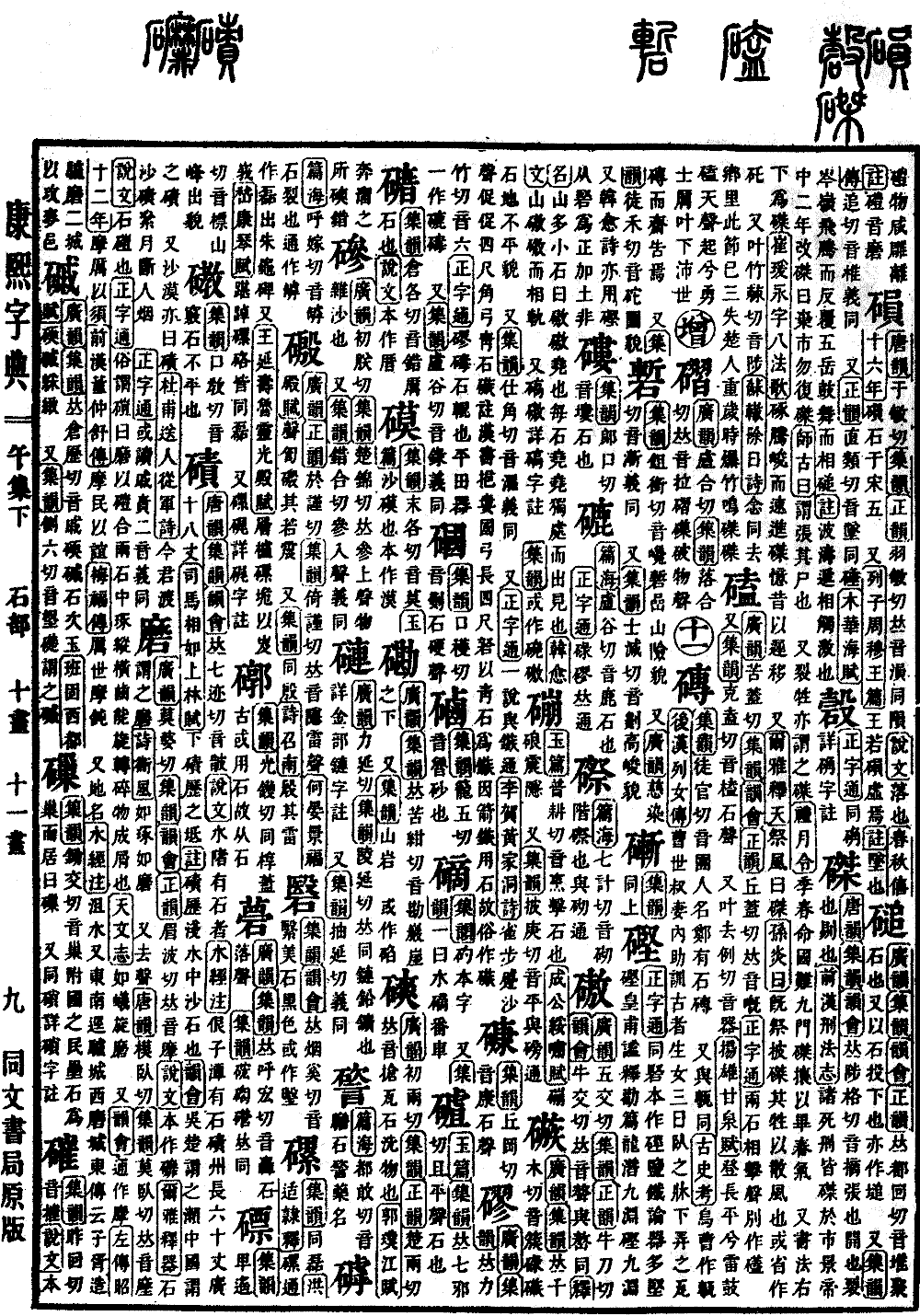
Wu Collection, Lower Volume
Radical: Stone (shí)
Kangxi Strokes: 16
Page 835, Entry 06
Pronounced qi. According to the Tang Rhymes (Tangyun), Collected Rhymes (Jiyun), and Rhyme Meeting (Yunhui), it is pronounced like the character for bark/crust (qiao).
According to the Explaining Graphs and Analyzing Characters (Shuowen), it refers to a place in the water where rocks have piled up.
Commentary on the Classic of Waterways (Shuijingzhu) notes that the Henzi Pool contains a rocky accumulation of stones, sixty zhang long and eighteen zhang wide.
Sima Xiangru in the Rhapsody on the Shanglin Park (Shanglin Fu) mentions descending upon the stony shoals. The commentary explains that the term indicates sand and stone in shallow water.
The Rhyme Meeting (Yunhui) notes that in the Wu and Chu regions, such a feature is called a rapid, while in the Central Plains it is called a qi.
It is also used to refer to a desert. Du Fu in his Poem Sending a Friend to Join the Army writes: Now you cross the sandy desert, where for many months human smoke has been severed.
Corrected Characters (Zhengzitong) notes that it is sometimes read with the sounds of the characters for sorrow (qi) and responsibility (ze), with the same meaning.