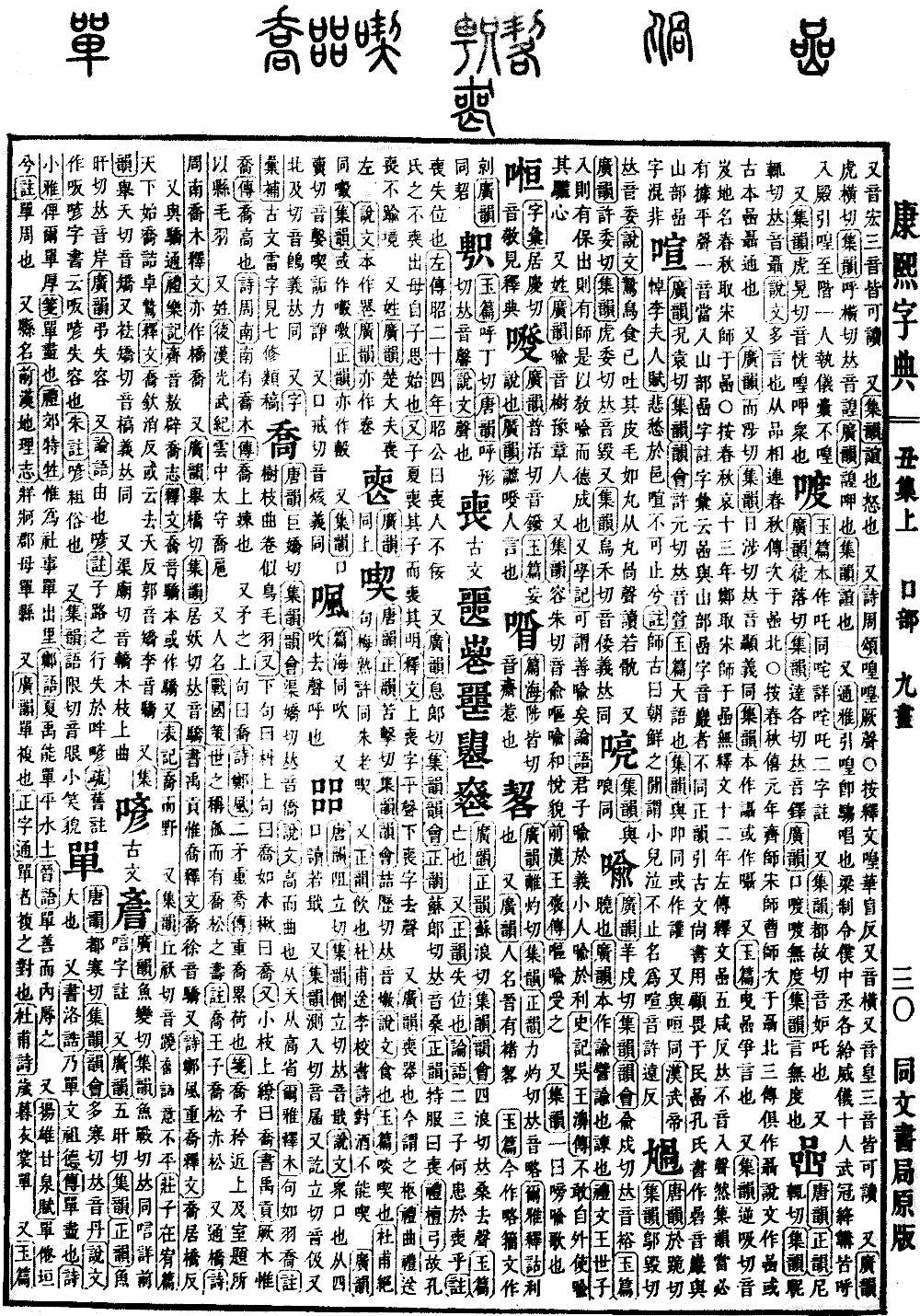
Chou Collection, Upper Volume
Radical: Mouth (kǒu)
Kangxi stroke count: 12
Page 200, Entry 22
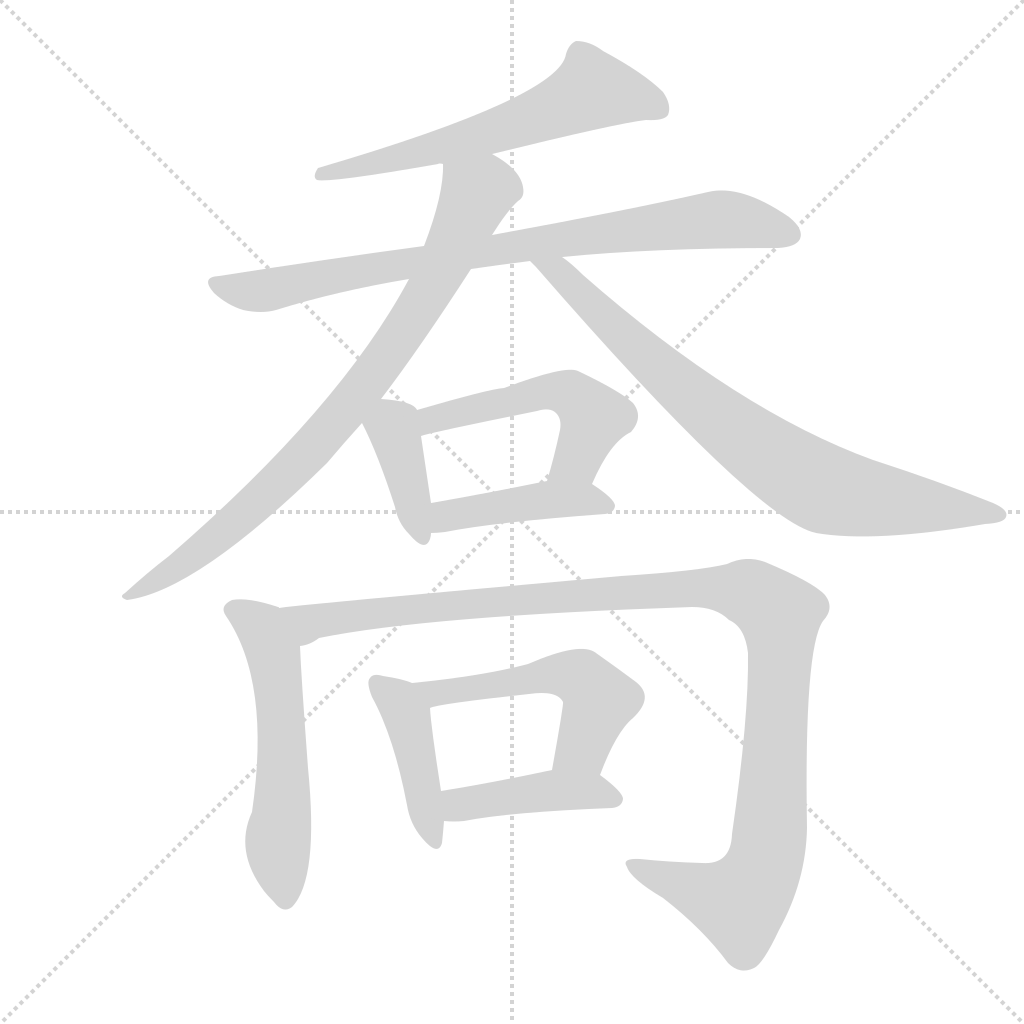
Pronounced qiao.
According to the Tang Dynasty Rhymes (Tangyun), the Jiyun, and the Rhyme Compilation (Yunhui), the sound is qiao.
According to the Explaining Graphs and Analyzing Characters (Shuowen), it means tall and curved, composed of the characters for young and tall (abbreviated).
According to the Literary Expositor (Erya), in the section explaining trees, it describes tree branches that are curved and spread out like feathers.
Commentary: The branches are curled like bird feathers.
Also, branches curving downward are called jiu, those curving upward are called qiao, and those resembling the catalpa tree are called qiao.
Also, small branches twining upward are called qiao.
According to the Book of Documents (Shujing), in the chapter Tribute of Yu (Yu Gong), it describes the trees there as tall.
Commentary: Qiao means tall.
According to the Book of Odes (Shijing), in the Zhou Nan section, it mentions tall trees in the south.
Commentary: Qiao means rising upward.
Also, the curved upper end of a spear is called qiao.
According to the Book of Odes (Shijing), in the Zheng Feng section, it mentions two spears decorated with layers of feathers.
Commentary: The term double qiao refers to feathers layered upon one another.
Note: Qiao refers to the spear shaft near the upper end where the spearhead is attached for hanging feathers.
Also a surname.
According to the History of the Later Han (Hou Hanshu), in the annals of Emperor Guangwu, it mentions the Administrator of Yunzhong, Qiao Hu.
Also a personal name.
According to the Strategies of the Warring States (Zhan Guo Ce), for generations people have aspired to the longevity of Prince Qiao and Chisongzi.
Commentary: Qiao refers to Prince Qiao; Song refers to Chisongzi.
Also written as the character for bridge.
According to the Book of Odes (Shijing), in the Zhou Nan section, the commentary on tall trees indicates it is also written in a variant form (qiao).
Also, according to the Guangyun and Jiyun, pronounced jiao.
According to the Book of Documents (Shujing), in the chapter Tribute of Yu, the commentary by Xu Miao reads it as jiao.
Also, according to the commentary on the Book of Odes (Shijing), Zheng Feng section, it is read as jiao.
Also interchangeable with the character for arrogant.
According to the Book of Rites (Liji), in the section on music, the music of the Qi state is described as arrogant and extreme, with a prideful spirit.
Commentary: Qiao is read as jiao; some versions write it as jiao.
Also, in the section on the records of customs, it refers to being arrogant and unrefined.
Also, according to the Jiyun, pronounced qiao. Qiao-jie refers to a mind that is not at peace.
According to the Zhuangzi, in the Zai You chapter, it describes the world beginning to manifest injustice and violence.
Commentary: Qiao is read as qiao; some say read as qiao; Guo Xiang reads it as jiao; Li Gui reads it as jiao.
Also, according to the Jiyun, pronounced jiao.
Also, pronounced gao. The meaning is the same.
Also, pronounced jiao. Refers to tree branches curving upward.
Textual research: In the Strategies of the Warring States (Zhan Guo Ce), the phrase reading of kings has been corrected according to the original text to read for generations.