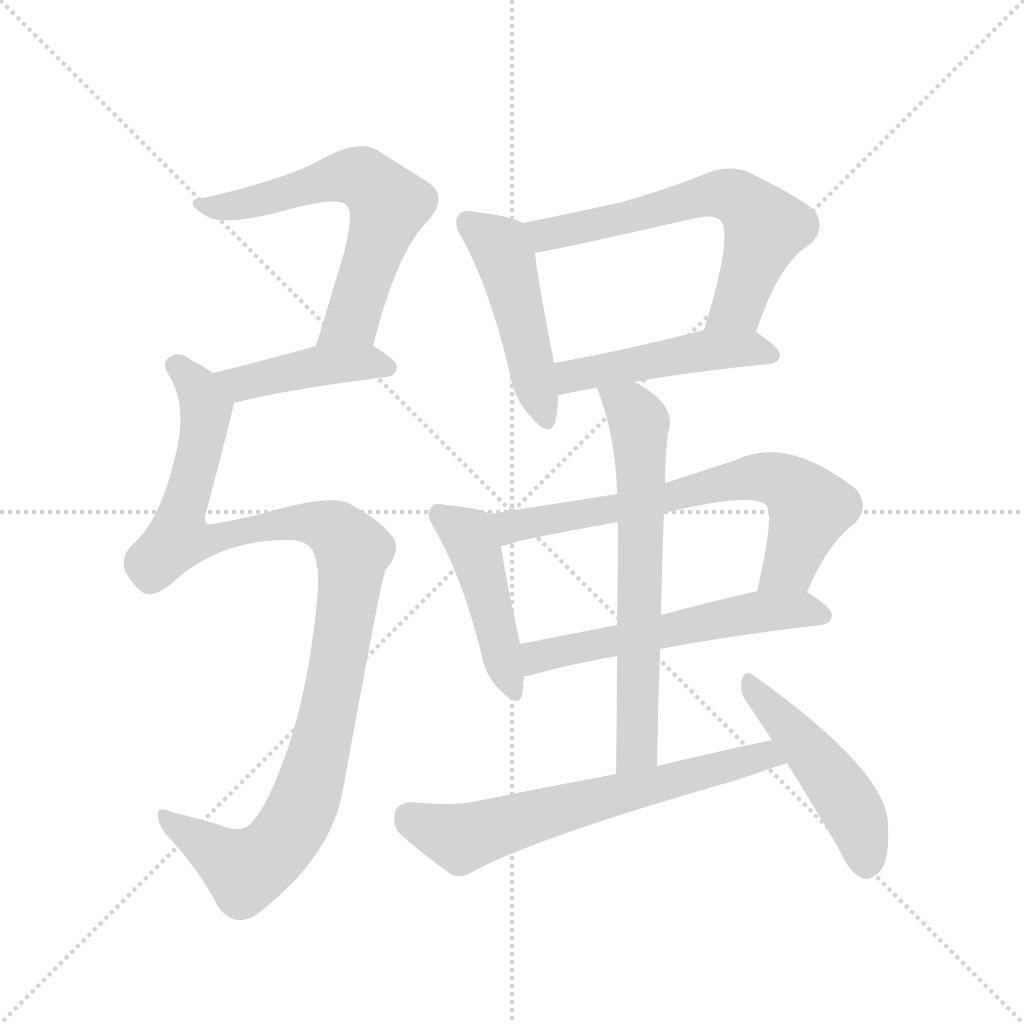
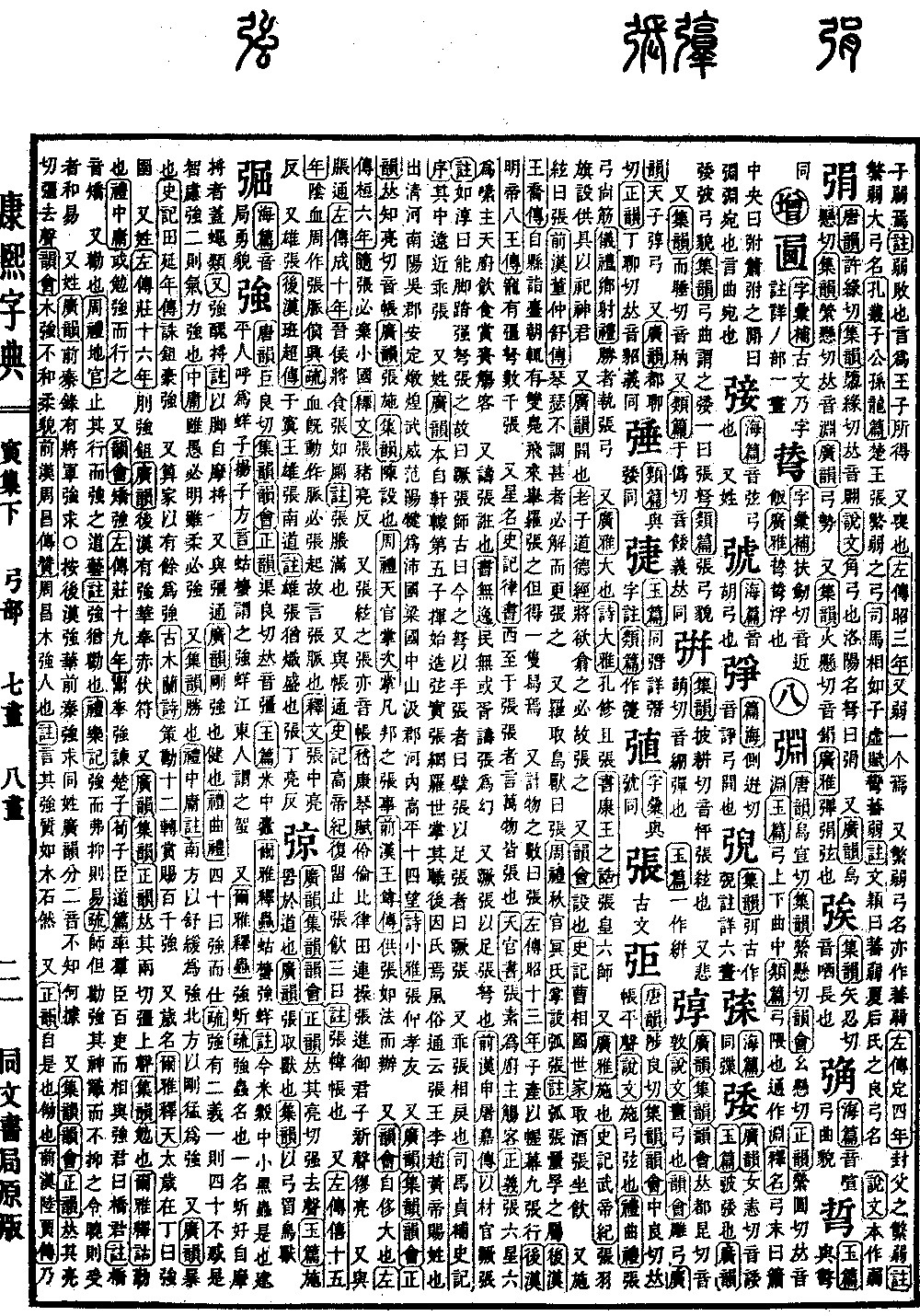
Yin Collection, Lower Volume
Radical: Bow (gōng)
Kangxi Strokes: 11
Page 359, Entry 01
According to the Xu annotations on the Explanation of Graphs and Analysis of Characters (Shuowen Xuzhu), it is the same as the character for strong. The stone inscriptions of the Qin Dynasty use the mouth component. It is the same as the character for strong (qiáng).
Pronounced qiang.
According to the Tang Rhyme (Tangyun), the Collected Rhymes (Jiyun), the Rhyme Compendium (Yunhui), and the Standard Rhymes (Zhengyun), the pronunciation is the same as the character for strong (jiāng).
According to the Jade Chapters (Yupian), it refers to a weevil found in rice. According to the Literary Expositor (Erya), in the chapter interpreting insects, it states the gu (a type of insect) is the strong. The annotation notes that this refers to the small black insect currently found in rice and grain. People in the Jianping region call it zi. According to the Regional Speech (Fangyan) by Yangzi, the gu is called strong. People in the Jiangdong region call it by a different name.
Also, according to the Literary Expositor (Erya), in the chapter interpreting insects, it mentions the strong-qi. The commentary explains that strong is the name of an insect. Another name is qi, which likes to rub its body, perhaps a type of fly.
Also, strong-chou-lu refers to rubbing with one's feet.
It is also used interchangeably with the character for strong (jiāng). According to the Broad Rhyme (Guangyun), it means firm or robust. According to the Book of Rites (Liji), in the chapter on Regulations for Daily Life (Qu Li), the age of forty is called strong, at which point one may serve in government. The commentary explains that strong has two meanings: first, at forty, one is not deluded, meaning one's wisdom and judgment are strong; second, one's physical energy is strong. According to the Doctrine of the Mean (Zhongyong), even if one is dull, one will surely become intelligent, and even if one is weak, one will surely become strong.
According to the Collected Rhymes (Jiyun), it means to surpass. According to the annotation to the Doctrine of the Mean (Zhongyong) in the Book of Rites (Liji), southerners consider ease as strong, while northerners consider hardness and ferocity as strong.
According to the Broad Rhyme (Guangyun), it means tyrannical. According to the History of the Han (Shiji), in the biography of Tian Yannian, it refers to purging the arrogant and tyrannical.
Mathematicians use this term to describe a remainder. According to the ancient Ballad of Mulan (Mulan Shi), when recording many meritorious deeds, the rewards numbered in the hundreds or thousands with a remainder.
It is the name of a Jupiter star. According to the Literary Expositor (Erya), in the chapter interpreting heaven, when the Grand Duke (Tai Sui) is in the year of ding, it is called strong-yu.
Also a surname. According to the Zuo Commentary (Zuozhuan), in the sixteenth year of Duke Zhuang, it mentions the cutting off of the feet of Qiang Chu. According to the Broad Rhyme (Guangyun), during the Later Han, there was a man named Qiang Hua who presented the Red Talisman.
Pronounced qiang (rising tone).
According to the Collected Rhymes (Jiyun), it means to exert effort. According to the Literary Expositor (Erya), in the chapter interpreting the classics, it means diligent. According to the Book of Rites (Liji), in the Doctrine of the Mean (Zhongyong), it refers to someone who forces himself to practice it.
According to the Rhyme Compendium (Yunhui), it means to pretend or force. According to the Zuo Commentary (Zuozhuan), in the nineteenth year of Duke Zhuang, Yu Quan forcefully remonstrated with the King of Chu. According to the Master Xun (Xunzi), in the chapter on the Way of the Subject, it refers to leading all the officials and ministers to force the ruler to correct himself. The annotation notes that qiao is pronounced the same as jiao.
Also, to encourage. According to the Rites of Zhou (Zhouli), in the section on the Ministry of Earth, it refers to correcting their conduct and encouraging them to study the arts of the Way. The annotation notes that strong is like encouragement. According to the Book of Rites (Liji), in the chapter on Music, it states that to encourage without suppressing is easy. The commentary explains that the teacher only encourages and enhances the student's understanding without suppressing him, so the recipient is compliant and it is easy.
Also a surname. According to the Broad Rhyme (Guangyun), the Record of the Former Qin (Qianqin Lu) mentions a General Qiang Qiu. Noting the Qiang Hua of the History of the Later Han (Hou Hanshu), the Qiang Qiu of the Record of the Former Qin (Qianqin Lu) share the same surname, but the Broad Rhyme (Guangyun) divides them into two pronunciations, the basis for which is unknown.
Pronounced qiang (falling tone).
According to the Rhyme Compendium (Yunhui), wood-strong describes an appearance that is not harmonious or soft. According to the biography of Zhou Chang in the History of the Former Han (Qian Han Shu), Zhou Chang was a wood-strong person. The annotation explains that his rigid nature was like wood or stone.
According to the Standard Rhymes (Zhengyun), it means self-righteous or stubborn. According to the biography of Lu Jia in the History of the Former Han (Qian Han Shu), one wishes to use the newly established and unstable Yue state to be stubborn and disobedient here. The annotation notes that qu-qiang means not yielding or submissive. The History of the Han (Shiji) writes it as the character for yielding-strong.
It is also used interchangeably with the character for swaddle (qiǎng). According to the Categorized Dictionary (Leipian), strong is a cloth bag for carrying an infant on one's back. According to the History of the Han (Shiji), in the biography of the Duke of Lu Zhou, King Cheng was in his infancy, within the swaddling clothes. The annotation states that the interpretation suggests strong-bao refers to swaddling clothes. The commentary adds that strong refers to a cloth eight inches wide and eight feet long used to wrap a child to be carried on the back.