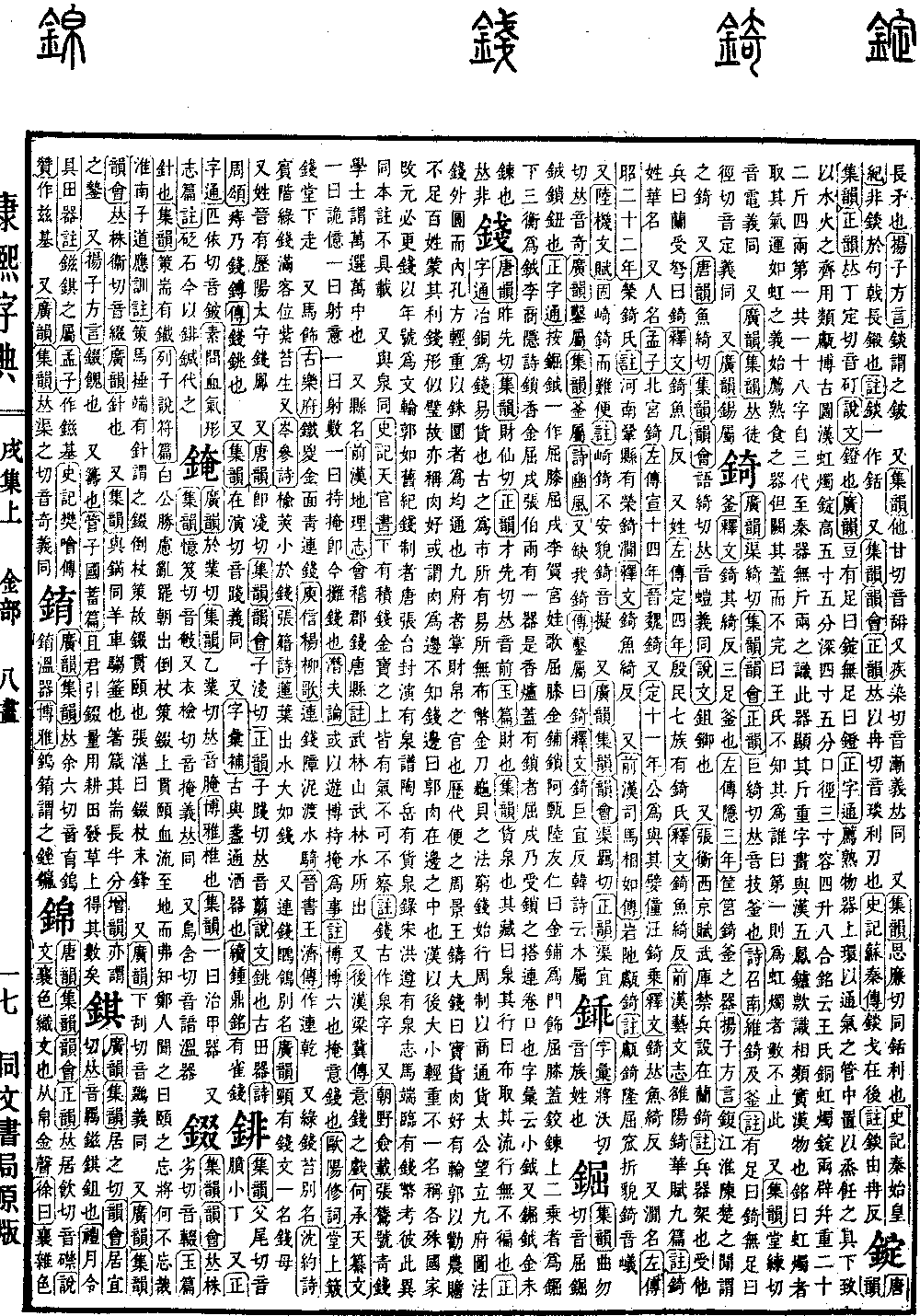
Xu Collection, Upper Volume
Radical: Metal (jīn)
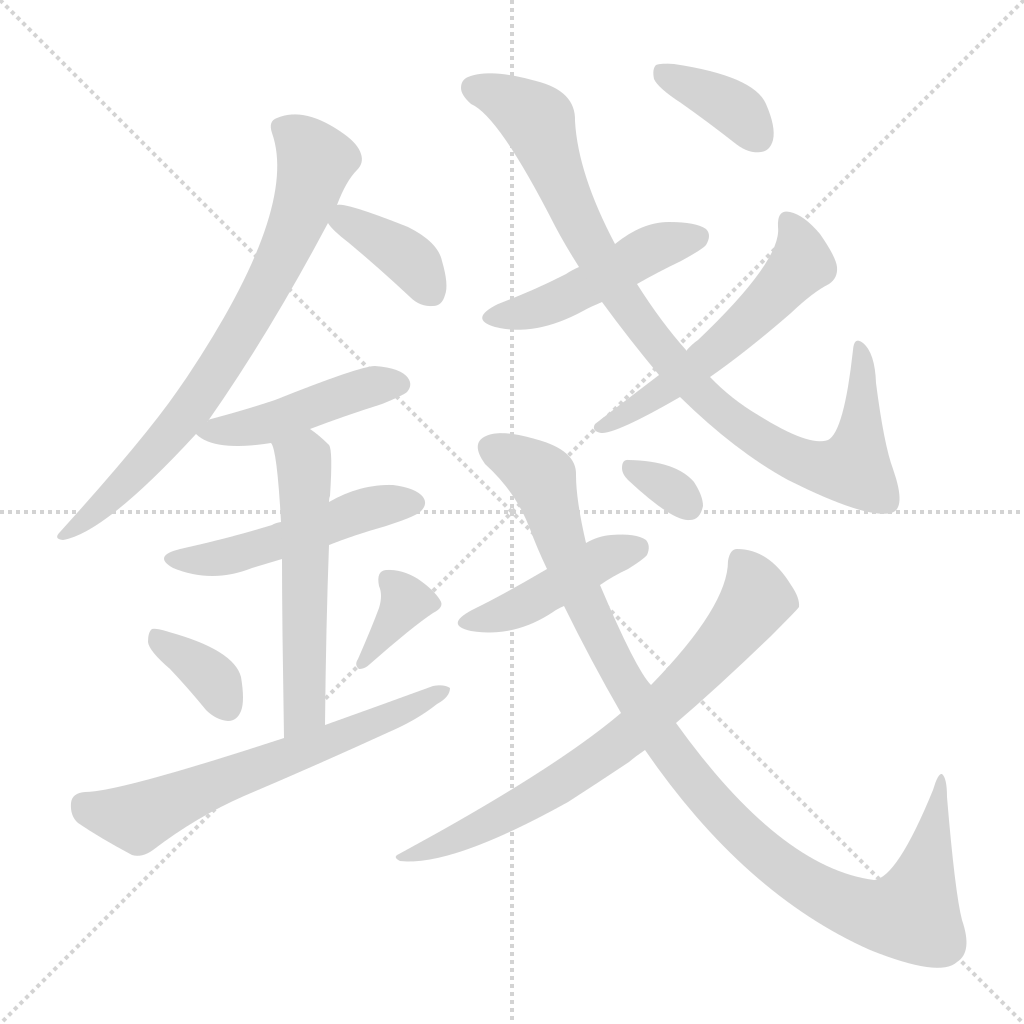
Money
Kangxi Stroke Count: 16
Page 1311, Entry 05
Pronounced qian.
Jade Chapters (Yupian): Wealth.
Collected Rimes (Jiyun): Currency. When stored it is called fountain, when in circulation it is called cloth. This implies that its flow is pervasive.
Correction of Characters (Zhengzitong): Smelting copper into money to facilitate trade. In ancient times, people traded what they had for what they lacked; after the methods of cloth currency, gold, knives, tortoises, and shells were exhausted, money began to circulate. During the Zhou Dynasty, regulations were established to facilitate trade. Taigong Wang established the circular currency method for the nine administrative treasuries; the money was round on the outside with a square hole in the center, and its weight was measured in zhu. The round shape signifies even circulation. The nine treasuries were the officials in charge of wealth and silk. Successive dynasties found this convenient. King Jing of Zhou cast large coins called treasure currency, which featured rims, intended to encourage agriculture and provide for the destitute, benefiting the people. The shape of the coin resembles a jade disk, so it is also called meat-rim. Some refer to the meat as the edge, not knowing that the edge of a coin is called the rim, and the meat lies between the edges. After the Han Dynasty, sizes and weights varied, names differed, and every time the state changed its reign title, it would mint new coins, using the reign title as the inscription, while the rims remained as before. Those who have recorded the currency system include Zhang Tai and Feng Yan of the Tang in the Records of Currency (Quanpu), Tao Yue in the Record of Currency (Huoquan Lu), Hong Zun of the Song in the Currency Records (Quanzhi), and Ma Duanlin in the Examination of Currency (Qianbi Kao); their accounts differ, and this entry does not record them in detail.
Also the same as fountain. Records of the Grand Historian (Shiji), Treatise on the Celestial Offices: Below there are piles of money; above gold and treasures there is always an aura, one must examine it. Commentary: Money was anciently written as the character for fountain.
Also, Notes on Court and Country (Chaoye Qianzai): Zhang Zhu was nicknamed the Green Money Scholar, meaning he was selected for excellence ten thousand times out of ten thousand.
Also a district name. History of the Former Han (Qianhan Shu), Treatise on Geography: Qiantang District, Kuaiji Commandery. Commentary: Where the Wulin Mountains and Wulin Water originate.
Also, History of the Later Han (Houhan Shu), Biography of Liang Ji: The game of guessing money. He Chengtian, Compendium of Writing (Zuanwen): One name is guessing, another is shooting at ideas, shooting at numbers, or holding coverings, which is today's gambling with coins. Hidden Man's Essays (Qianfu Lun): Some occupy themselves with gambling and guessing games. Commentary: Bo refers to the game of six, and Yan refers to guessing money. Ouyang Xiu's Ci poetry: Tossing money in the hall, running below the hall.
Also horse ornaments. Ancient Music Bureau (Gu Yuefu): Iron golden-faced green linked-money patterns. Yu Xin, Willow Song: Linked-money patterns on the saddle flap as one rides across the water. Book of Jin (Jin Shu), Biography of Wang Ji: Written as linked-dry.
Also green money, another name for moss. Shen Yue's poetry: Green money fills the guest steps, purple moss grows in the guest quarters.
Also, Cen Shen's poetry: Elm pods smaller than money. Zhang Ji's poetry: Lotus leaves out of the water as large as money.
Also linked-money, another name for the wagtail. Broad Rimes (Guangyun): The neck has money-like patterns. Also called mother of money.
Also a surname. In the Jin there was a Prefect of Liyang named Qian Feng.
Pronounced jian.
Explanation of Simple and Compound Characters (Shuowen): A spade. An ancient farming tool. Book of Odes (Shijing), Zhou Hymns: Prepare your spades and hoes. Commentary: Money, a spade.
Also pronounced jian. Meaning is the same.
Also, Supplement to the Collection of Characters (Zihuibu): In ancient times, it was interchangeable with the character for cup. A wine vessel. Continuation of Bronze Inscriptions (Xu Zhongding Ming): There is a sparrow cup.
Textual Research: Correction of Characters: Smelting copper into money to facilitate trade. Taigong Wang established the circular currency method for the nine administrative treasuries—carefully corrected from the original text's diagram method to circular method. Book of Odes, Zhou Hymns: Prepare your spades and hoes—carefully corrected from the original text's typo to the correct character for prepare.