Xu Collection, Upper Volume
Radical: Metal (jīn)
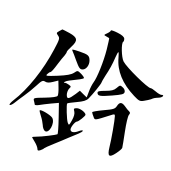
Qian
Kangxi strokes: 12
Page 1298, Entry 17
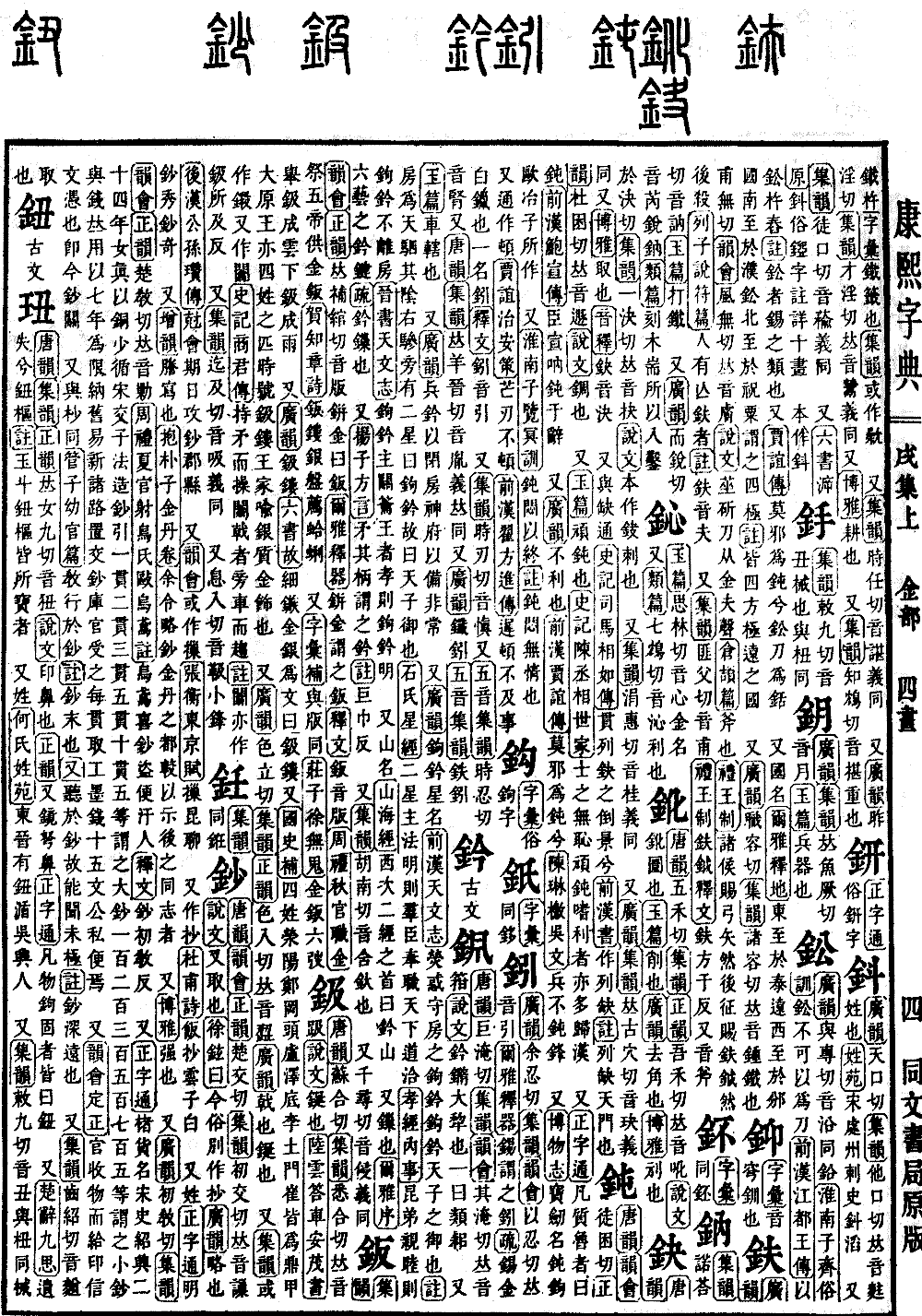
According to the Tang Dynasty Rhyme Dictionary (Tangyun), the sound is jian. According to the Collected Rhymes (Jiyun) and the Rhyme Collection (Yunhui), the sound is jian. The pronunciation is the same as the character for pincer (qian). The Explanation of Writing and Analysis of Characters (Shuowen Jiezi) states: Qian is a type of large plow. Another view states it is an agricultural tool similar to a spade. According to the Jade Chapters (Yupian), it refers to the linchpin at the ends of an axle. According to the Expanded Rhyme Dictionary (Guangyun), military qian are used to lock rooms, and the divine cabinet is used to guard against unexpected events. According to the Expanded Rhyme Dictionary (Guangyun), Gouqian is the name of a constellation. The History of the Former Han (Qian Hanshu), Treatise on Astronomy (Tianwenzhi), records: Mars remained near the Gouqian star in the Room (Fang) mansion. Gouqian refers to the carriage of the Son of Heaven. The commentary notes: The Room mansion is the Heavenly Team, and the two stars beside the right outer horse on its shaded side are called Gouqian; thus it is referred to as the carriage of the Son of Heaven. The Shi Family Astronomical Classic (Shi Shi Xingjing) states: These two stars govern laws and regulations; if they are bright, it indicates that the ministers are performing their duties and the world is well-governed. The Classic of Filial Piety (Xiaojing), Internal Affairs (Neishi), records: If brothers live in harmony, the Gouqian star will not depart from the Room mansion. The Book of Jin (Jinshu), Treatise on Astronomy (Tianwenzhi), states: The Gouqian star governs the key; if the monarch is filial, the Gouqian star shines brightly. It is also the name of a mountain. The Classic of Mountains and Seas (Shanhaijing) records: The second section of the Western Classics begins with Mount Qian. It also refers to a lock. The Preface to the Er Ya (Erya Xu) records: The key to the six arts. The commentary explains: Qian means a lock. According to the Dialect (Fangyan) by Yang Xiong, the handle of a spear is called qian. The commentary notes: Pronounced jin. According to the Collected Rhymes (Jiyun), the pronunciation is han. It refers to foot shackles. It is also pronounced qin. The meaning is the same.