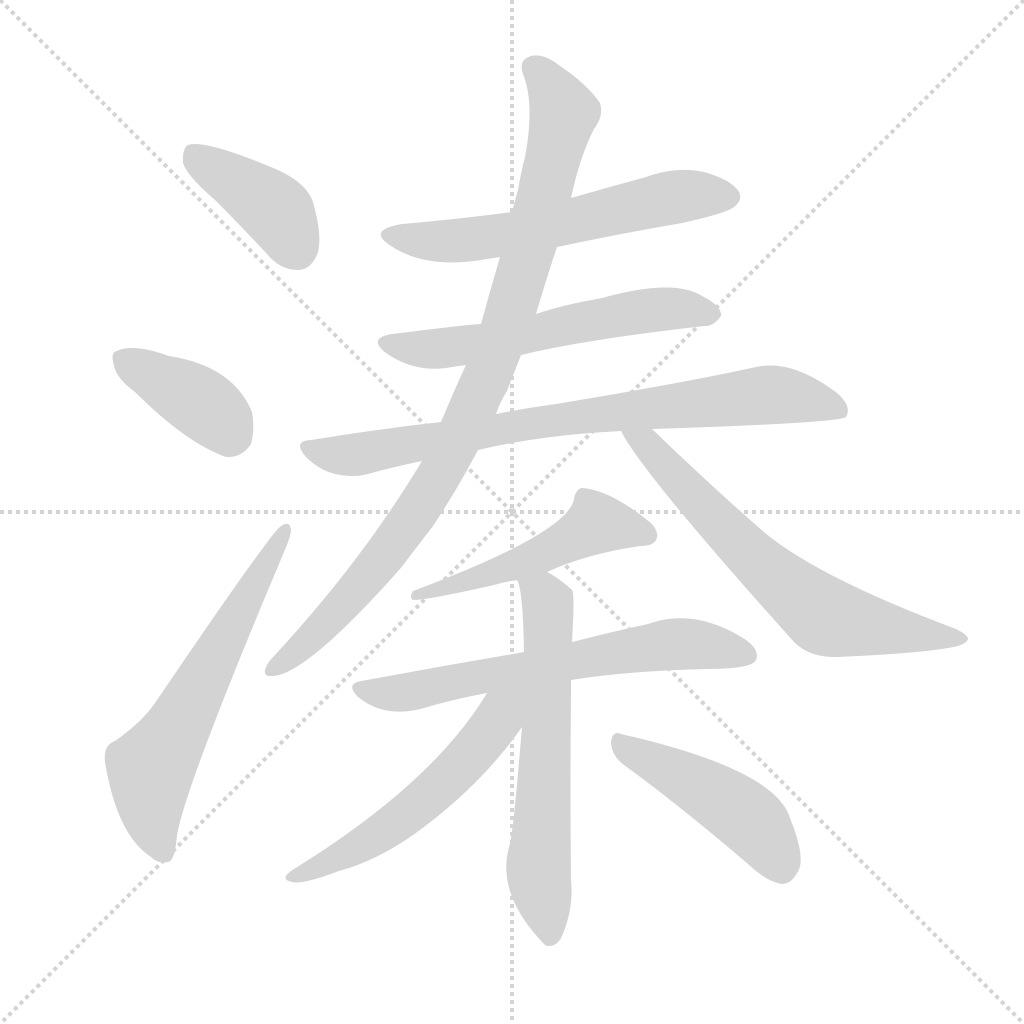
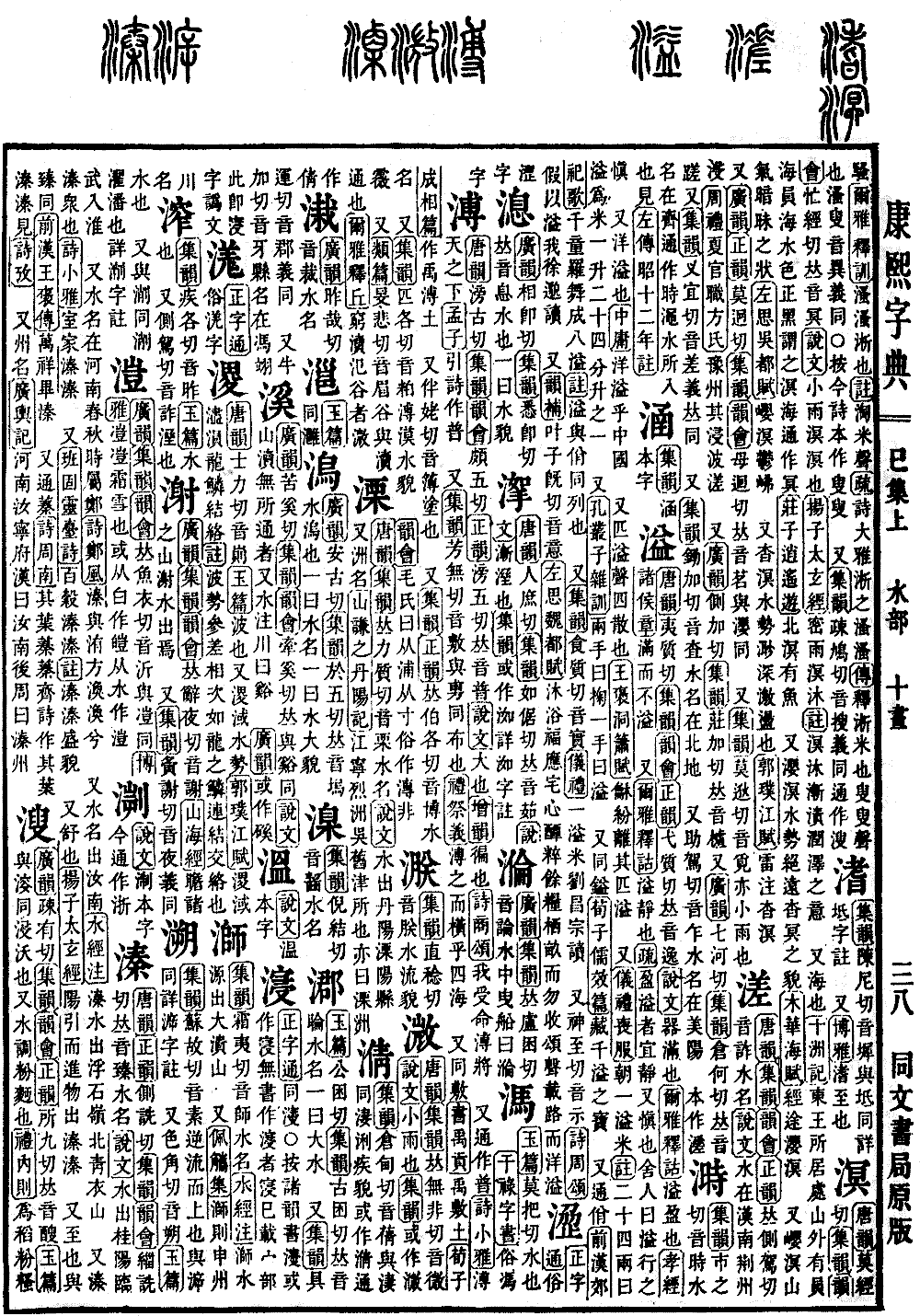
Si Collection, Upper Volume
Radical: Water (shuǐ)
Zhen
Kangxi strokes: 14
Page 640, Entry 33
Pronounced zhēn.
A name of a river. According to the Shuowen Jiezi, the river rises in Linyuan, Guiyang, and flows into the Hui River. Also a river name, located in Henan. During the Spring and Autumn period, it belonged to the state of Zheng. In the Book of Odes (Shijing), Zheng Feng section, it is written: The Zhen and Wei rivers are swelling and rushing.
Also a river name, rising in Runan. According to the Commentary on the Water Classic (Shuijing Zhu), the Zhen River rises from Qingyi Mountain, north of Fushi Ridge.
Also zhen-zhen, meaning numerous. In the Book of Odes (Shijing), Xiao Ya section, it is written: The household is numerous and flourishing. Also in the poem Lingtai by Ban Gu, it says: The hundred grains are flourishing. The commentary notes that zhen-zhen describes an appearance of abundance.
Also means to expand. In the Taixuanjing by Yang Xiong, it is written: The yang energy draws forth and advances, and things emerge in abundance.
Also means to arrive, same as zhen. In the Biography of Wang Bao from the Book of Han (Hanshu), it is written: Ten thousand blessings all arrive.
Also used interchangeably with zhen (lush). In the Book of Odes (Shijing), Zhou Nan section, it is written: Its leaves are lush. The Qi version of the Odes writes it as its leaves are zhen-zhen. See the Shikao (Examination of the Odes).
Also a prefecture name. According to the Guangyu Ji (Record of the Vast World), in Henan, Runan Prefecture was called Runan during the Han dynasty, and Zhen Prefecture during the Later Zhou dynasty.
The character zī originally follows the structure of the character for silk, and does not follow the structure of the character for river.
Correction note: The Shuowen Jiezi states the river rises in Linyuan, Guiyang, and flows into the Hui River. Following the original text, the entry has been corrected from the previous erroneous reading of Huai River to Hui River.