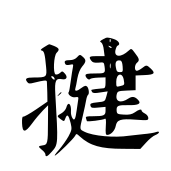
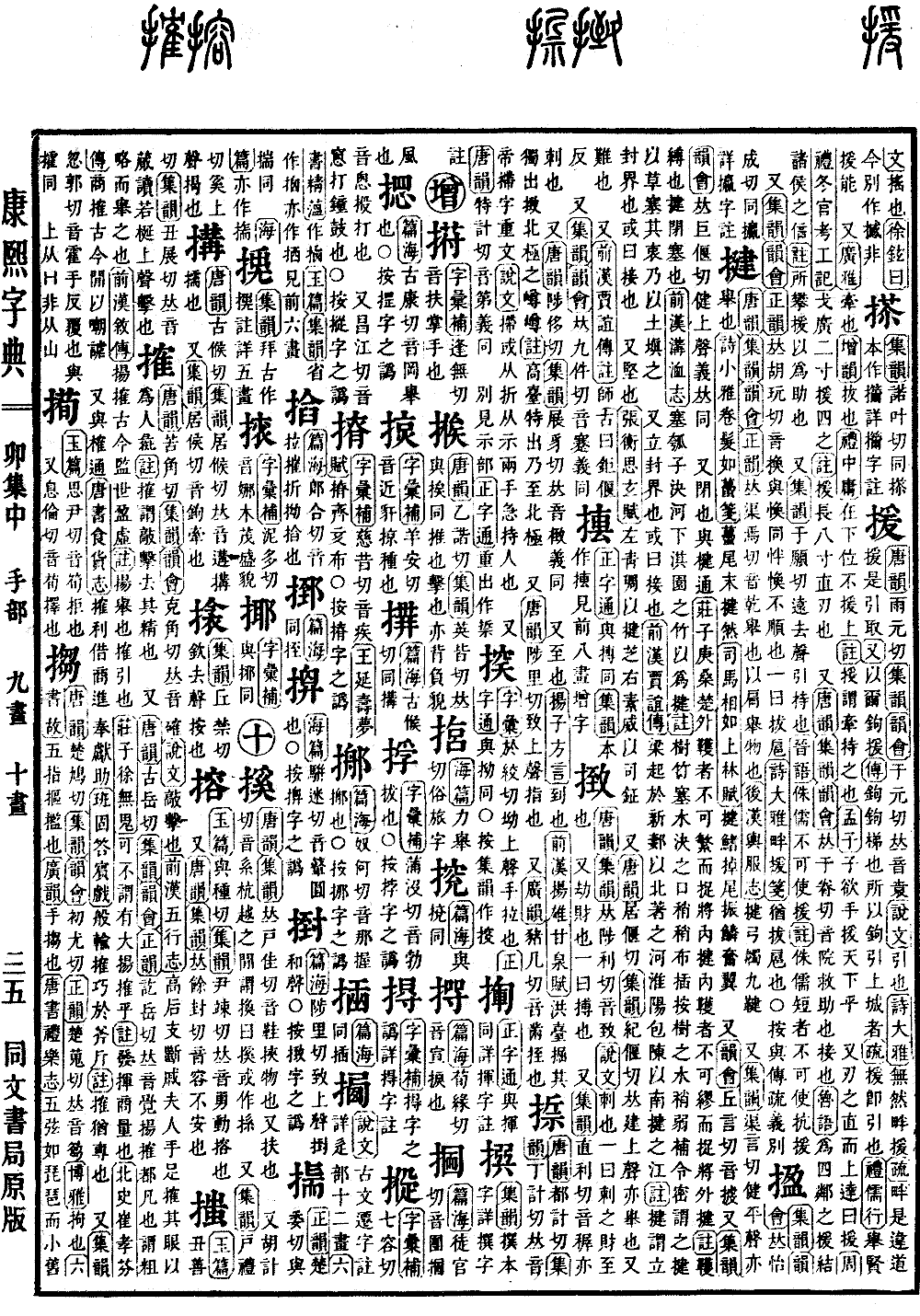
Mao Collection, Middle Volume. Radical: Hand (shǒu). Kangxi strokes: 13. Page 445, Entry 04.
According to Tang Yun, Jiyun, Yunhui, and Zhengyun, pronounced qian (level tone). Meaning to lift up. To carry items on the shoulder. As recorded in the History of the Later Han (Hou Hanshu): To lift a bow case, there are nine bow containers. Furthermore, according to Jiyun, pronounced qian (level tone). Also meaning to lift up. As noted in the Book of Odes (Shijing), commentary on the Small Odes (Xiaoya) regarding the appearance of hair curled like a scorpion's tail: The tail of a scorpion with the end curved upward. As written in Sima Xiangru's Rhapsody on the Imperial Park (Shanglin Fu): Lifting the fins and waving the tail, vibrating scales and flapping wings.
Furthermore, according to Yunhui, pronounced qian (level tone). Furthermore, according to Jiyun and Yunhui, pronounced jian (rising tone). Meaning the same. Also signifies to close or block. Interchangeable with the character for a bar or bolt (jian). As written in the Zhuangzi: If external constraints are too many, one cannot grasp firmly, and will seek to close inward. If internal constraints are too many, one cannot hold fast, and will seek to close outward. The commentary notes: Bindings mean to tie up. Closing means to block or obstruct. As written in the History of the Former Han (Qian Hanshu): To block the breach in the Huzi River, cut bamboo from the Qi Garden to use as a brace. The commentary notes: Setting up bamboo to block the breach of the river, gradually arranging, inserting, and planting; when the water force weakens, insert more to make it dense, which is called jian, stuffing the middle with grass and filling it solid with earth.
Also signifies to establish a boundary. Or signifies to connect. As written in the History of the Former Han (Qian Hanshu), biography of Jia Yi: The territory of Liang begins north of Xinqi, connecting the Yellow River and Huaiyang, including the southern region, and joins the Yangtze River. The commentary notes: Jian means to establish a boundary, or signifies to connect.
Also signifies firm or solid. As written in Zhang Heng's Rhapsody on Contemplating the Mystery (Sixuan Fu): On the left using green jade to secure the fungus of immortality, on the right using white ornaments to manage the gongs and drums.
Furthermore, according to Tang Yun, pronounced jian (rising tone), and according to Jiyun, pronounced jian (rising tone). Also meaning to lift up. Also signifies difficult. Furthermore, according to the commentary on the History of the Former Han (Qian Hanshu), biography of Jia Yi, Shigu states: Pronounced jian (rising tone). Furthermore, according to Jiyun and Yunhui, pronounced jian (departing tone). Meaning the same.