Chen Collection, Middle Volume
Radical: Tree (mù)
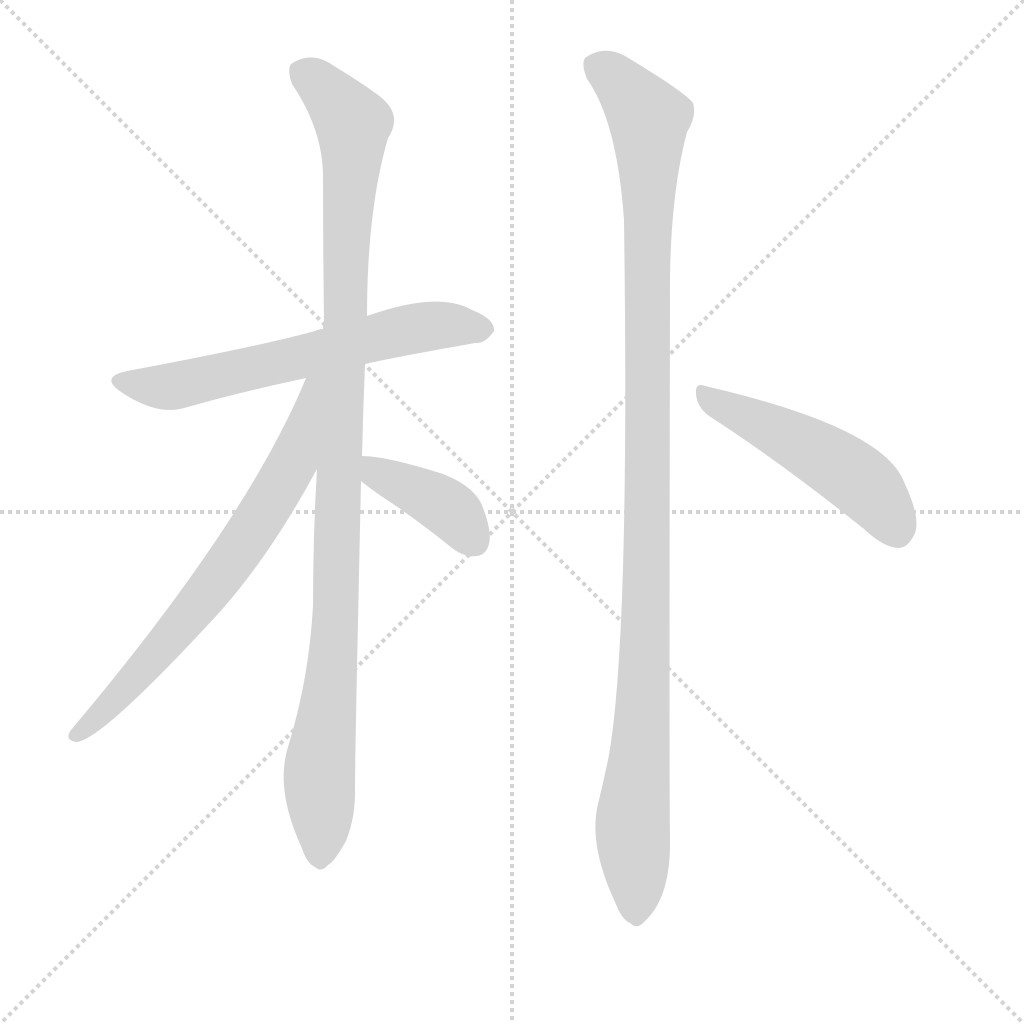
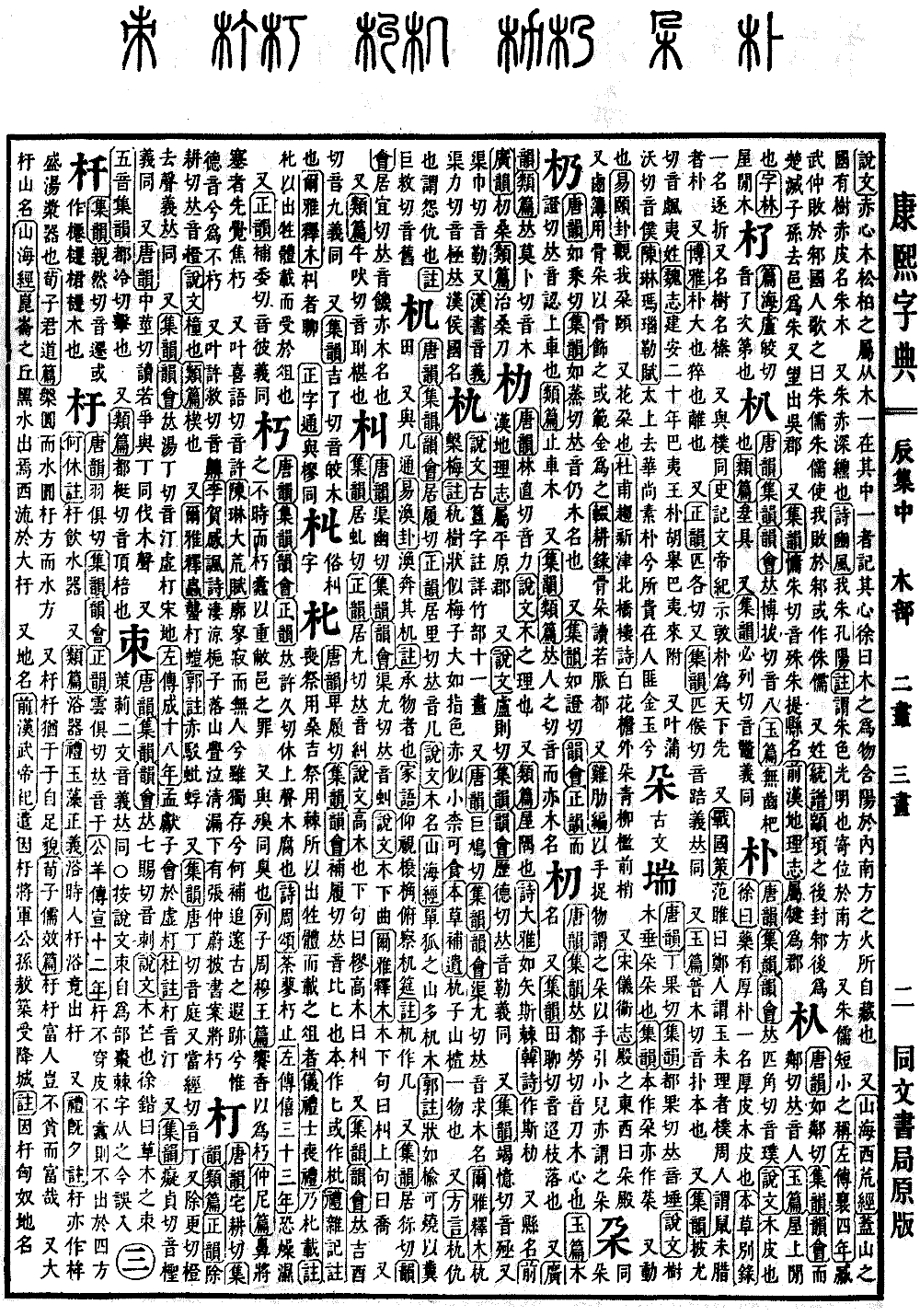
Entry: 朴
Kangxi strokes: 16
Page 510, Entry 04
Pronounced pu (falling tone), same as the character for unpolished jade (pu).
Explanation in Explanation of Graphs and Analysis of Characters (Shuowen Jiezi): Tree bark.
Xu states: Among medicinal materials, there is "houpu," also known as "houpi," which is tree bark.
Records of Herbs (Bencao Bielu) record: This tree is named zhen, and its fruit is named zhuzhe.
Also used interchangeably with the character for unhewn wood (pu).
Records of the Grand Historian (Shiji), Annals of Emperor Wen: Records that (Emperor Wen) set a standard for the world through his honest and simple nature.
Also, in Strategies of the Warring States (Zhanguo Ce), Fan Ju said: People of Zheng call unprocessed jade "pu," and people of Zhou call undried rat meat "pu."
Also, Erudite Broadness (Boya) explains that "pu" carries the meanings of huge, sudden, and separation.
Also, Correct Rhymes (Zhengyun): Pronounced pi (entering tone).
Also, Collection of Rhymes (Jiyun): Pronounced bo (entering tone), same as the character for fall down (bo). The meaning is the same.
Also, Jade Chapters (Yupian): Pronounced pu (entering tone), same as the character for strike (pu). The meaning is root or essence.
Also, Collection of Rhymes (Jiyun): Pronounced pi (level tone), same as the character for piao. It is a surname used by ethnic minorities.
Records of Wei (Weizhi) record: In the 20th year of Jian'an, the leader of the Ba-Yi, Pu Hu, led the Ba-Yi tribes to come and submit.
Also, rhyme reading: Pronounced pu (entering tone), same as the character for servant (pu).
Chen Lin, Rhapsody on the Agate Inkstone (Manaole Fu): Writes: The way of the ancients was to cast aside ostentation and value simplicity; what is precious is the person themselves, not gold or jade.
Collation note: Records of Herbs (Bencao Bielu) stated: One name is zhuzhe. Another record says the tree is named zhen. Now, carefully following the original text, it is changed to: The tree is named zhen, and its fruit is named zhuzhe.
Entry: 樸
Pronounced pu (falling tone), same as the character for unpolished jade (pu).
Explanation in Explanation of Graphs and Analysis of Characters (Shuowen Jiezi): Written as the character with the tree radical and pu component. Meaning unprocessed wood.
Xu states: Earthenware is called "huai," and unprocessed wood is called "pu."
Book of Documents (Shujing), Timber for Making Tools (Zicai): Records: Having diligently hewn and processed the wood, waiting only for red pigment to be applied for decoration.
Also, all artifacts that have not yet been shaped are called "pu."
Book of Rites (Erya), Explanation of Implements: Records that processing wood is called "du," and processing jade is called "diao."
Guo's commentary: These are all names for processing raw materials (zhi pu).
Also refers to a simple, unadorned essence.
Book of Rites (Liji), The Suburban Sacrifice (Jiaotesheng): Records: Riding in a plain carriage is to honor its simplicity.
Also, Collection of Rhymes (Jiyun), Rhyme Compendium (Yunhui), Correct Rhymes (Zhengyun): Pronounced bo (entering tone), same as the character for oracle (bu).
Book of Odes (Shijing), Greater Odes (Daya): Writes: The yu trees and the pu trees grow lush and clustered together.
Commentary: Explains "pu" as the fu tree.
Annotated notes: Explains it as the appearance of trees like white rui growing closely connected to one another.
Book of Rites (Zhouli), Winter Official, Artificer's Record (Kaogongji): Records: Methods for inspecting carriages, desiring that their structure be tightly joined and the carriage wheels have a small contact area with the ground.
Commentary: Explains "pu shu" as being as firm as if joined together.
Also, Collection of Rhymes (Jiyun): Pronounced pu (entering tone), same as the character for strike (pu).
Zhang Heng, Rhapsody on the Eastern Capital (Dongjing Fu): Writes: Follow frugality, value simplicity. Remember Confucius's teaching to overcome oneself and return to propriety, and practice Laozi's teaching that knowing contentment brings happiness.
Also refers to hard, sturdy timber.
Also, Collection of Rhymes (Jiyun): Pronounced pu (entering tone), same as the character for servant (pu). Meaning lush and dense trees.
Also, Wide Rhymes (Guangyun): Pronounced pu (entering tone), same as the character for pu. It is a county name.
Book of the Former Han (Qian Hanshu), Treatise on Geography: Records that it belonged to Wuwei Commandery.
Also, Tang Rhymes (Tangyun): Pronounced pu (falling tone), same as the character for shop (pu).
Huainanzi, On the Spirit (Jingshen Xun): Writes: Clearly understand the pure and white essence, and through non-action return to simplicity.