You Collection, Upper Volume
Radical: Speech (yán)
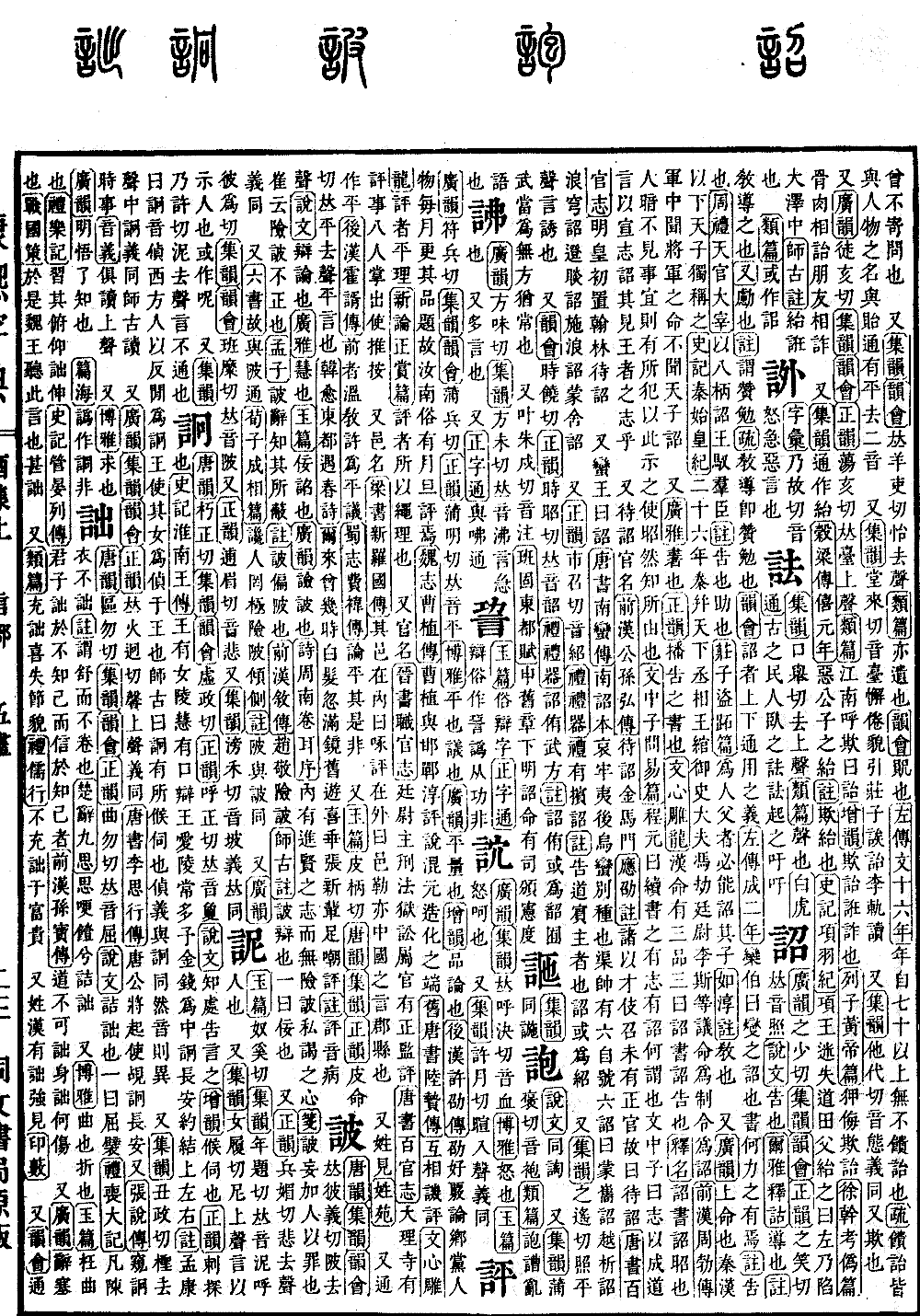
評
Kangxi stroke count: 12
Page 1155, Entry 01
Pronounced píng.
Broad Rimes (Guangyun): To evaluate, to discuss.
Collection of Rimes (Jiyun), Rhyme Anthology (Yunhui): To evaluate.
Correct Rimes (Zhengyun): To evaluate.
Explanatory Notes (Boya): To level; to discuss.
Broad Rimes (Guangyun): To measure evenly.
Expanded Rimes (Zengyun): To grade and comment.
History of the Later Han (Hou Hanshu), Biography of Xu Shao: Shao enjoyed critically discussing the people of his native region. Every month he would change their grading and commentary; thus, the customs of Runan included the Monthly Evaluations.
Records of Wei (Weizhi), Biography of Cao Zhi: Cao Zhi and Handan Chun discussed and evaluated the beginnings of the primordial creation.
Old Book of Tang (Jiu Tangshu), Biography of Lu Zhi: To mutually criticize and evaluate.
The Literary Mind and the Carving of Dragons (Wenxin Diaolong): To evaluate is to level the principles.
New Treatises (Xinlun), Chapter on Correct Rewards: To evaluate is that by which one aligns with reason.
Also, a title for an official position.
History of Jin (Jinshu), Treatise on Official Posts: The Commandant of Justice managed legal cases; subordinate officials included the Zheng, the Jian, and the Ping.
Book of Tang (Tangshu), Treatise on Official Posts: The Court of Judicial Review had eight evaluators (pingshi), who were responsible for dispatching envoys to investigate and judge.
Also, the name of a town.
Book of Liang (Liangshu), Account of the Silla Kingdom: Their towns located inside were called Zhuoping, and those outside were called Yile, which are equivalent to the commanderies and counties of the Central Kingdom.
Also, a surname; see Surname Garden (Xingyuan).
Also, used interchangeably with ping.
History of the Later Han (Hou Hanshu), Biography of Huo Xu: Previously, the Master's teaching allowed for impartial discussion.
Records of Shu (Shuzhi), Biography of Fei Yi: To discuss and impartially judge right and wrong.
Also, Jade Chapters (Yupian): Pronounced bìng (falling tone).
Tang Rimes (Tangyun), Collection of Rimes (Jiyun), Correct Rimes (Zhengyun): Pronounced bìng (falling tone).
To speak critically.
Han Yu, Poem on Meeting Spring in the Eastern Capital: How much time has passed since then; white hair suddenly fills the mirror. Old friends are happy to be eccentric, the new generation is full of mockery and criticism.
Commentary: Ping is pronounced bìng (falling tone). Zhang refers to being eccentric.