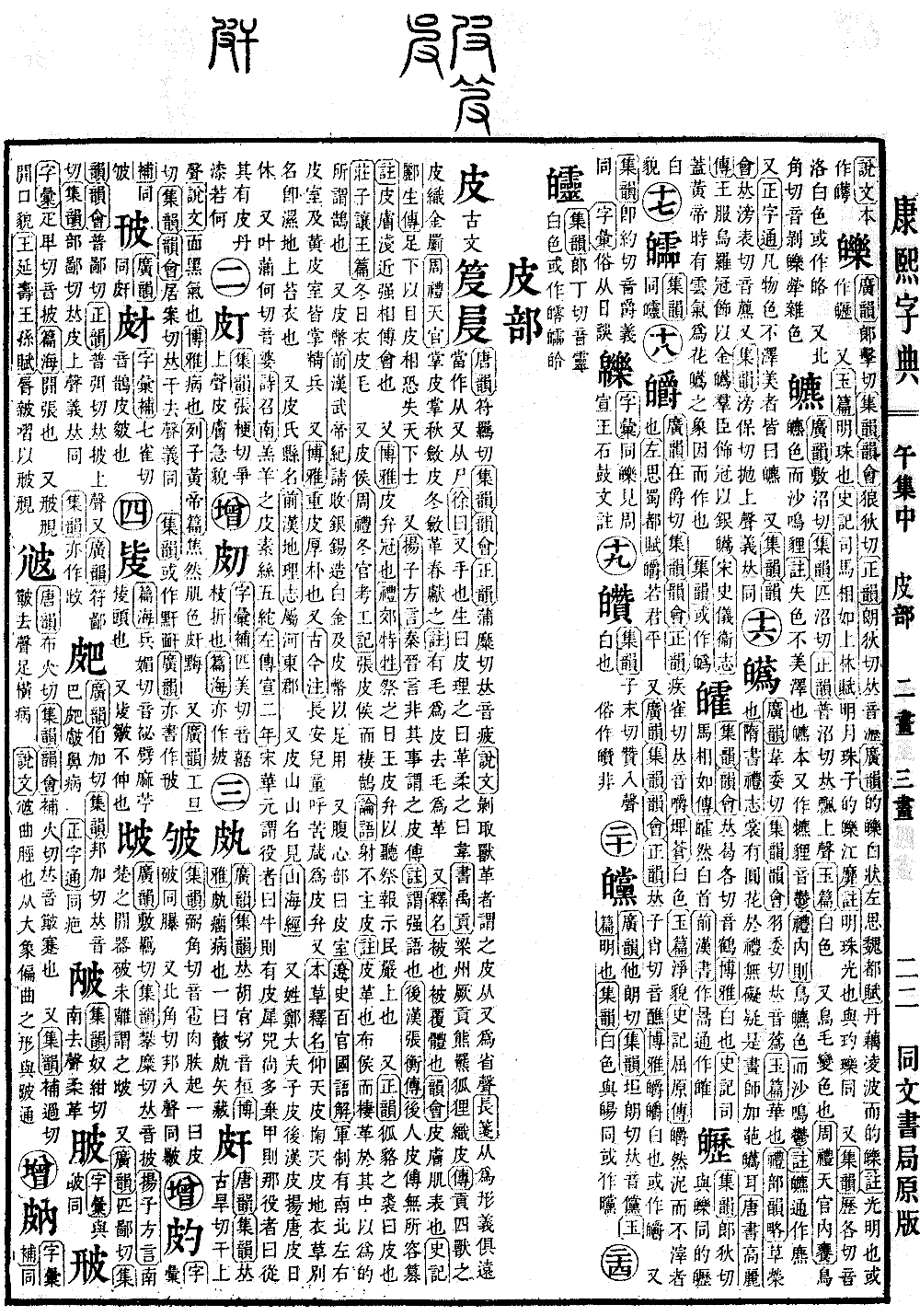
Wu Collection, Middle Volume
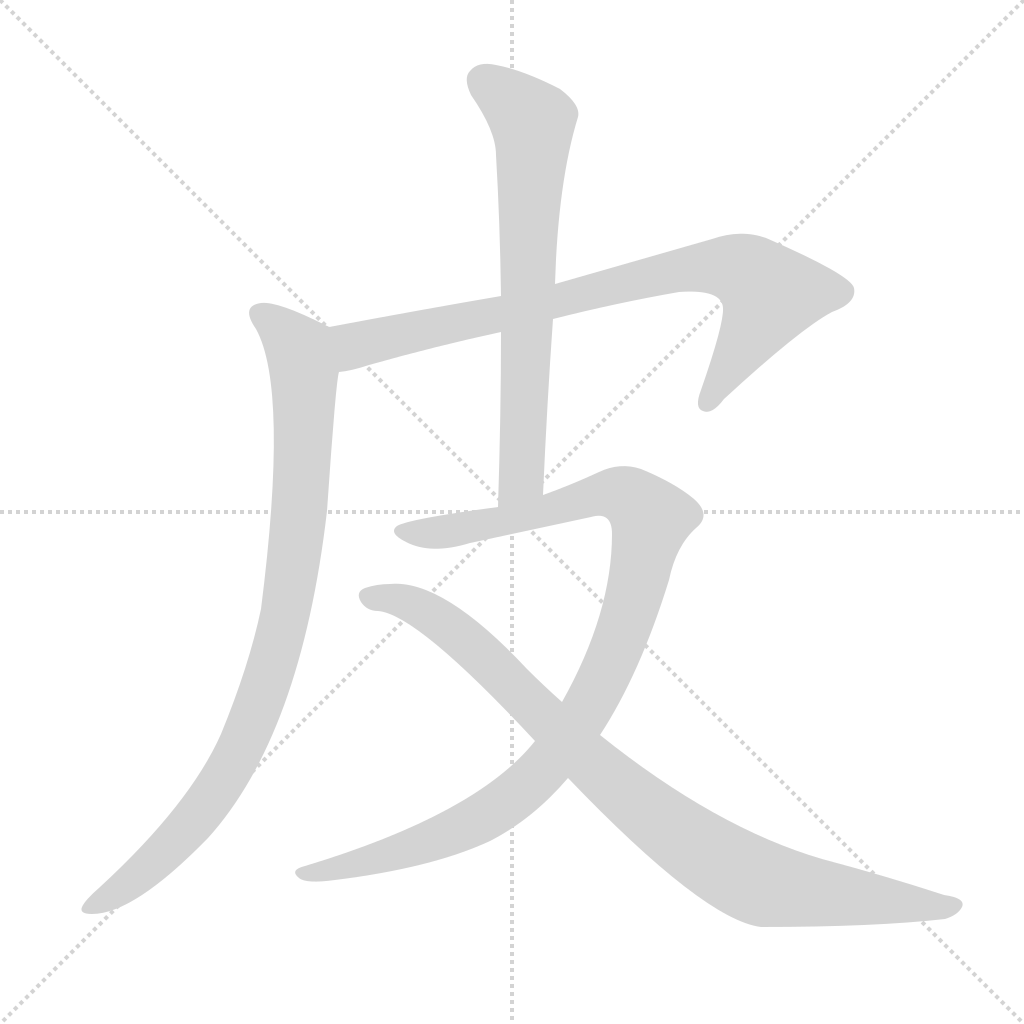
Radical: Skin (pí)
Kangxi Strokes: 5
Page 790, Entry 12
Ancient form. Tang Rhymes (Tangyun): Pronounced pi. Collected Rhymes (Jiyun), Rhyme Meetings (Yunhui), Correct Rhymes (Zhengyun): Pronounced pi. Meaning: Tired.
Shuowen (Explaining Graphs and Analyzing Characters): To peel or strip animal hide is called skin. Composed of hand and a contracted phonetic element.
Long Jian (Long Commentary): The composition is distant in form and meaning. It should be composed of hand and corpse.
Xu says: Hand signifies the hand. When fresh, it is called skin; when processed, it is called leather; when softened, it is called tanned leather.
Book of Documents (Shujing), Tribute of Yu (Yugong): In Liangzhou, the tribute consisted of bear, brown bear, fox, and raccoon skins, and woven pelts.
Commentary: The tribute consisted of the skins of these four beasts and woven decorative fabrics.
Rites of Zhou (Zhouli), Offices of Heaven (Tianguan): The Supervisor of Skins collects skins in autumn and leather in winter, presenting them in the spring.
Note: If it has hair, it is called skin; when hair is removed, it is called leather.
Also, Explaining Names (Shiming): To cover; meaning to cover the body.
Rhyme Meetings (Yunhui): Skin, the surface of the flesh.
Records of the Grand Historian (Shiji), Biography of Li Sheng: If you judge others by their skin alone, you may lose the scholars of the world.
Also, Yangzi's Regional Dialect (Fangyan): In the Qin and Jin regions, referring to things that are not true is called skin-transmission.
Note: Meaning to force an argument.
Book of the Later Han (Hou Hanshu), Biography of Zhang Heng: Later generations use skin-transmission, with no room for manipulation.
Note: Shallow and superficial, forcibly attaching meaning.
Also, Guangya (Broad Refinements): Skin refers to a ceremonial cap.
Book of Rites (Liji), Suburban Sacrifice and the Sacrificial Animals (Jiaotesheng): On the day of the sacrifice, the King wears a deerskin cap to listen to the report of the sacrifice, showing the people the solemnity of the event.
Also, Correct Rhymes (Zhengyun): A cloak of fox or raccoon fur is called skin.
Zhuangzi, Yielding the Kingly Way (Rangwang): In winter, wear fur clothing.
Also, Skin Target. Rites of Zhou (Zhouli), Winter Offices (Dongguan Kaogongji): Stretching a skin target to serve as a resting place for the central mark.
Analects (Lunyu): Archery does not prioritize the skin.
Note: Skin is leather. A cloth target is set up with leather at the center to serve as the mark, which is the so-called target center.
Also, Skin Currency. Book of Han (Hanshu), Annals of Emperor Wu: Requesting the collection of silver and tin to manufacture white gold and skin currency to satisfy expenditures.
Also, The headquarters of the inner guard is called the Skin Chamber. History of Liao (Liaoshi), Explanation of National Terms for Officials: The military system included North, South, Left, and Right Skin Chambers, as well as the Yellow Skin Chamber, all of which commanded elite troops.
Also, Guangya: Heavy skin refers to magnolia bark.
Also, Records of Old and New (Gujinzhu): Children in Chang'an call the bladder cherry a skin cap.
Also, Materia Medica (Bencao), Explaining Names: Facing-heaven, skin-cupped, heavenly skin, and earthly clothing are other names for moss. It is the moss that grows on damp ground.
Also, Pishi, name of a county. Book of Han (Hanshu), Treatise on Geography: Belonged to Hedong Commandery.
Also, Mount Pi, name of a mountain. See Classic of Mountains and Seas (Shanhaijing).
Also, a surname. Zi Pi, a dignitary of Zheng; Pi Yang of the Later Han; Pi Rixiu of the Tang Dynasty.
Also, Rhyming as po: Pronounced po.
Book of Odes (Shijing), Odes of Shao and Nan (Shaonan): The skin of the lamb, with five bands of white silk.
Zuo Commentary (Zuo Zhuan), Second Year of Duke Xuan: Hua Yuan of Song said to the laborers, If there is cow skin, there is still plenty of rhinoceros and bison skin; if we abandon our armor, what then? The laborers replied, Following the fact that there is skin, what of the red lacquer?