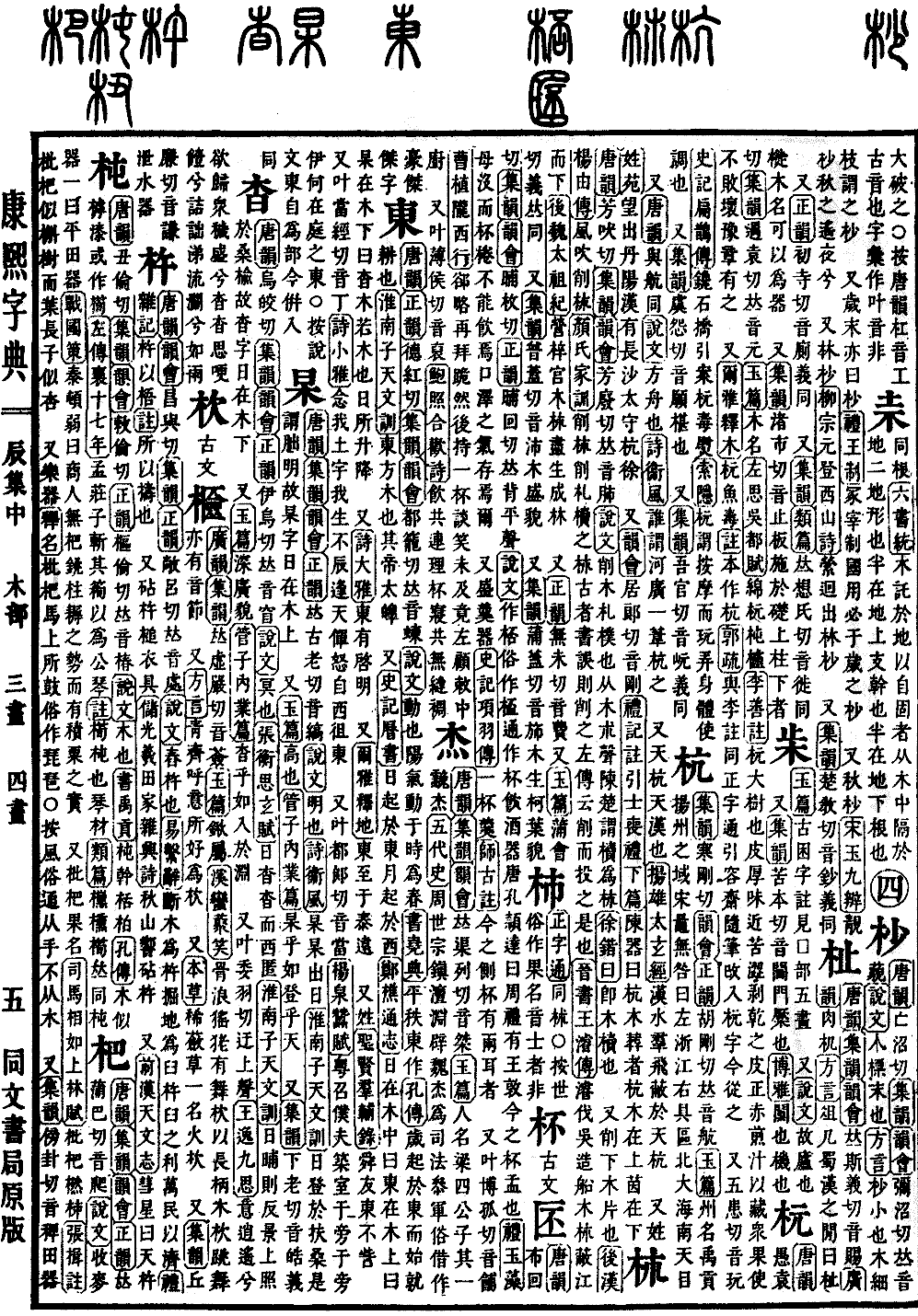
Chen Collection, Middle Volume
Radical: Tree (mù)
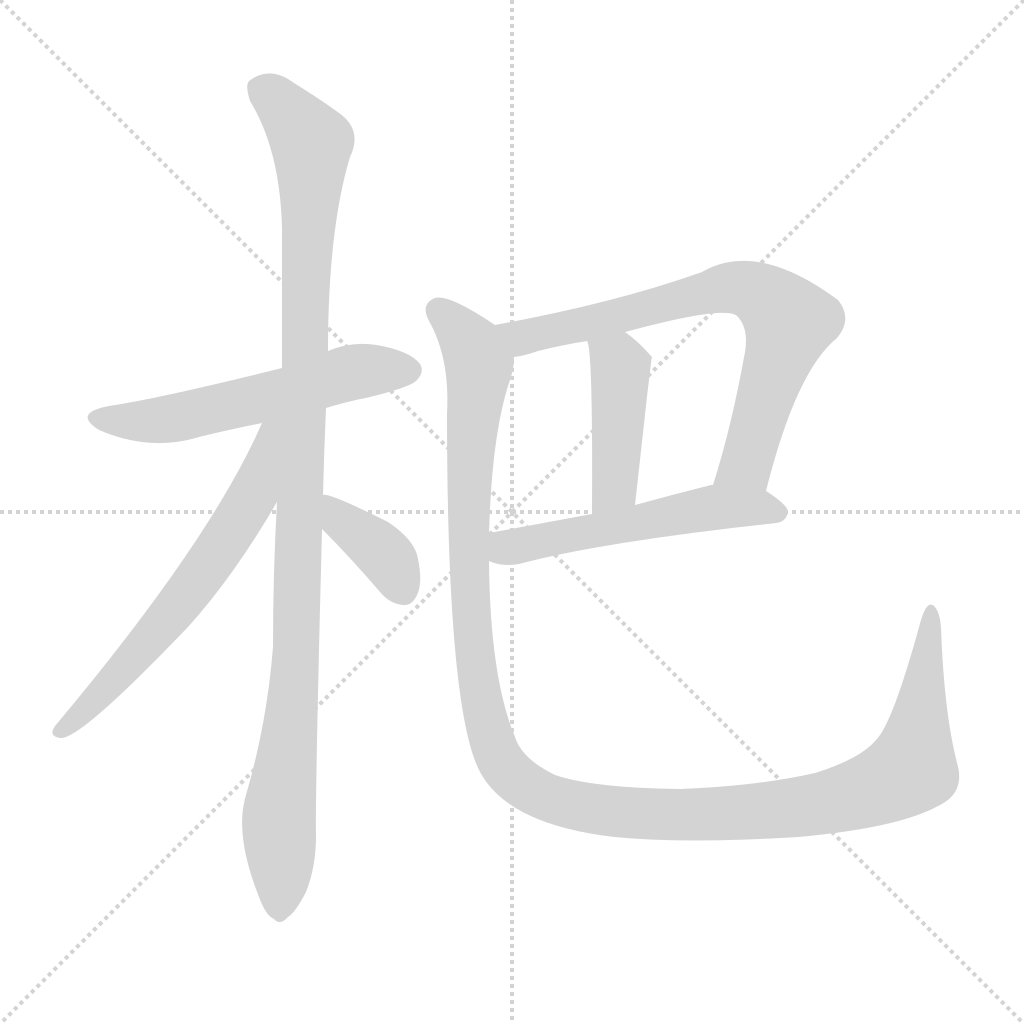
Pa
Kangxi Stroke Count: 8
Page 513, Entry 19
Pronounced pa. Pronunciation is the same as pa.
Shuowen Jiezi (Explaining Single-component Characters and Analyzing Compound Characters) defines this as a tool for gathering wheat. Another interpretation describes it as an agricultural implement for leveling fields. In the Strategies of the Warring States (Zhanguo Ce), Dun Ruo of the State of Qin stated: Merchants do not possess the pa, the yao (sickle), the zhu (plow pole), or the nou (hoe), yet they have grain piled up like mountains.
It also refers to the loquat, a type of fruit. Sima Xiangru’s Rhapsody on the Shanglin Park (Shanglin Fu) mentions the pi-pa tree. Zhang Yi’s commentary explains: The loquat tree resembles the oak but has longer leaves, and its fruit resembles an apricot.
It also refers to a musical instrument. The Explanation of Names (Shiming) records: The pi-pa is an instrument played on horseback. It is commonly written with the variant character (pipa). According to the Comprehensive Account of Customs (Fengsu Tong), this character should be categorized under the Hand radical, not the Tree radical.
Also, the Jiyun (Collection of Rhymes) notes the pronunciation as bang, same as the pronunciation of the character for a side or a square. It refers to a tool used in the fields. It is also noted with the pronunciation as bai, with the same meaning.
Additionally, the Yunhui (Collection of Rhymes) records that it is the same as the character ba (handle). It refers to the handle of an object or tool. The Book of Jin (Jin Shu), Biography of Wang Meng, records: After Wang Meng passed away, Liu Tan placed a fly-whisk with a rhinoceros horn handle into his coffin.