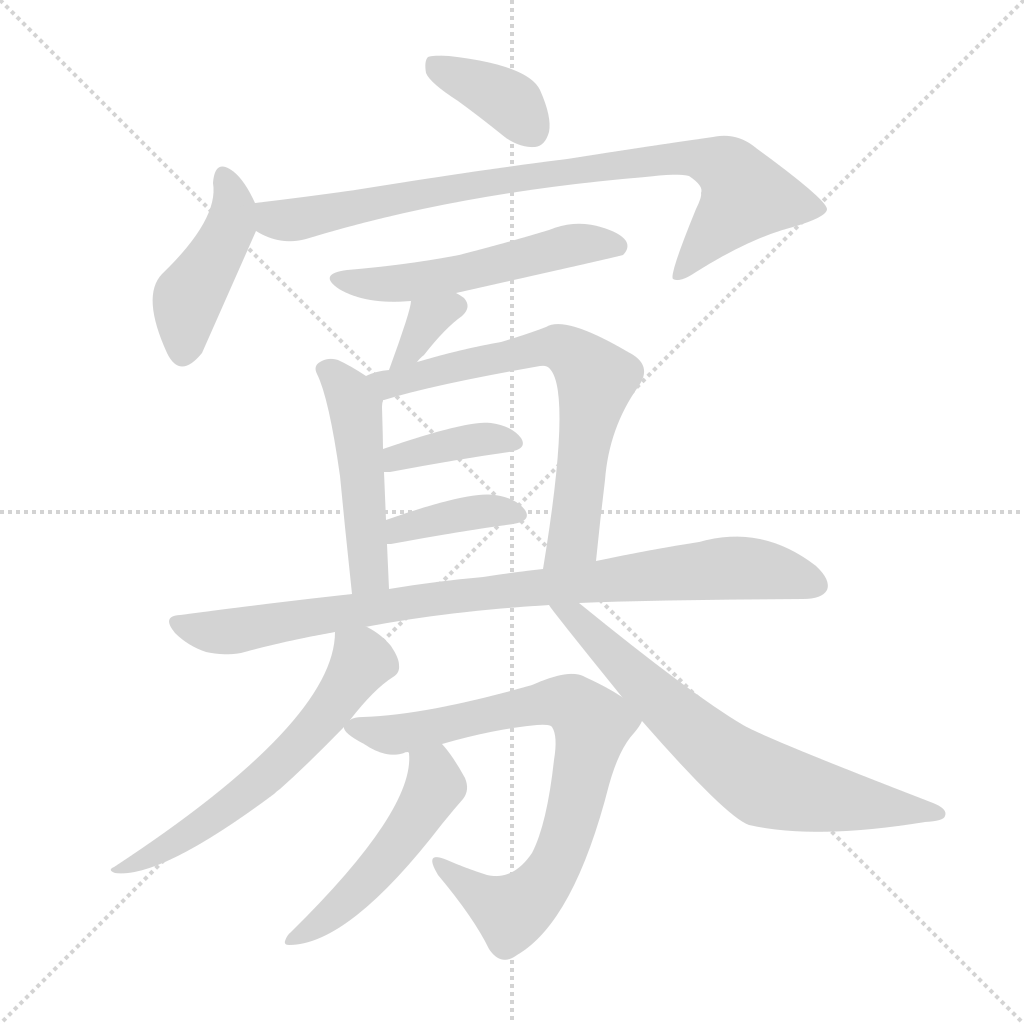
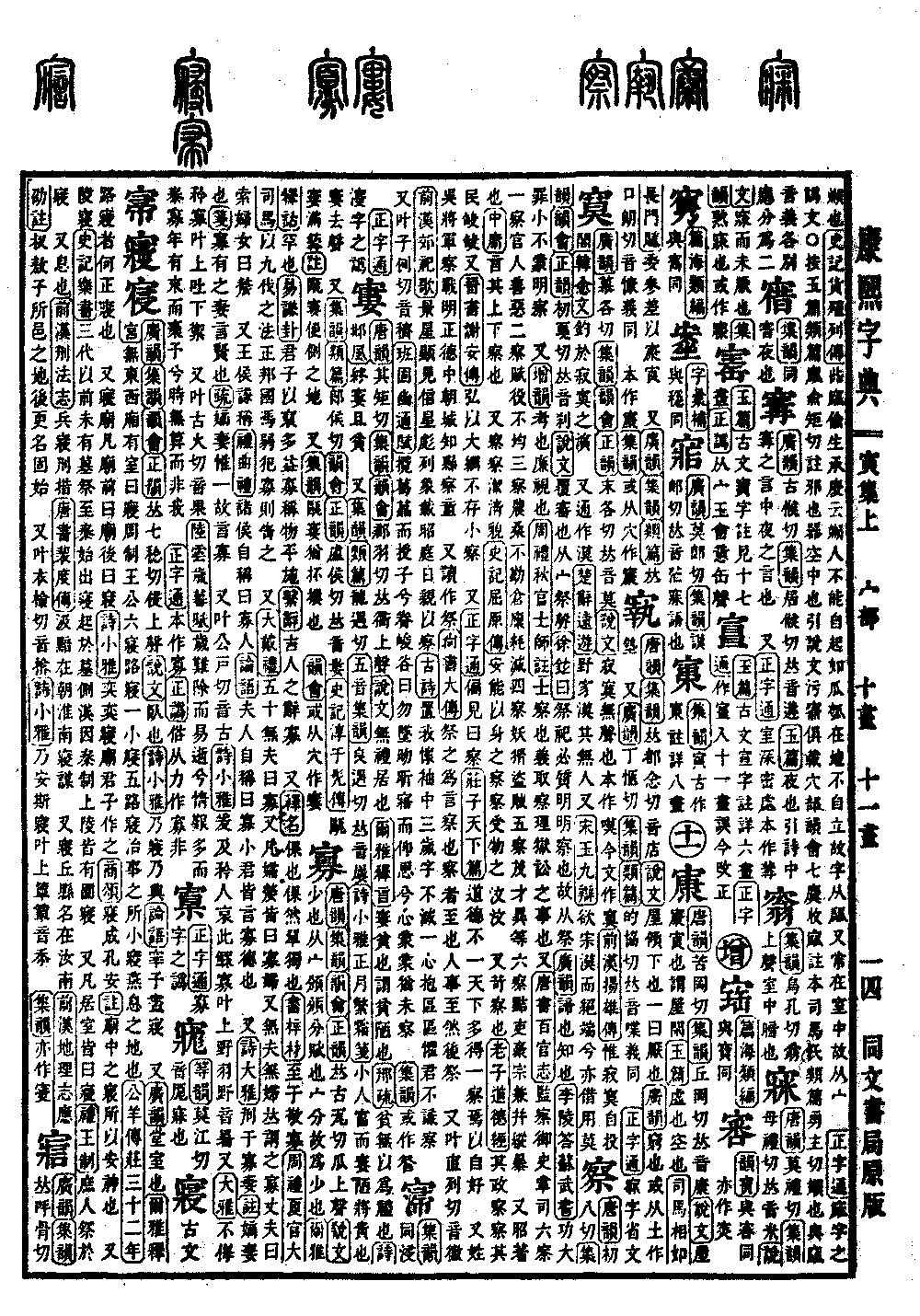
Yin Collection, Upper Volume
Radical: Roof (bù)
14 strokes
Page 290, Entry 19
Pronounced gua (rising tone).
According to the Shuowen Jiezi (Explaining Single-component Characters and Analyzing Compound Characters), it means few. The character is composed of the radical for roof and the element representing distribution. Distribution means to divide and bestow. Bestowing items beneath a roof leads to a reduction in quantity.
The Erya (Approaching Elegance) defines it as rare.
Book of Changes (Yijing), Hexagram of Humility: The noble person takes the surplus to supplement the deficit, weighing matters fairly to bestow.
Appended Statements (Xici): The fortunate person speaks little.
It is also defined in the Shiming (Explanations of Names) as lonely, or being all alone.
Book of Documents (Shangshu), Timber of the Catalpa (Zicai): To the point of respecting those who are alone and few.
Rites of Zhou (Zhouli), Summer Offices, Grand Marshal: Use the nine categories of punitive regulations to rectify the feudal states; if any bully the weak or infringe upon the few, then launch a punitive expedition against them.
Dai's Record of Rites (Da Dai Liji): A woman of fifty years who has no husband is termed gua.
All widows are referred to as widows. One without a spouse is also termed gua. A man without a wife is called suo, and a woman without a husband is called li.
It is used as a humble self-reference for kings and feudal lords.
Book of Rites (Liji), Summary of the Rules of Propriety (Quli): Feudal lords refer to themselves as the lonely person (guaren).
Analects (Lunyu): When referring to the wife of the ruler of one's own state to a foreign state, she is called the humble consort (gua xiaojun); both usages imply that one's own virtue is sparse.
Book of Odes (Shijing), Greater Odes: Concerning the principal wife. Commentary notes: Principal wife. Note: The one and only wife, emphasizing her virtuous nature. Sub-commentary: There is only one principal wife, therefore she is referred to as gua.
Alternatively pronounced gu. Book of Odes (Shijing), Lesser Odes: Extending kindness to the poor and distressed, showing pity to these widowers and widows. This rhymes with the preceding character ye (pronounced shu).
Also appears in the Greater Odes: Do not bully the widowers and those who are few. This rhymes with the preceding character tu and the following character yu.
Alternatively pronounced guo. Lu Yun, Rhapsody on the End of the Year: The years are difficult to retain yet easy to lose; emotionally, there are many difficulties and little peace. The passage of time comes only to abandon me; the flow of time cannot be calculated, yet none of it belongs to me.
Correct Character Guide (Zhengzitong): The original form is written as gua.
Rectification of Errors (Zheng'e): The common form of the character written with the power radical at the bottom is incorrect. The character gua is correctly written with the distribution element at the bottom.
Textual research: In the Analects, the wife of the ruler of one's own state is referred to as the humble consort when speaking to a foreign state. Revised according to the original text.