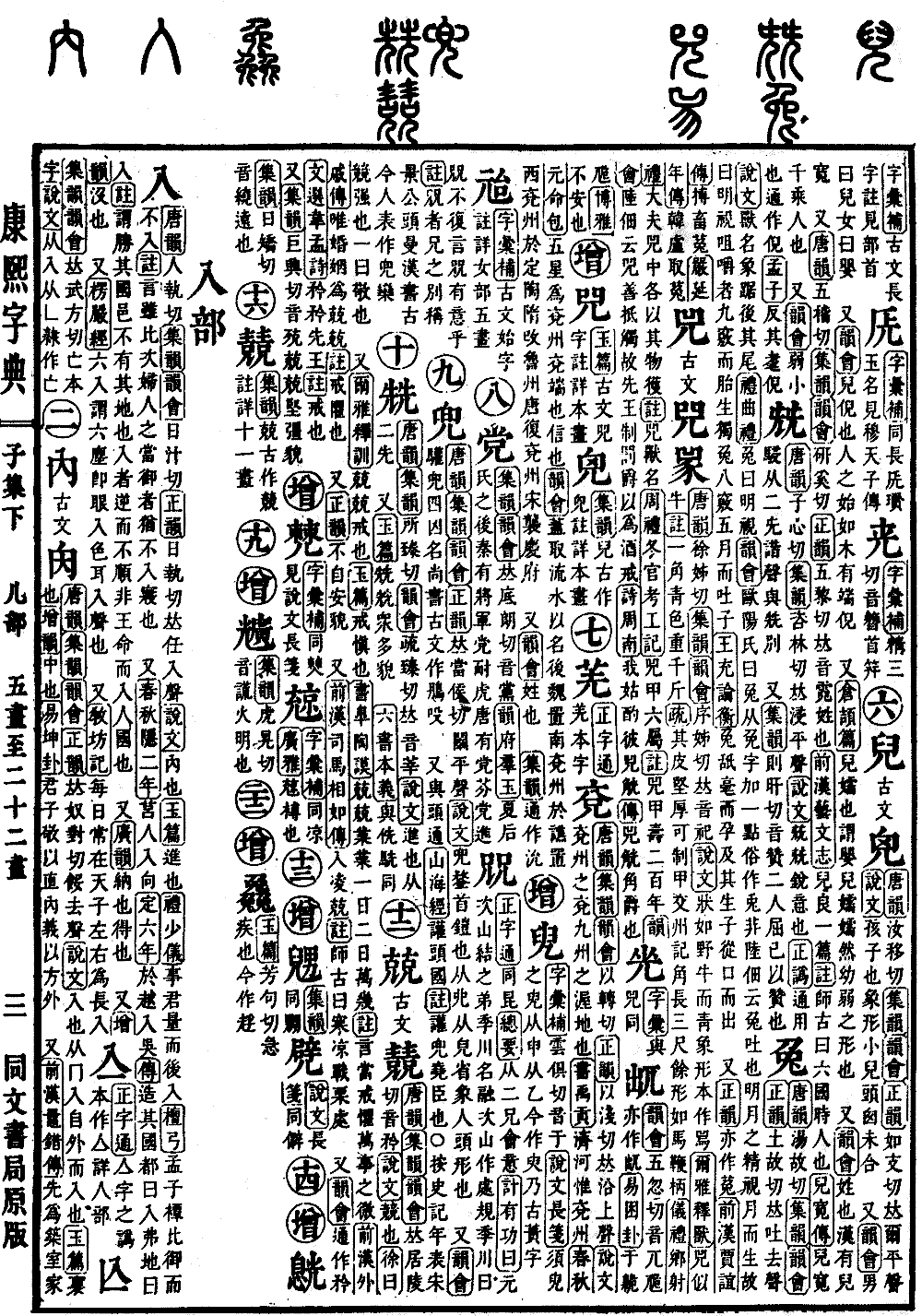
Zi Collection, Page Position: Lower
Radical: Enter (rù)
Kangxi Strokes: 4
Page 125, Entry 35
Pronounced nei (falling tone).
Shuowen Jiezi (Explanation of Simple and Compound Characters): It means to enter. The character is composed of the radical for wide enclosure and the radical for enter, indicating movement from the outside to the inside.
Yupian (Jade Chapters): It means interior or inside.
Zengyun (Expanded Rhymes): It carries the meaning of middle or center.
Book of Changes (Yijing), Kun Hexagram: The superior person uses respect to rectify their inner heart and righteousness to regulate their external behavior.
History of the Former Han (Qian Hanshu), Biography of Chao Cuo: First construct houses for them, providing one hall and two inner rooms. Annotation: Two inner rooms refers to the two interior chambers.
Yunhui (Collection of Rhymes): A chamber or room is called nei. The restricted quarters of the emperor are called nei. Under the Han system, the area inside the emperor's palace was called xingnei, where nei is synonymous with the forbidden central quarters. During the Tang dynasty, there were the Three Nei: the Imperial City was located in the northwest corner of Chang'an and called the West Nei; the East Nei was the Daming Palace, located to the east of the West Nei; the South Nei was the Xingqing Palace, located to the south of the East Nei.
There is also the term Five Nei, referring to the five viscera.
Records of the Three Kingdoms (Weizhi), Annotation to the Biography of Wang Jun: Hearing the order, one is shocked and terrified, as if the five viscera and six entrails have lost their support.
There is also the official title Zhi Nei. Records of the Rites of Zhou (Zhouli), Annotation to the Heaven Officials: Zhi Nei is an official in charge of receiving and storing. Similar to contemporary offices managing currency receipts, which are called Shao Nei.
There is also the place name Henei. Records of the Rites of Zhou (Zhouli), Summer Officials, Shifangshi: The Henei region is called Jizhou, and its mountain guardian is Mount Huo.
Pronounced rui (falling tone). Same as the character for a river confluence. Sometimes written in a variant form (neì).
Same as the character for a mortise and tenon joint (rui). Records of the Rites of Zhou (Zhouli), Winter Officials, Kao Gong Ji: Adjust the mortise to insert the tenon and bind them together.
Pronounced na (entering tone). Same as the character for to accept or insert (na). Mencius: As if he himself had pushed him into the ditch.
Verification: In the Records of the Rites of Zhou, Summer Officials, Shifangshi, the text reads Jibei. It is noted that the original text has been corrected to Jizhou.