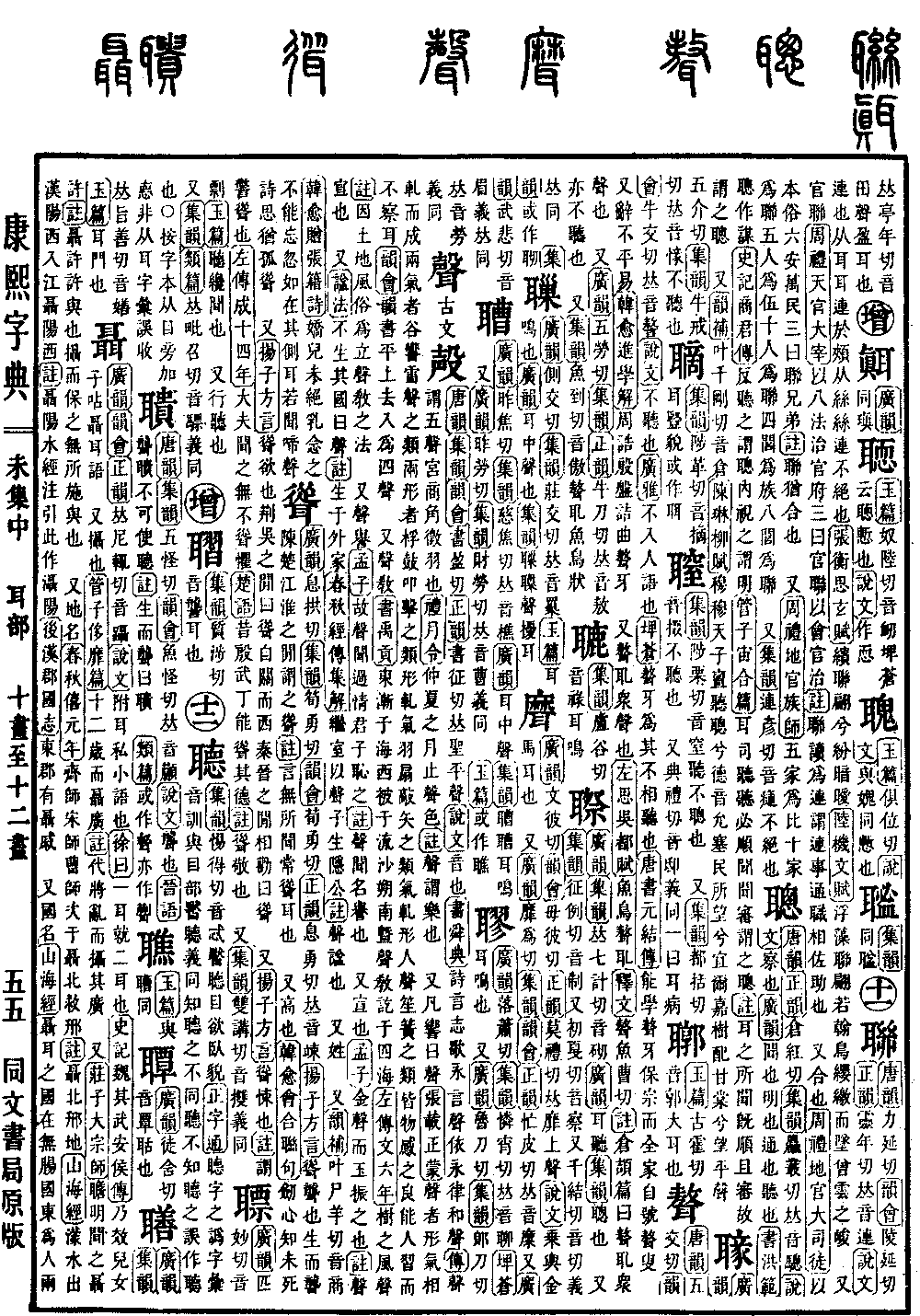
Wei Collection, Middle Volume
Radical: Ear (ěr)
Nie
Kangxi stroke count: 18
Page 969, Entry 28
Guangyun (Comprehensive Rhymes), Yunhui (Collection of Rhymes), and Zhengyun (Correct Rhymes) all state the pronunciation is nie (entering tone), which is the same as the pronunciation of the word for treading.
Shuowen (Explaining Graphs and Analyzing Characters) defines this as speaking in a low voice close to someone's ear.
Xu says it refers to one ear drawing near to another.
Records of the Grand Historian (Shiji), Biography of Marquis Weiqi and Wu'an: Eventually imitating the behavior of women and children, whispering into one another's ears.
It also carries the meaning of gathering or aggregating.
Guanzi, Essay on Extravagance: After twelve years, the scope expanded.
Commentary: When a dynasty is about to fall into chaos, one should gather in its reach.
Zhuangzi, Great and Venerable Teacher: Zhanming heard this and expressed agreement.
Commentary: Nie-xu means to agree. It implies gathering something and maintaining it, rather than imposing it externally.
It is also a place name.
Spring and Autumn Annals (Chunqiu), First Year of Duke Xi: The armies of Qi, Song, and Cao stationed at Niebei to rescue the state of Xing.
Commentary: Niebei is a location within the state of Xing.
Classic of Mountains and Seas (Shanhaijing): The Meng River originates in Hanyang and flows west into the area west of Nieyang.
Commentary: Regarding Nieyang, the Commentary on the Water Classic (Shuijing Zhu) cites this text as Sheyang.
Book of the Later Han (Hou Hanshu), Treatise on Commanderies and Kingdoms: There is Nieqi in Dong Commandery.
It is also the name of a state.
Classic of Mountains and Seas (Shanhaijing): The state of Nie'er (Ear-hanging) lies east of the Wuchang (No-intestines) state, where the people use their hands to hold up their long ears.
Commentary: This refers to ears that are so long that the people must use their hands to gather them while walking.
It is also a surname.
Records of the Grand Historian (Shiji), Biographies of Assassins: Nie Zheng was a man from Shenjing in the Zhi region.
Genealogy of Surnames (Xingpu): A grand master of the state of Chu held a fief in Nie, and thus adopted Nie as a surname.
It is also a personal name.
Records of the Grand Historian (Shiji), Biographies of Assassins: Jing Ke once traveled through Yuci and discussed swordsmanship with Gai Nie.
Commentary: The Suoyin (Search for Hidden Meanings) states: Gai is the surname, and Nie is the personal name.
Jiyun (Collection of Rhymes) notes the pronunciation is ri-she (entering tone), the same as the pronunciation of the word for whispering. It also means to speak privately.
Zhengzitong (True Character Guide) notes the pronunciation is zhi-she (entering tone). It is the same as the character for thinly sliced meat.
Book of Rites (Liji), Lesser Rules of Deportment: Raw beef, mutton, and fish should be sliced thinly and then minced into sashimi.
Commentary: The meaning of nie here is to slice like wood shavings. One first cuts it into thin slices like a bean leaf, then repeatedly minces it to create sashimi.
Jiyun (Collection of Rhymes) notes the pronunciation is yi-she (entering tone), the same as the pronunciation of the word for leaf. It is equivalent to the character for moving or fluttering.
Also pronounced zhi-she (entering tone), the same as the pronunciation of the word for glistening. It means to close or fold.
Erya (Approaching Elegance), Explaining Trees: The shou-gong (palace-guarding) pagoda tree has leaves that close during the day and open at night.
Commentary: Pagoda tree leaves that close during the day and open at night are called shou-gong pagoda trees. Nie is pronounced zhe (entering tone).
Also pronounced shi-she (entering tone), the same as the pronunciation of the word for wading. It is equivalent to the character for a type of climbing plant.
Also pronounced chi-she (entering tone), the same as the pronunciation of the word for shaking. It refers to the appearance of leaves shaking.