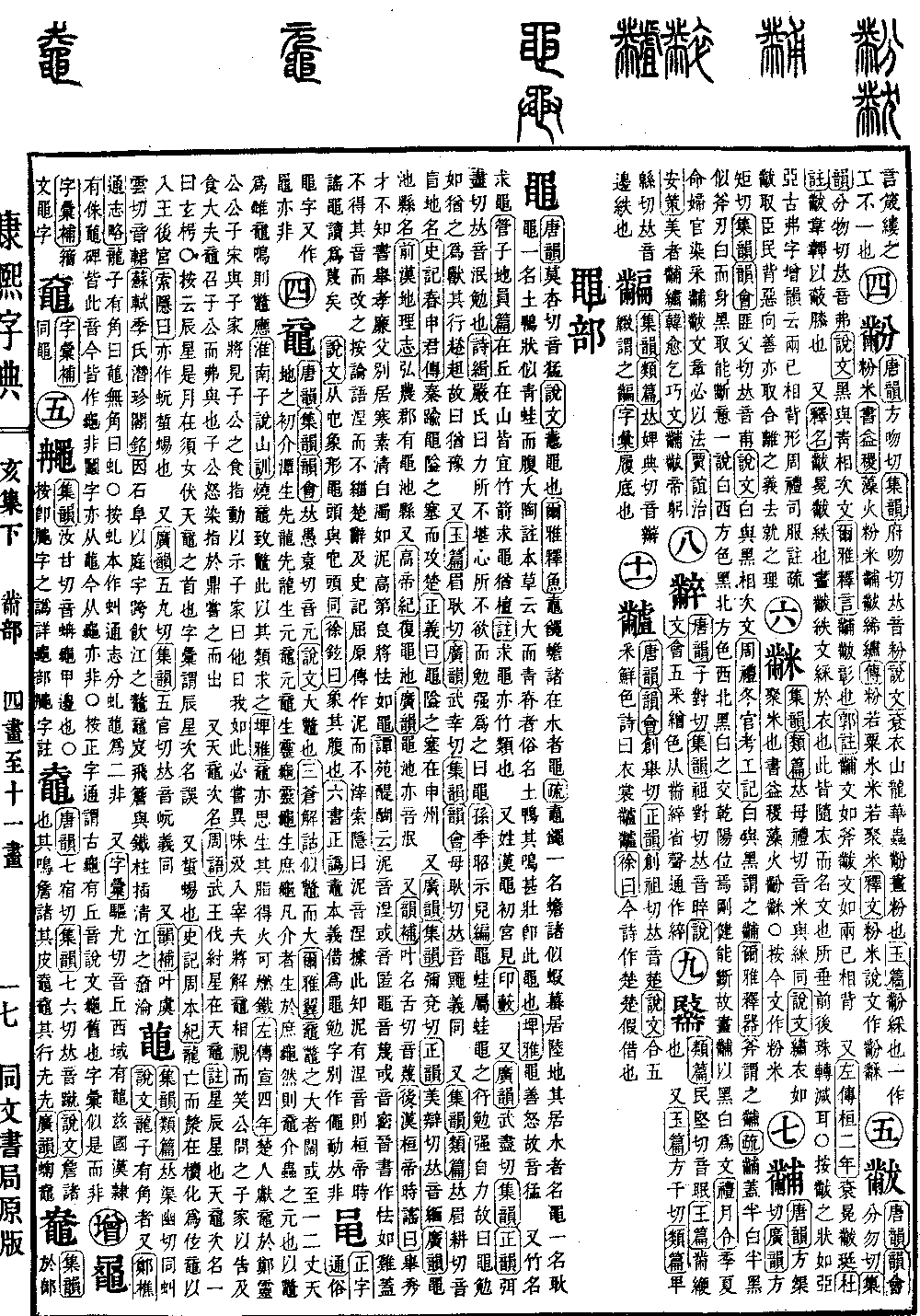
Hai Collection, Lower Volume
Radical: Frog (mǐn)
Kangxi strokes: 13
Page 1523, Entry 09
Pronounced meng (falling tone).
Explaining Characters and Phrases (Shuowen Jiezi): Refers to a type of amphibian.
Literary Expositor (Erya): Mentions the term quchan (a toad-like creature); those that live in water are called min.
Commentary: Explains that qu, also known as chanzhu, resembles a toad and lives on land; those that live in water are called min. Also known as gengmin. Also known as tuya (earth duck). It is shaped like a frog but has a larger belly. Tao Hongjing, in his annotations to the Materia Medica (Bencao), states: Those that are large in size with green backs are commonly called earth ducks. Their croaking is very loud; this is the min referred to here.
Expanded Odes (Piya): States that the min is easily provoked to anger, hence the pronunciation is the same as meng.
Also refers to a type of bamboo called qiumin.
Master Guan (Guanzi): Land Resources section states: In hilly and mountainous areas, it is suitable for growing arrow bamboo, qiumin, and sandalwood.
Annotation: Explains that qiumin is also a type of bamboo.
Also a surname. There was a Min Chugong during the Han Dynasty, as seen in the Collection of Seals (Yinsou).
Pronounced min (rising tone).
Meaning: To strive or exert effort.
Collected Explanations of the Odes (Shiji): Mr. Yan says: When one's strength is insufficient and one's heart is unwilling, yet one exerts effort to do it, it is called min.
Sun Jizhao’s Notes (Sun Jizhao Shijian Bian): States that min is a type of frog. The movement of a frog is a forced exertion, hence the term minmian (striving). Just as the you is a type of beast that hesitates and does not advance, hence the term youyu (hesitation).
Pronounced meng (rising tone).
Same meaning as above.
Pronounced mang.
Refers to a place name.
Records of the Grand Historian (Shiji): Biography of Lord Chunshen records: The State of Qin crossed the Minai Pass to attack the State of Chu.
Orthodox Meaning (Zhengyi): States that the Minai Pass is in Shen Prefecture.
Pronounced mian (rising tone).
Minchi is the name of a county.
History of the Former Han (Qianhan Dili Zhi): Hongnong Commandery had Minchi County.
Annals of Emperor Gao (Gaodi Ji): Mentions returning to Minchi.
Minchi is also pronounced as min (rising tone).
Rhyme Supplement (Yunbu): Rhyming variant pronounced mie (entering tone).
Folk song from the time of Emperor Huan of the Latter Han: The recommended scholar of talent (xiucai) does not know how to read. The recommended filial and incorrupt (xiaolian) lives apart from his father. Those who claim to be poor and clean are as muddy as filth, and those who claim to be high-ranking generals are as cowardly as a min.
Tanyuan Tihu states: Mud is pronounced like nie (entering tone) or like ni (entering tone). Min is pronounced like mie (entering tone) or like mi (entering tone). The History of Jin (Jinshu) writes it as cowardly as a chicken, likely changing the character because the original pronunciation was misunderstood. According to the Analects of Confucius (Lunyu), there is the phrase neized (not blackened), and the Chu Elegies (Chuci) and Records of the Grand Historian (Shiji): Biography of Qu Yuan write it as muddy and not polluted. The Search for Hidden Meanings (Suoyin) says: Mud is pronounced like nie; based on this, one knows that mud has the pronunciation of nie, thus the min in the folk song of Emperor Huan’s time is pronounced as mie.
Explaining Characters and Phrases (Shuowen Jiezi): The character shape follows the component for a snake (tuo); it is a pictograph. The head of the min is the same as the head of the snake.
Xu Xuan’s commentary: It depicts the shape of its abdomen.
Six Scripts (Liushu Zhenge): The original meaning of the character for frog (wa), wrongly borrowed for the min in minmian. Sometimes written as [min] or [min]. These are incorrect. The original character for zhi (black) followed a specific radical. The character for snake (tuo) originally followed a simplified radical.