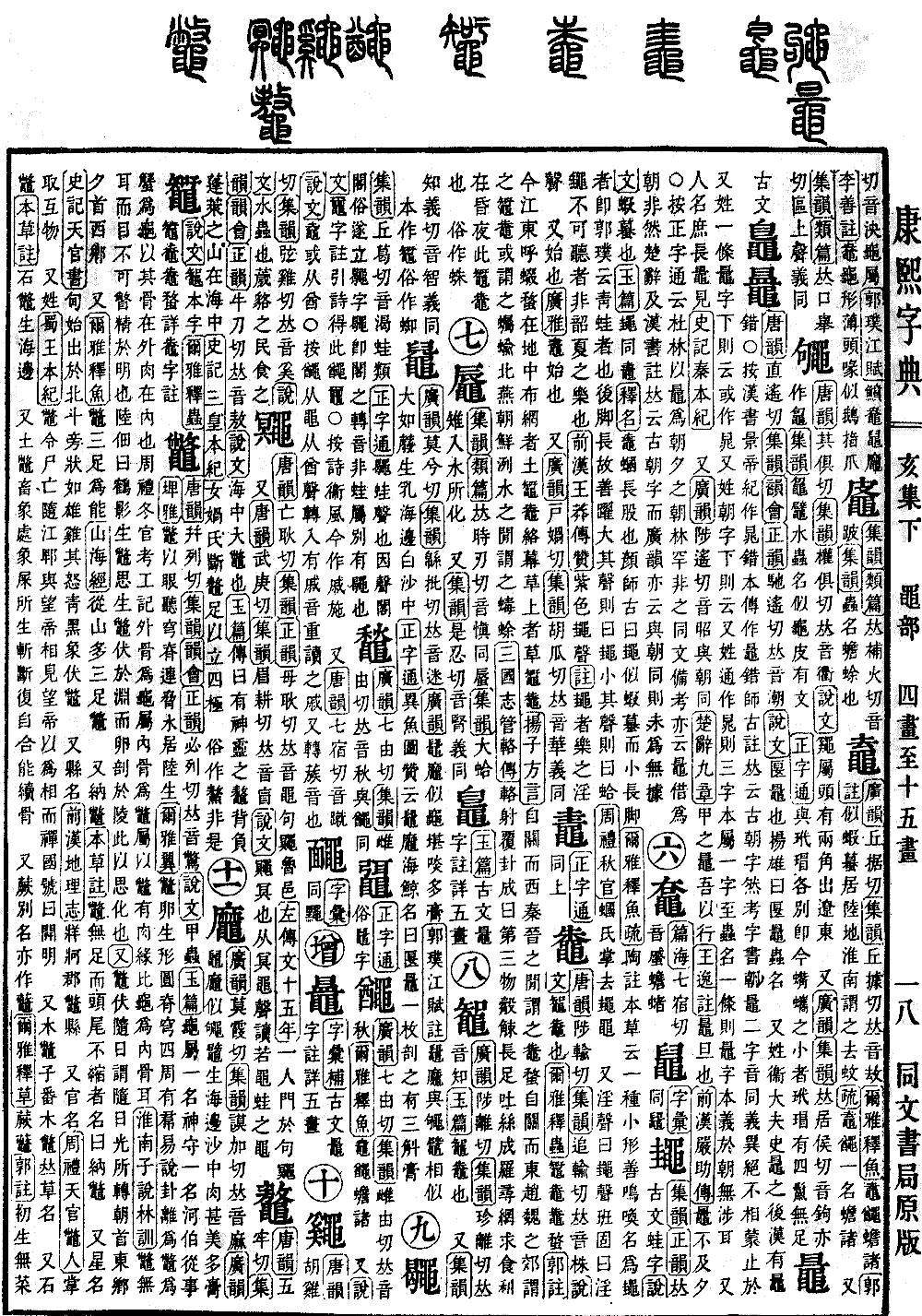
Hai Collection, Lower Volume
Radical: Frog (mǐn)
Kangxi Strokes: 18
Page 1524, Entry 04
According to Tang Rhymes (Tangyun), Collected Rhymes (Jiyun), Rhyme Meetings (Yunhui), and Orthodox Rhymes (Zhengyun), the pronunciation is chao. In the Explaining Graphs and Analyzing Characters (Shuowen), it refers to a certain insect. Yang Xiong states that this insect is a type of beetle. It is also used as a surname, descending from Shi Chao, a grand master of the State of Wei. During the Han dynasty, there was Chao Cuo. According to the Book of Han (Hanshu), specifically the Annals of Emperor Jing, it is written as Chao, while in the biographical section, it is written as Chao. Yan Shigu notes that it is the ancient form of the character for morning. However, an examination of dictionary texts shows that while the two characters are pronounced the same, they have different meanings and are entirely unrelated. Regarding the surname entry, it is noted that it is sometimes written as Chao. Under the entry for the surname Chao, it is noted that it is commonly written as Chao. Thus, these three characters were originally the same. As for the insect name, that is the original meaning of this character and is unrelated to the character for morning. It is also used in personal names, such as Shuzhang Chao, as seen in the Records of the Grand Historian (Shiji), Annals of Qin. According to the Broad Rhymes (Guangyun), the pronunciation is zhao, which is the same as the character for morning. In the Songs of Chu (Chuci), Nine Declarations (Jiuzhang), it says: My morning (zhao) is for my journey. Wang Yi comments: This refers to the early morning. In the Biography of Yan Zhu in the Former Han (Qianhan), it mentions an event occurring before evening. The Orthodox Character Guide (Zhenzitong) notes that Du Lin believed this character represented morning and evening, though Lin Han disagreed. The Preparation for Unified Characters (Tongwenbeikao) also states that using this character as a substitute for the character for morning is incorrect. However, the annotations in the Songs of Chu and the Book of Han suggest it is an ancient form of the character for morning, and the Broad Rhymes also equates it with the character for morning; therefore, this view is not without foundation.