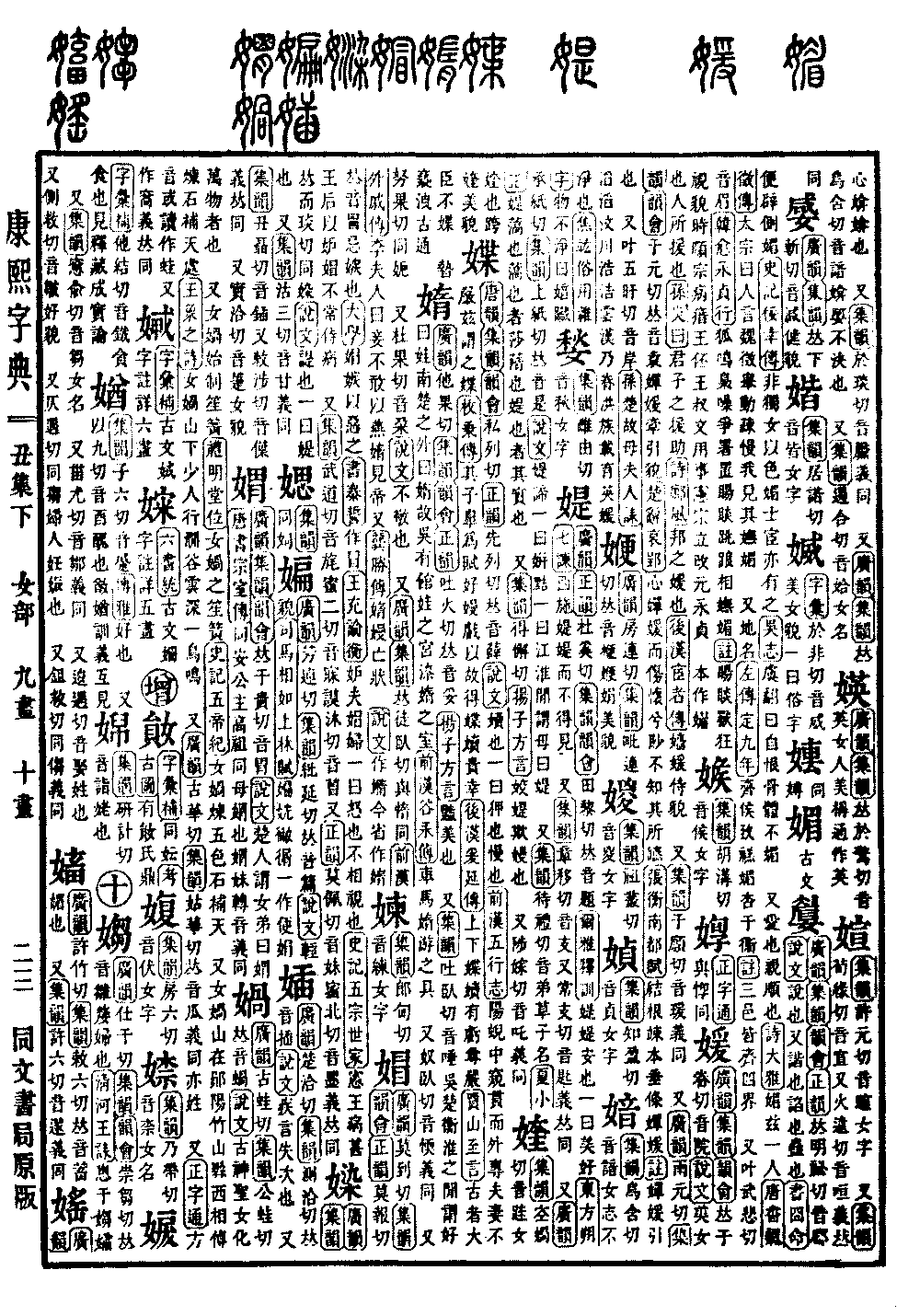
Chou Collection, Lower Volume
Radical: Woman (nǚ)
Mei
Kangxi strokes: 12
Page 267, Entry 07
Ancient script form
Broad Rhymes (Guangyun), Collected Rhymes (Jiyun), Rhyme Meetings (Yunhui), Correct Rhymes (Zhengyun): Pronounced mi (falling tone).
Explanation from Origins of Characters (Shuowen): To please. Also, to harmonize, to flatter, to bewitch.
Book of Documents (Shangshu), Charge to Jiong (Jiongming): Toadying, side-taking, and flattering.
Records of the Grand Historian (Shiji), Biography of Flatterers and Favorites: It is not only women who use beauty to please, but also official courtiers who do the same.
Annals of Wu (Wuzhi): Yu Fan said: I regret that my bone structure is not charming.
Also: To love, to be close and obedient.
Book of Odes (Shijing), Greater Odes (Daya): Loving this one person.
History of the Tang Dynasty (Tangshu), Biography of Wei Zheng: Emperor Taizong said: People say that Wei Zheng’s movements are coarse and slow, but I find him charming and elegant.
Also: A place name.
Zuo Tradition (Zuozhuan), Ninth Year of Duke Ding: The Marquis of Qi gave the places Zhuo, Mei, and Xing to the state of Wei.
Commentary: These three cities were all on the western border of Qi.
Also: Rhymes with wu bei, pronounced mei (level tone).
Han Yu, Song of Yongzhen (Yongzhenxing): Foxes cry and owls screech, fighting for appointments, glaring and leaping, charming and enchanting one another.
Commentary: Shan describes the wild, frantic look of a beast. At the time, Emperor Shunzong was ill and mute, and Wang Pi and Wang Shuwen were in power. When Emperor Xianzong ascended the throne, he changed the era name to Yongzhen. Originally written as the variant form.
Textual Research: Zuo Tradition (Zuozhuan), Ninth Year of Duke Ding: The Marquis of Qi gave the places Zhuo, Mei, and Xing to the state of Wei. Commentary: The three cities were all on the fourth border of Qi. Corrected to western border in accordance with the original text.