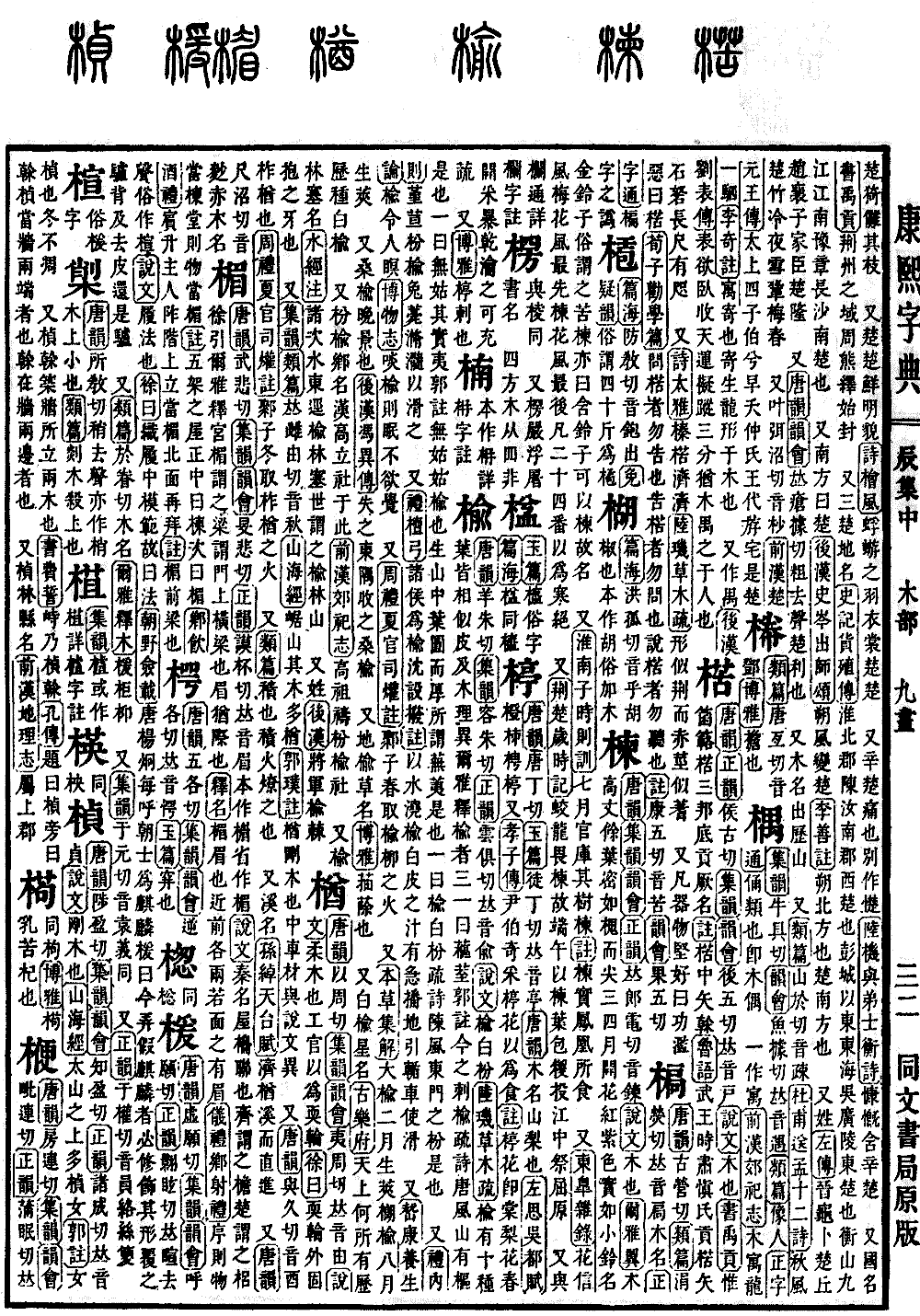
Chen Collection, Middle Volume. Radical: Tree (mù). Kangxi stroke count: 13. Page 540, Entry 14.
Pronounced mei. Originally written as mei. Simplified as mei. In the Shuowen Jiezi (Shuowen), it is noted that in the Qin region, the lintel of a house is called mei, in the Qi region it is called yan, and in the Chu region it is called lv. Xu cites the Erya: Explaining Dwellings (Erya), stating that mei is referred to as a beam, indicating the horizontal beam above a door. Mei is like an edge. In the Shiming (Shiming), it is stated: Mei is like an eyebrow. Those near the front are both called mei, as if there were eyebrows on a face. In the Book of Etiquette and Ceremonial (Yili): In the archery ritual, if in the side hall, the objects are aligned with the ridgepole; if in the main hall, they are aligned with the lintel. The commentary states: In a building with five rafters, the center is called the ridgepole, and the next is called the lintel. In the Book of Etiquette and Ceremonial: The guest ascends, and the host stands on the eastern steps, facing north below the lintel, and bows twice. The commentary states: Lintel refers to the front beam. The character for lintel is written with the component for eyebrow. Textual research: In the Book of Etiquette and Ceremonial, the guest ascends, and the host stands on the eastern steps, standing beneath the lintel, facing north and bowing twice. Carefully following the original text, the character for stand is removed.