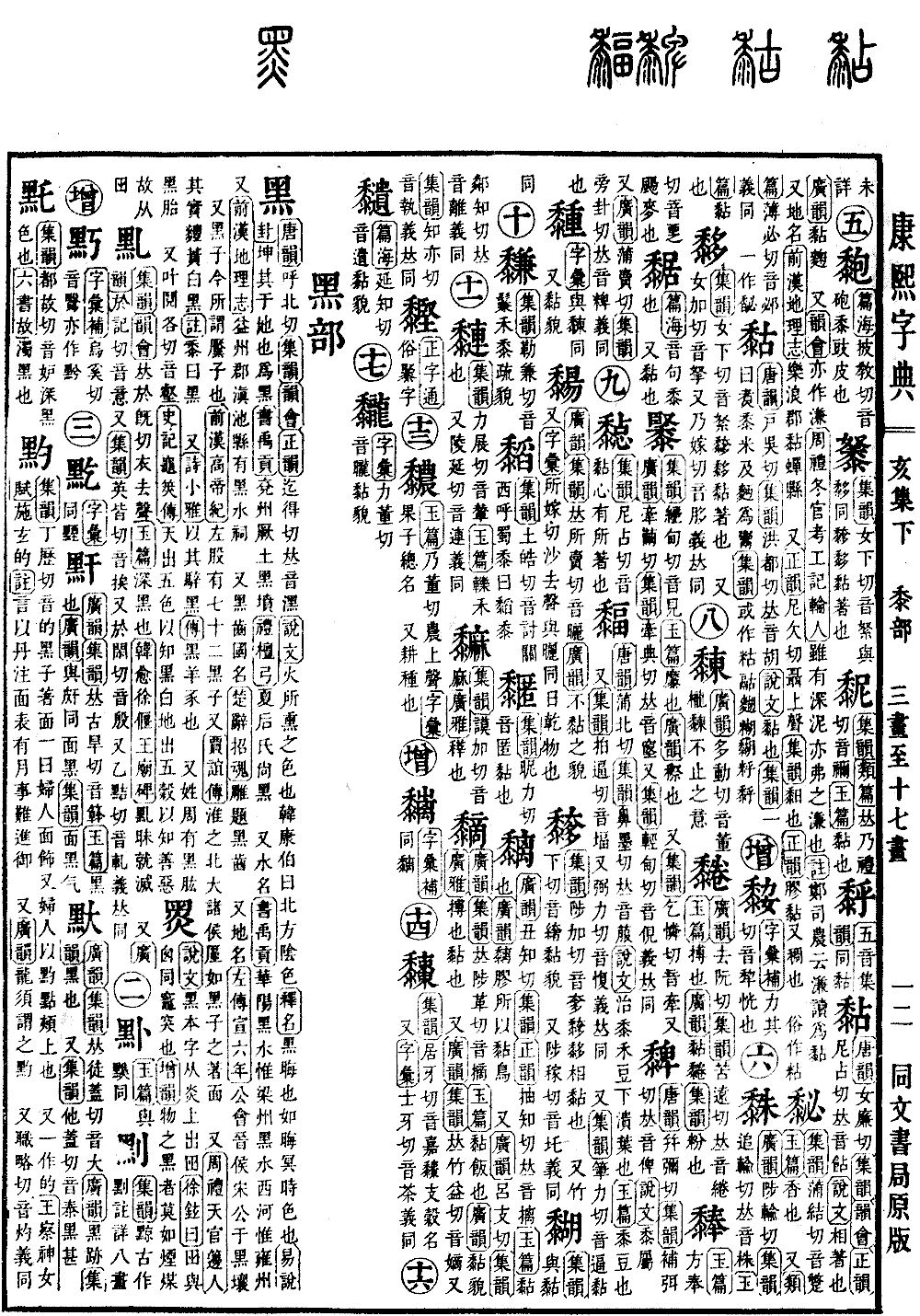
Hai Collection, Lower Volume
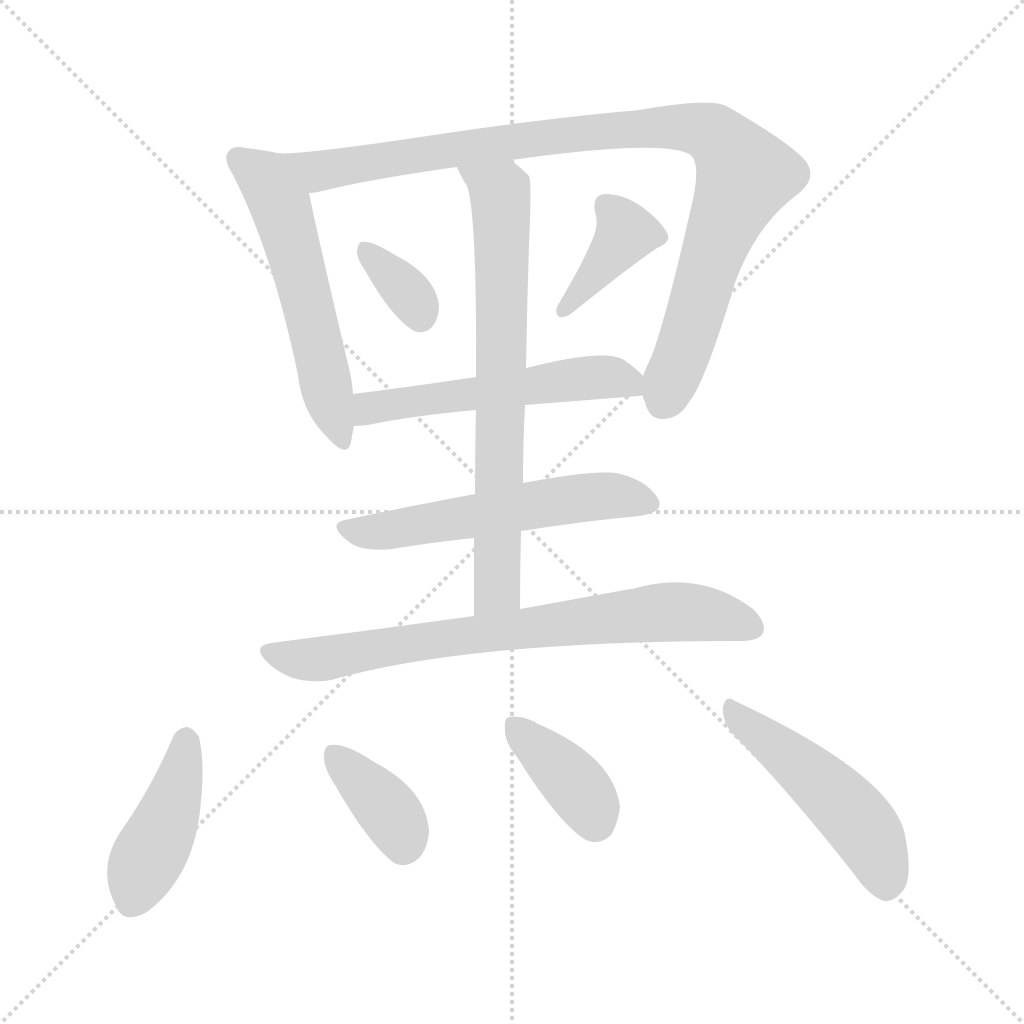
Radical: Black (hēi)
Kangxi Strokes: 12
Page 1518, Entry 36
Pronounced hei.
According to the Explaining Graphs and Analyzing Characters (Shuowen Jiezi), it is the color formed by the soot of fire. Han Kangbo states: This is the dark color of the north. The Explanation of Names (Shiming) says: Black is darkness, like the color of the sky at dusk. The Book of Changes (Yijing), section on the Discussion of Trigrams, states that the Kun trigram symbolizes the earth and represents the color black. The Book of Documents (Shangshu), section on the Tribute of Yu, records that the soil of Yanzhou is black and fertile. The Book of Rites (Liji), section on Tan Gong, states that the Xia dynasty honored the color black.
It also refers to a body of water. The Book of Documents (Shangshu), section on the Tribute of Yu, states that the land between Huayang and the Black Water is Liangzhou, and the land between the Black Water and the Western River is Yongzhou. Furthermore, the History of the Former Han (Qian Hanshu), section on Geography, notes that there is a Black Water Shrine in Dianchi County, Yizhou Commandery.
There is also the Black-Teeth Kingdom. The Verses of Chu (Chuci), section on the Summons of the Soul, mentions the custom of tattooed foreheads and black teeth.
It also refers to a place name. The Zuo Tradition (Zuo Zhuan), sixth year of Duke Xuan, records that Duke Xuan of Lu held a meeting with the Duke of Jin and the Duke of Song at Heirang.
It also refers to a black spot, which is what is now called a mole. The History of the Former Han (Qian Hanshu), section on the Annals of Emperor Gao, records that Emperor Gao of Han had seventy-two black spots on his left thigh. Furthermore, the Biography of Jia Yi states that the Huaiyang Kingdom, when compared with other major vassal states, was merely like a black spot on a face.
In the Rites of Zhou (Zhouli), section on the Officials of Heaven and the Bian-offering official, it is recorded that the baskets contained hemp seeds, white millet, and black millet. The commentary explains that black millet is what is called black.
The Book of Odes (Shijing), section on the Lesser Odes, mentions using red oxen and black sheep and pigs for sacrifice. The commentary explains that black refers to the sheep and pigs.
It is also a surname. In the Zhou dynasty, there were figures named Heigong and Heitai.
Also pronounced as he (like the sound of the word for ravine). The Records of the Grand Historian (Shiji), section on the Biography of the Turtle and Milfoil, says: Heaven reveals five colors to distinguish white and black; the earth produces five grains to differentiate good and evil.
Textual research: In the Biography of Jia Yi, the phrase regarding the vassal states north of Huai has been corrected by adding the character yang after Huai and changing the character north to the character compare, according to the original text. In the Records of the Grand Historian, section on the Biography of the Turtle and Milfoil, the phrase concerning Heaven revealing five colors and the earth producing five grains has been amended to match the original text.