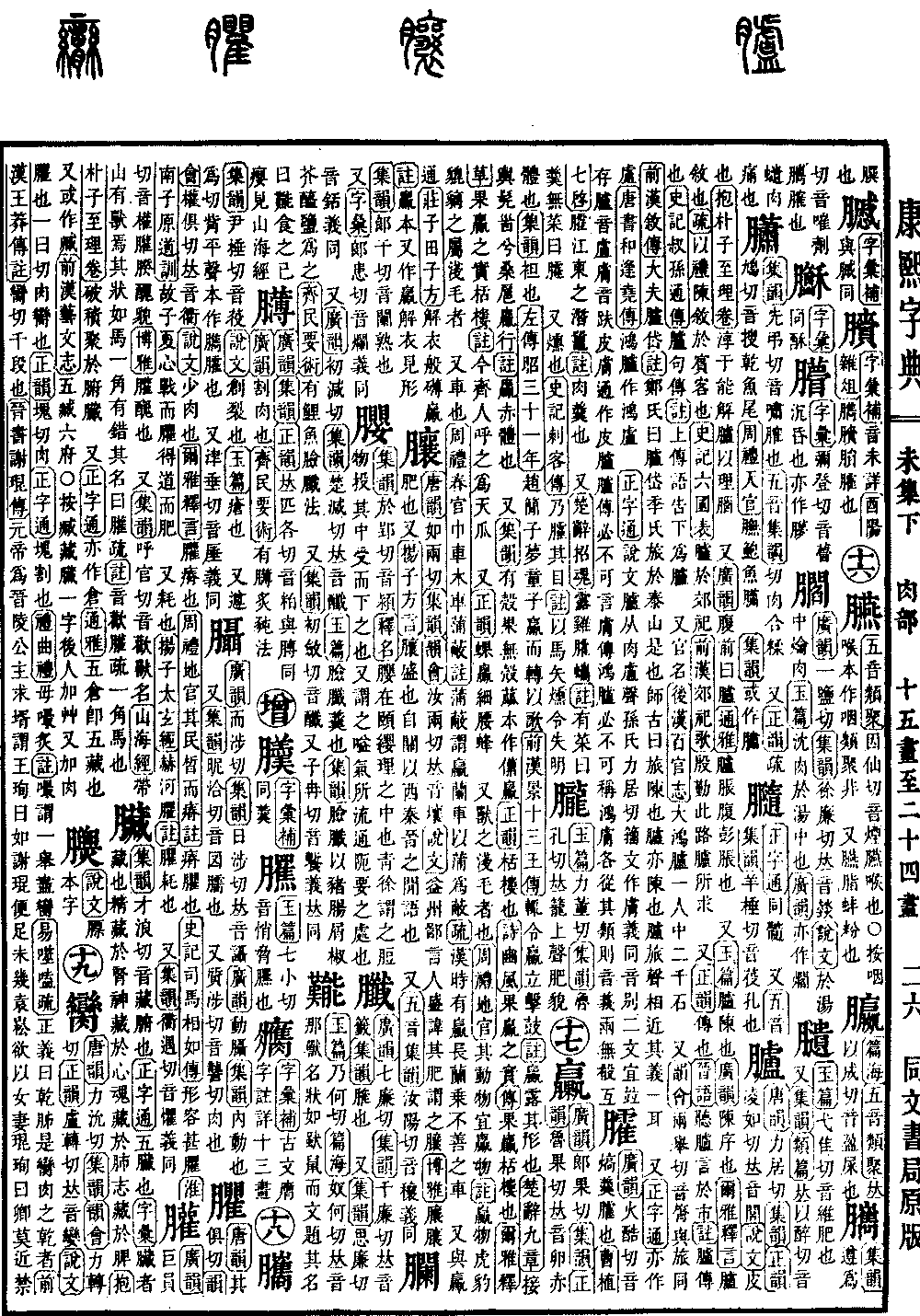
Wei Collection, Lower Volume
Radical: Meat (ròu)
Entry: Lu
Kangxi stroke count: 22
Page 998, Entry 12
Tangyun pronunciation: lu
Jiyun and Zhengyun pronunciation: lu
Shuowen Jiezi says: It refers to skin.
Baopuzi, Chapter on Ultimate Principles (Baopuzi): Chunyu was able to dissect the skin to examine the brain.
Also, Guangyun says: The front of the abdomen is called lu.
Tongya says: Lu-zhang refers to a bloated abdomen.
Also, Yupian says: Lu means to display or arrange.
Guangyun says: To display means to set in order.
Erya, Explanation of Words (Erya): Lu means to narrate or arrange.
Commentary: It means to arrange and present in order to guests.
Records of the Grand Historian, Chronological Table of the Six States (Shiji): Arranged at the suburban sacrifices.
History of the Former Han, Songs of the Suburban Sacrifices (Qian Hanshu): Earnestly pursuing this path to state one's requests.
Also, Zhengyun says: It means to transmit.
Discourses of the States (Guoyu): Listen to the transmitted words in the marketplace.
Commentary: Lu means to transmit.
Records of the Grand Historian, Biography of Shusun Tong (Shiji): Transmitting the words of the decree.
Commentary: Transmitting words from above to those below is called lu.
Also, a title of an official.
History of the Later Han, Treatise on Government Officials (Hou Hanshu): There is one Grand Herald (Da Honglu), with a salary of two thousand shi.
Also, Yunhui pronunciation: lu. It is the same as the word for group or troop.
History of the Former Han, Account of the Author (Qian Hanshu): The grand officer arranged the sacrifices at Mount Tai.
Commentary: Master Zheng says: The arrangement at Mount Tai refers to the Ji family offering sacrifices at Mount Tai. Master Shigu says: To travel or camp means to arrange; lu also means to arrange. The sounds of lu and the word for troop are similar, and their meanings are the same.
Also, Zhengzitong says: It is also written as the character for hut.
Book of Tang, Biography of He Fengyao (Tangshu): The Grand Herald is written as Grand Hut.
Zhengzitong says: Shuowen Jiezi says: Lu is formed from the radical for meat and the sound of a hut. Sun Mian says the pronunciation is lu; the seal script form is written as the character for skin, and the meaning is the same but the pronunciation differs. The two characters should both be preserved. Lu is pronounced lu, while the skin character is pronounced fu. Skin and lu are used interchangeably, but one cannot say fu-transmission for lu-transmission, nor can one call the Grand Herald the Grand Skin. Each follows its own category, so the meaning and the words do not become confused or mixed.