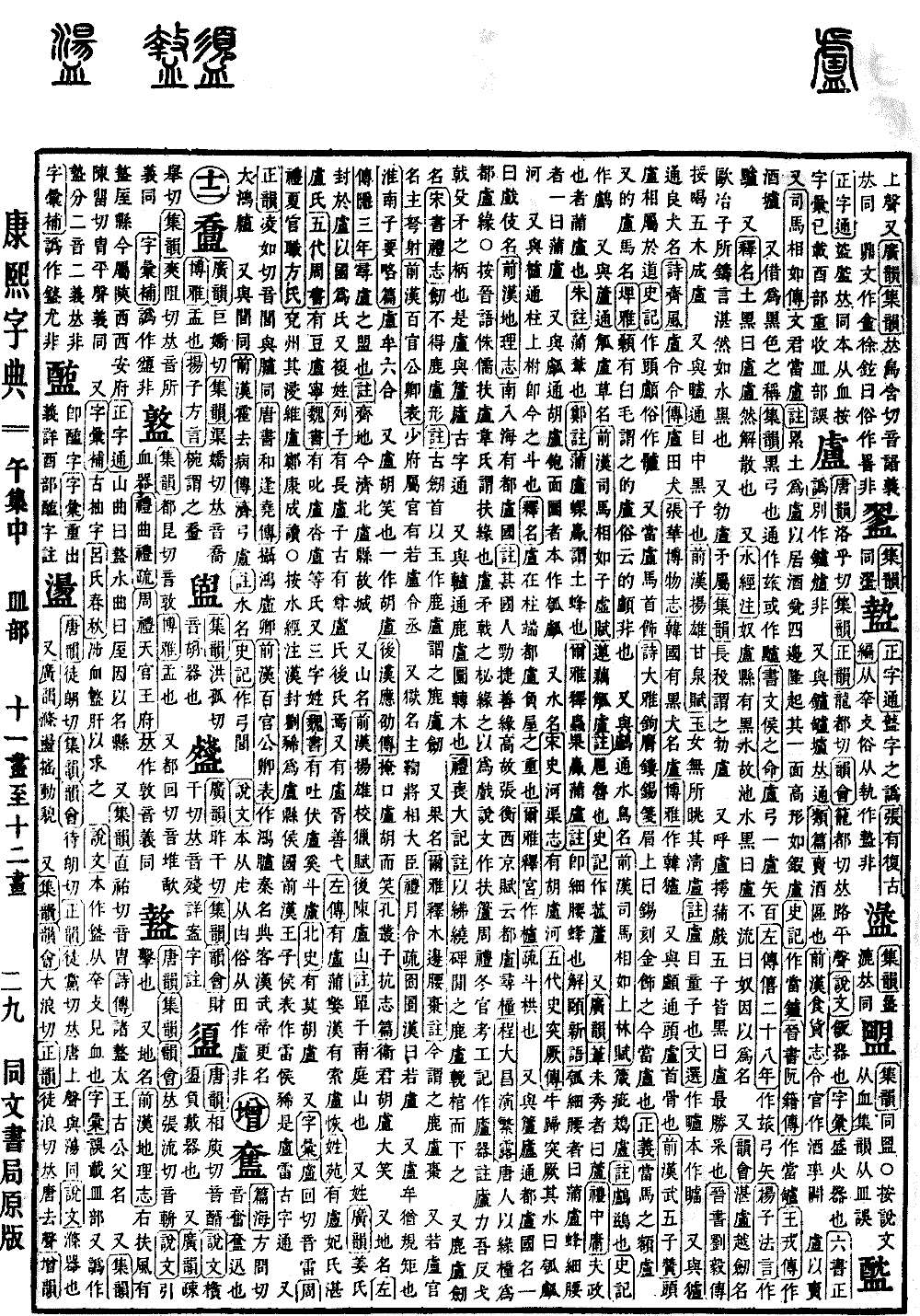
Wu Collection, Middle Volume. Radical: Dish (mǐn). Kangxi Strokes: 16. Page 797, Entry 06.
Pronounced luo. Also pronounced long. Also pronounced long. Read as lu (level tone). According to the Shuowen Jiezi (Explanation of Simple and Compound Characters), it is a vessel for holding cooked rice. According to the Zihui (Compendium of Characters), it is a vessel for holding fire. The Liushu Zheng’e (Correction of the Six Writings) states that it is sometimes written in the variant forms lu and lu, which is incorrect. It is also interchangeable with the characters lu, lu, and lu.
According to the Leipian (Classified Chapters), it refers to a place where wine is sold. The Book of Han (Hanshu), Treatise on Food and Money, mentions that when the government commanded the brewing of wine, large establishments were opened to sell it. In the Biography of Sima Xiangru, it is recorded that Zhuo Wenjun sat by the hearth selling wine. The commentary notes that this refers to a platform made of earth built to hold wine jars, with four sides raised and one side higher, resembling a blacksmith's furnace. The Records of the Grand Historian (Shiji) writes it as lu. The Book of Jin (Jinshu), Biography of Ruan Ji, writes it as lu. The Biography of Wang Rong writes it as lu.
It is also used as a loan word for the color black. According to the Jiyun (Collection of Rhymes), it refers to a black bow. It is interchangeably used with lu. Sometimes written as lu. In the Book of Documents (Shujing), Order to Duke Wen, it mentions one black bow and one hundred black arrows. In the Zuo Zhuan, 28th year of Duke Xi, it is written as lu bow and arrows. In the Fayan (Model Sayings) by Yang Xiong, it is written as lu.
According to the Shiming (Explanation of Names), a blackish earth color is called lu. Lu describes the appearance of earth that is dark and loose. According to the Commentary on the Water Classic (Shuijingzhu), Nulu County has a black river; therefore, stagnant black pond water is called lu, and water that does not flow is called nu, which is why they are named as such.
According to the Yunhui (Collection of Rhymes), Zhanlu is the name of a precious sword from the State of Yue, forged by Ouyezi. It means the sword blade is clear and dark black like water. Bolu is a type of spear. According to the Jiyun, a long spear is called a bolu.
Hulu is a term from the Chupu game (a type of gambling game). When five dice all show black, it is called lu, which is the highest score. In the Book of Jin, Biography of Liu Yi, it describes shaking and calling out to make the five wooden dice become lu.
It is also interchangeable with lu, referring to the black pupil of the eye. In the Book of Han, Gan Quan Fu by Yang Xiong, it describes the jade maiden without a home, looking at her clear pupils. The commentary notes that lu refers to the pupil. The Wenxuan (Selections of Refined Literature) writes it as lu. It was originally written with the character for eye.
It is also interchangeable with lu, the name of a good hunting dog. The Book of Odes (Shijing), Odes of Qi, mentions the ringing of bells on hunting dogs. The commentary states that lu refers to a dog used for hunting. According to Zhang Hua’s Bowuzhi (Record of Investigations of Things), the State of Han had black dogs called lu. The Boya (Erya) writes it as Han-lu.
It is also interchangeable with lu, head-lu, meaning skull. In the Book of Han, Eulogy on the Five Sons of Emperor Wu, it speaks of skulls connected on the road. The Records of the Grand Historian writes it as tou-lu. Common usage writes it as lu.
Danglu is an ornament on a horse’s head. In the Book of Odes, Great Odes, with annotations on horse trappings, it states that the part on the horse’s forehead is called xi, engraved with metal decorations, which is what is now called danglu. The commentary explains that this ornament is located on the horse’s forehead.
Delu is the name of a horse. According to the Piya (Amplification of the Erya), a horse with white hair on its forehead is called delu. Common usage writes it as delu, which is incorrect.
It is also interchangeable with lu, the name of a water bird. In the Book of Han, Shanglin Fu by Sima Xiangru, it mentions the bird species. The commentary notes that it is a cormorant. The Records of the Grand Historian writes it as lu.
It is also interchangeable with lu, the reed plant. Gulu is the name of a grass. In the Book of Han, Zixu Fu by Sima Xiangru, it mentions lotus roots and gulu. The commentary notes that it is the hulu plant. The Records of the Grand Historian writes it as gulu.
According to the Guangyun (Broad Rhymes), a reed that has not yet sprouted is called lu. In the Book of Rites (Liji), Doctrine of the Mean, it discusses what is called government, comparing it to the pulu insect. The Zhu commentary says pu is a reed. The Zheng commentary says pulu refers to the guoluo, which is an earthen wasp. The Erya, Explanation of Insects, says the guoluo is the pulu. The commentary says this refers to the slender-waisted wasp. The Jieyi Xinyu (New Words to Ease the Mind) states that the hulu (gourd) has a slender waist called pulu. The wasp with a slender waist is also called pulu.
It is also interchangeable with hu (gourd). Hulu is a type of gourd with a round surface. It was originally written as hu. It is also the name of a river. The History of Song (Songshi), Treatise on Rivers and Canals, mentions the Hulu River. The History of the Five Dynasties (Wudaishi), Account of the Turks, mentions the Niuti Turks, where the water is called Hu River.
It is also interchangeable with lu, the bracket (dougong) on top of a pillar, which is what is now called dou. The Shiming says lu is at the top of the pillar, with the dougong bearing the weight of the roof. The Erya, Explanation of Palaces, writes it as lu. The sub-commentary states it is the dougong.
It is also interchangeable with lu and lu. Dulu is the name of a country. Some say it is the name of an acrobatic performance. In the Book of Han, Treatise on Geography, it mentions that to the south, entering the sea, is the Dulu Kingdom. The commentary notes that the people of that country are strong and agile, skilled at climbing, which is why Zhang Heng’s Xijing Fu mentions Dulu people performing pole climbing. Cheng Dachang’s Yanfanlu states that in the Tang Dynasty, people called pole climbing dulu-yuan. According to the Discourses of the States (Guoyu), there is the phrase for dwarves supporting the lu, which Wei Zhao explains as supporting, meaning climbing. Lu is the handle of a spear or halberd, which they climb for sport. The Shuowen Jiezi writes it as lu. The Book of Rites, Record of Trades, writes it as lu-qi. Note: Lu, pronounced li-wu, is the handle of a dagger-axe, halberd, shu, or spear. This shows that lu is anciently interchangeable with the characters lu and lu.
It is also interchangeable with lu, the lulu (pulley), which is a round rotating piece of wood. In the Book of Rites, Record of Funerary Rites, it notes using ropes wound around the lulu between the coffin and the outer casket to lower the coffin. Lulu is also the name of a sword. In the Book of Song (Songshu), Treatise on Rites, it states a sword cannot be made into the shape of a lulu. The commentary notes that ancient sword pommels were made of jade in the shape of a lulu (pulley), called the lulu sword.
It is the name of a fruit. The Erya, Explanation of Trees, in the note on the bian-yao jujube, says it is now called the lulu jujube.
Rulu is the name of an official post, responsible for archery and crossbows. In the Book of Han, Table of Officials, it is noted that the 少府 (Shaofu, Minister Steward) had subordinates including the Rulu-lingcheng. It is also the name of a prison responsible for interrogating ministers and generals. In the Book of Rites, Monthly Ordinances, the commentary states that during the Han Dynasty, prisons were called Rulu.
Lumu describes something like a compass or square. The Huainanzi, Yaolue Chapter, discusses the planning of the heavens and the earth. Luhuhu describes the appearance of laughter. Also written as hulu. In the Biography of Ying Shao (Book of the Later Han), it describes covering the mouth and laughing in a luhu manner. The Kongcongzi, Anti-zhi Chapter, records the Ruler of Wei laughing in a hulu manner.
It is the name of a place. In the Zuo Zhuan, 3rd year of Duke Yin, it mentions an alliance at the place called Lu. The commentary notes that it is a place in the State of Qi, the old city in the present-day Jibei, Lu County. It is the name of a mountain. In the Book of Han, Hunting Fu by Yang Xiong, it mentions the Houlu Mountain. The commentary notes that it is a mountain in the southern court of the Chanyu.
It is a surname. According to the Guangyun, the Jiang surname was enfeoffed at Lu, taking the state name as the clan name. There are also double-character surnames. The Liezi mentions Changluzi; in ancient times there was the Zunlu clan, which later became a surname. There is also Luxu, skilled in archery. The Zuo Zhuan mentions Lupu Bi, and the Han Dynasty had Suolu Hui. The Xingyuan (Garden of Surnames) lists Lufei and Zhanlu. The Zhou Book (Zhoushu) mentions Doulu Ning. The Book of Wei (Weishu) mentions Chilu and Talu. There are also three-character surnames. The Book of Wei mentions Tufulu and Xidoulu. The History of Northern Dynasties (Beishi) mentions Mohulu.
According to the Zihui, pronounced lu-hui, read as lei. In the Book of Rites, Summer Official, Office of the Regional Commissioner, the rivers of Yanzhou include the Lu River and the Wei River. Zheng Kangcheng reads it this way. According to the Commentary on the Water Classic, Liu Xi was enfeoffed as the Marquis of Lu County during the Han Dynasty. The Book of Han, Table of Royal Marquises, writes it as "Lei Marquis Xi," which shows that lu and lei were anciently interchangeable.
According to the Zheng Yun, pronounced ling-ru, read as lu. It is the same as lu. In the New Book of Tang (Tangshu), Biography of He Fengyao, it mentions being promoted to Honglu Qing (Minister of State Ceremonial). The Book of Han, Table of Officials, writes it as Honglu; in the Qin Dynasty, it was called Dianke, and Emperor Wu of Han changed it to Da Honglu. It is also the same as lu. In the Book of Han, Biography of Huo Qubing, it mentions crossing the Gonglu River. The commentary notes it is a water name. The Records of the Grand Historian writes it as Gonglu.
The Shuowen Jiezi originally classified it under the radical for tiger. The common character is written with field at the bottom, which is incorrect.
Textual research: In the Book of Odes, Great Odes, with annotations on metal decorations, the text says on the eyebrows is called xi. Note that the character xi should be written with the character yi. The two instances of the character xi have been corrected to the proper character for metal decoration. In the Book of Rites, Summer Official, Office of the Regional Commissioner, it mentions the waters of Yanzhou as Wei and Lu. According to the original text, "Wei Lu" has been corrected to "Lu Wei."