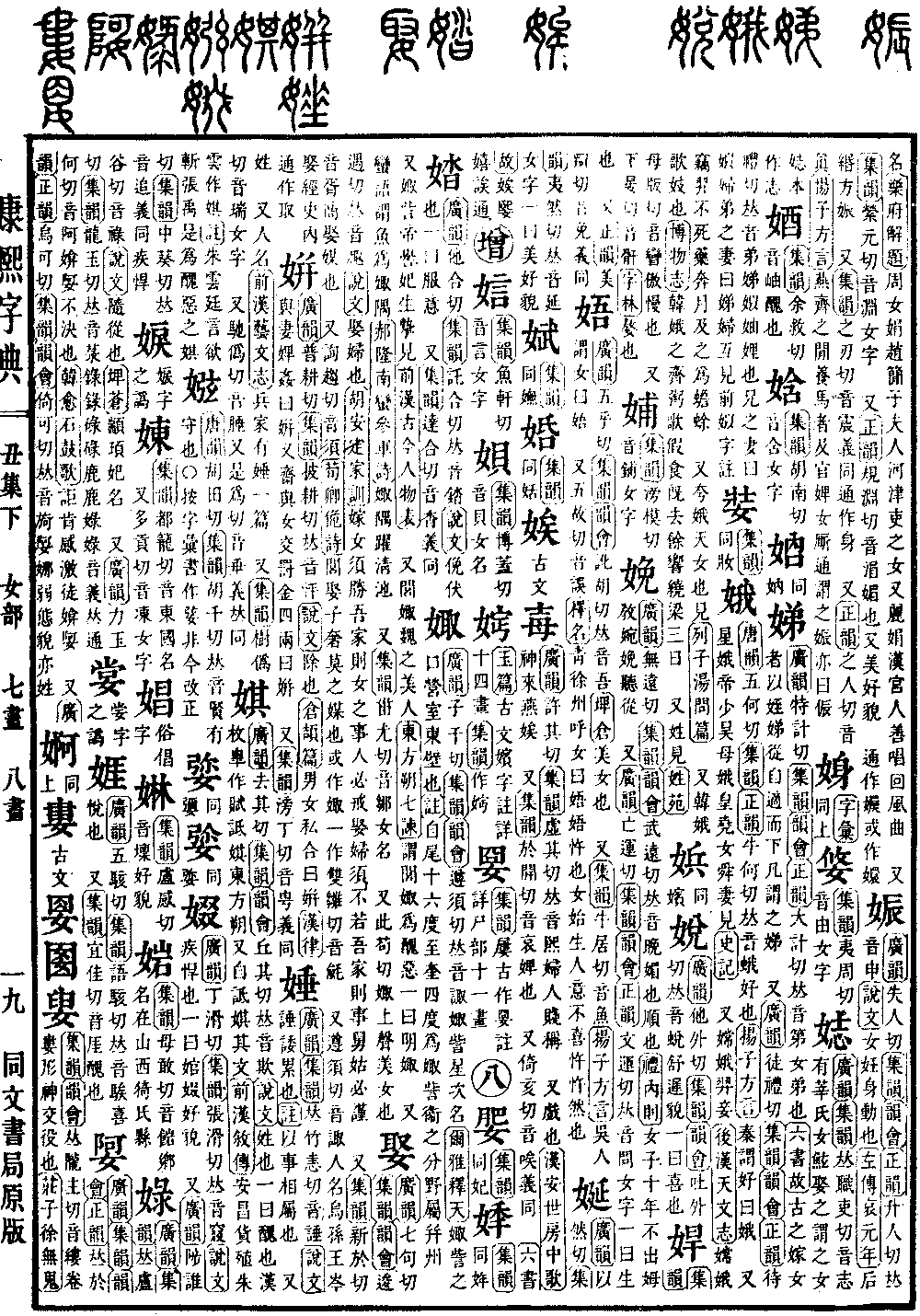
Chou Collection, Lower Volume
Radical: Woman (nǚ)
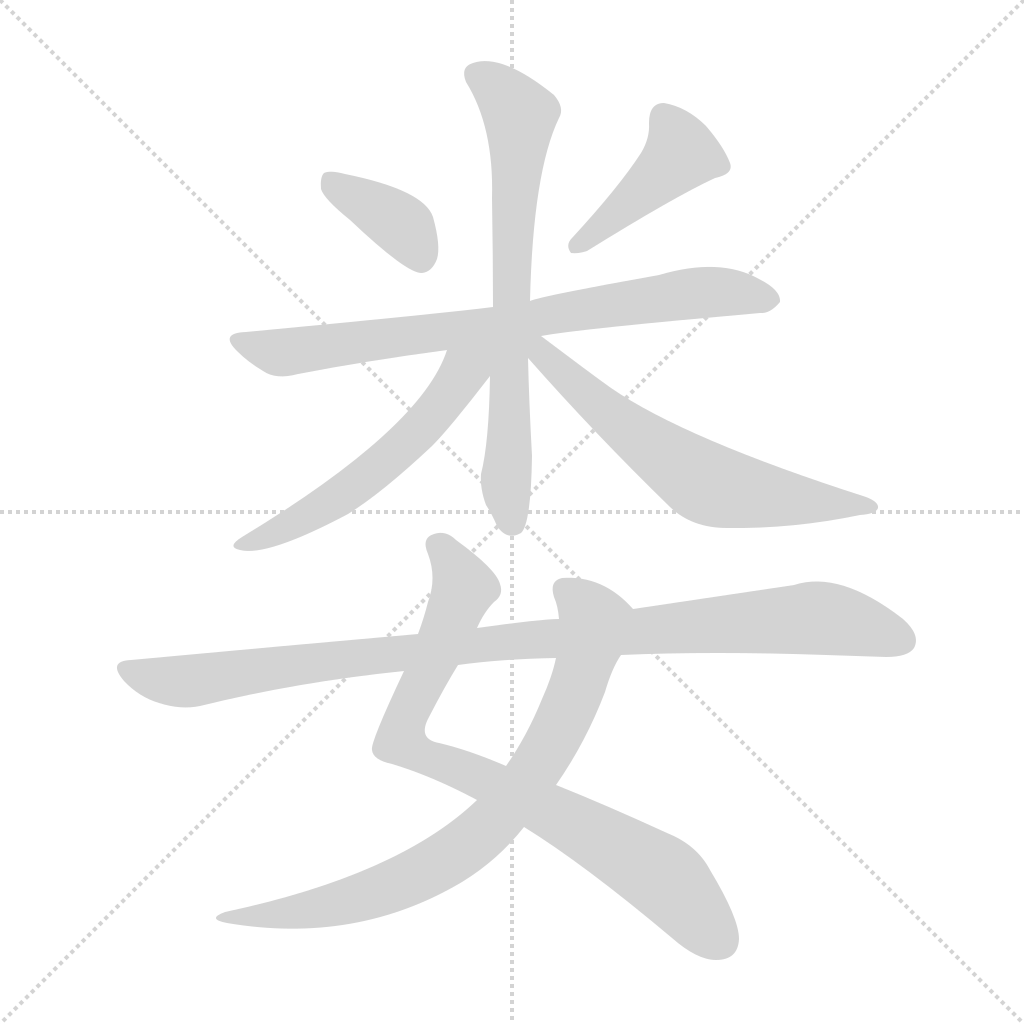
婁
Kangxi stroke count: 11
Page 263, Entry 12
Ancient form. Collected Rimes (Jiyun) and Collection of Phonetic Rhymes (Yunhui) state it is pronounced lü (rising tone). Juanlou, meaning the involvement of form and spirit in service. Book of Master Zhuang (Zhuangzi), chapter Xuwugui: Shun raised the land of Tongtu, teeth lengthened and brightness faded, unable to rest or return, this is what is called juanlou.
To tie a horse is called wei; to tie an ox is called lou. Niu ma wei lou, see the Gongyang Commentary (Gongyangzhuan).
Collected Rimes (Jiyun) states it is pronounced lü (falling tone). Zheng Rimes (Zhengyun) states it is pronounced lü (falling tone). Same as lü. To be vexatious or frequent. History of the Former Han (Qianhan), Biography of Gongsun Hong: The Emperor was just initiating meritorious works, frequently (lou) promoting the virtuous and the worthy. Also, Annals of Emperor Yuan (Yuandiji): The common people frequently (lou) encountered disasters and calamities.
Collected Rimes (Jiyun) states it is pronounced lei (rising tone). Dianlou, a place name. Located in the territory of the Western Qiang.
Broad Rimes (Guangyun) states it is pronounced lou (rising tone). Collected Rimes (Jiyun) and Collection of Phonetic Rhymes (Yunhui) state it is pronounced lou (rising tone). Zheng Rimes (Zhengyun) states it is pronounced lou (rising tone). A star name. Book of Rites (Liji), Monthly Ordinances (Yueling): In the last month of winter, the sun is in the Nü constellation at dusk, and in the Lou constellation. Huainanzi, Treatise on Astronomy (Tianwenxun): In the second month, the constellations Kui and Lou are established.
A place name. Spring and Autumn Annals (Chunqiu), Duke Yin, 4th year: The people of Ju attacked Qi and took Moulou. Also, Duke Xi, 18th year: The army of the Marquis of Wei was at Zilou.
A river name. Records of the Grand Historian (Shiji), Correct Meanings (Zhengyi): To the northeast of the river, flowing downward for over three hundred li and entering the sea, is the Lou River; today it is part of Songjiang, and there is a Lou County.
A person's name. Lilou, an ancient person with excellent eyesight. Elegies of Chu (Chucheng), Nine Declarations (Jiuzhang): Lilou gazes slightly, and the blind believe he has no vision. Also Qianlou, a recluse of the State of Qi, who authored the four chapters of Qianlouzi.
A surname. During the Han dynasty, Lou Jing was granted the surname Liu by the Emperor Gaozu. During the Tang dynasty, there was Lou Shide.
A beast name. Han Poetry Outer Commentary (Hanshiwaizhuan): In the north, there is a beast named Lou that alternates between eating and watching.
Same as a variant. Zuo Commentary (Zuozhuan), Duke Ding, 14th year: Since you have already fixed your Lou pig.
Collected Rimes (Jiyun) states it is pronounced lou (level tone). Zheng Rimes (Zhengyun) states it is pronounced lou (level tone). To drag. Classic of Poetry (Shijing), Odes of Tang (Tangfeng): You have clothes, do not drag them, do not trail (lou) them.
Appearance of engraving or carving. He Yan, Rhapsody on the Jingfu Hall (Jingfudiangfu): Adorned with algae patterns, woven with intricate openwork. Red blossoms and jade-like stone, red and patterned silks appearing separated and distinct (lilou). Commentary: Lilou means engraved and carved clearly.
Also means stupid or dim-witted. Su Shi's Exposition (Sushi Yanyi): People of the time referred to those without discernment as Zhulou, unable to distinguish. Zhulou was a small state, used to describe insignificant people unable to discern. Six Writings Source (Liushugu): During the Spring and Autumn period, the State of Zhu was called Zhulou.
Collected Rimes (Jiyun) states it is pronounced lou (rising tone). Zheng Rimes (Zhengyun) states it is pronounced lou (rising tone). Same as lou. A small mound. Zuo Commentary (Zuozhuan), Duke Xiang, 24th year: Taishu said: On a bulou (small mound), there are no pines or cypresses. The original character does not follow the radical cliff, or perhaps it is the character.
Also, it is an ancient form of lou. The character represents a woman in the middle of a mother. The other is a common variant.
Textual research: To tie a horse is called wei, to tie an ox is called lou. Niu ma wei lou, see Zuo Commentary (Zuozhuan). Note: The cited passage comes from the Gongyang Commentary (Gongyangzhuan), so I have corrected the reference from Zuo Commentary to Gongyang. Zuo Commentary (Zuozhuan), Duke Yin, 4th year: The people of Ju attacked Qi and took Moulou. Note: The cited passage is from the Classic of Spring and Autumn (Chunqiujing), so I have corrected the reference from Zuo Commentary to Spring and Autumn (Chunqiu).