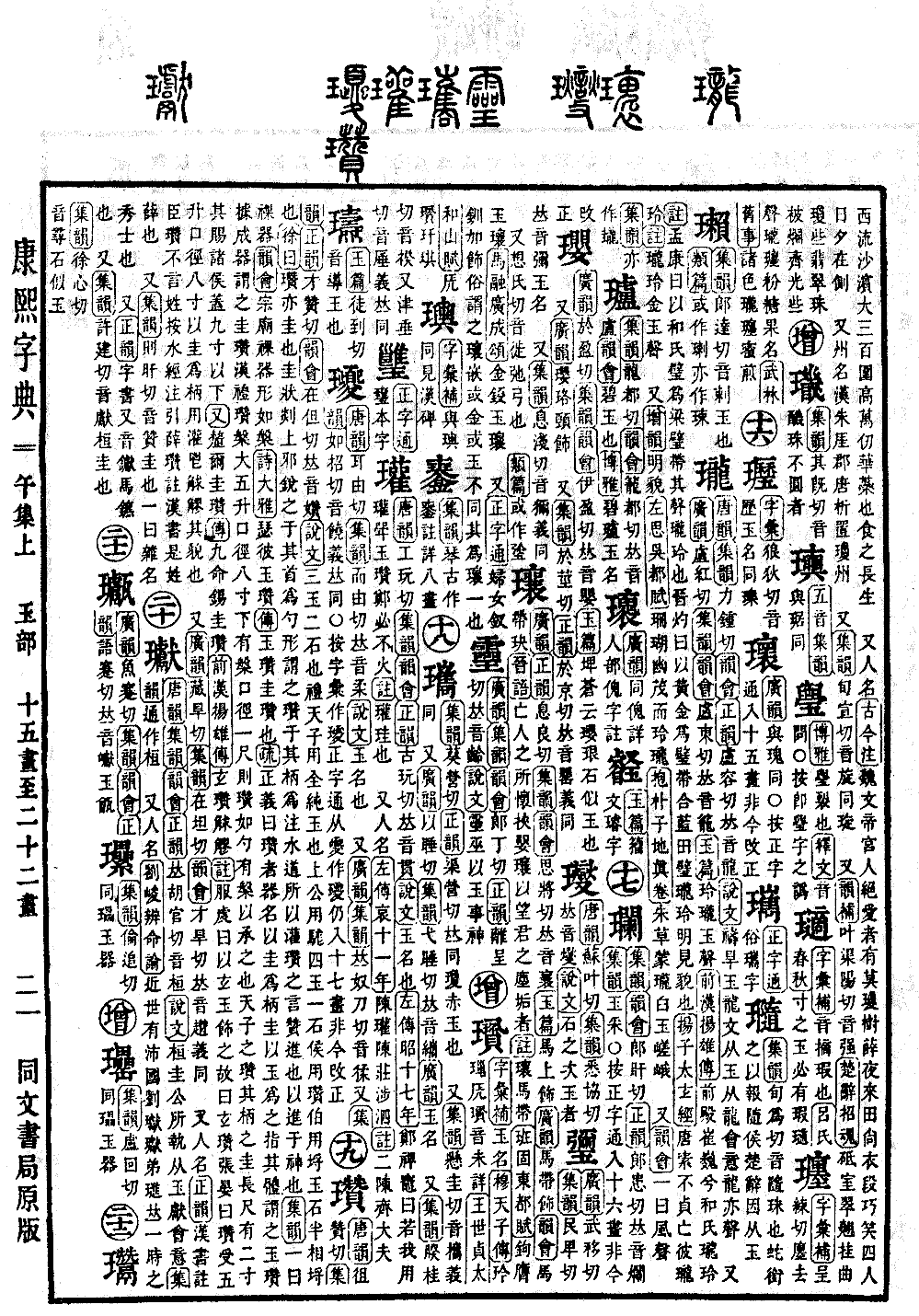
Wu Collection, Upper Volume
Radical: Jade (yù)
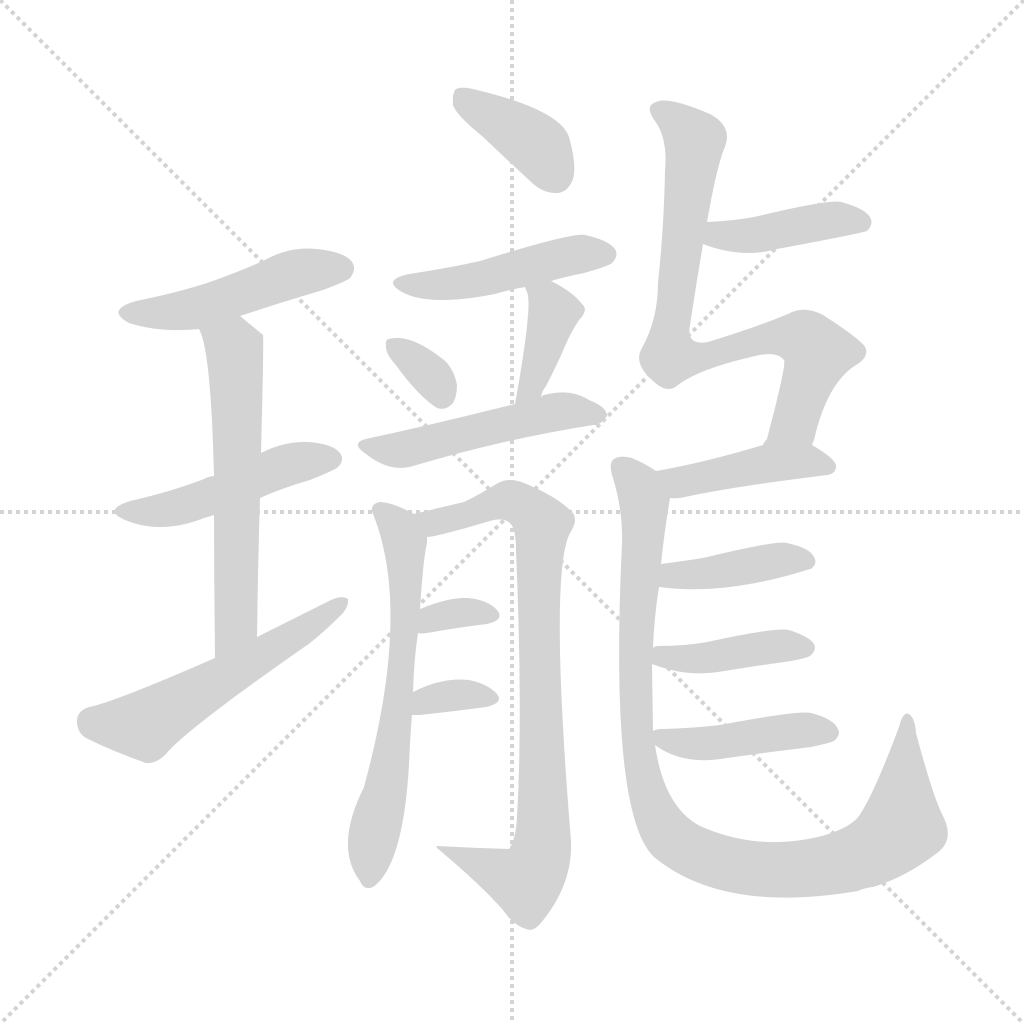
Long
Kangxi strokes: 21
Page 745, Entry 11
According to Tang Rhymes (Tangyun) and Collection of Rhymes (Jiyun), pronounced long. According to Rhyme Compilation (Yunhui) and Corrected Rhymes (Zhengyun), pronounced long. Pronunciation is the same as long. Explaining Writing (Shuowen Jiezi) states: This is a jade implement used for praying for rain and preventing drought, engraved with dragon-shaped patterns. The character is formed by the combination of jade and dragon. It is an associative compound character, and the element dragon also indicates the sound.
Also, according to Broad Rhymes (Guangyun), pronounced long. According to Collection of Rhymes (Jiyun) and Rhyme Compilation (Yunhui), pronounced long. Pronunciation is the same as long. The Jade Chapters (Yupian) explains: Linglong, describing the crisp sound of jade stones colliding. The Biography of Yang Xiong in the History of the Former Han (Qianhan) records: The front palace is towering, adorned with the linglong of the He Clan jade. The commentary by Meng Kang says: This refers to using the He Clan jade to decorate the palace beams and wall belts, producing a sound that is crisp and pleasant. Jin Zhuo says: It is using gold to make wall belts, inlaid with Lantian jade. Linglong refers to the appearance of being bright and clear. The Great Profound Scripture (Taixuanjing) by Yang Zi writes: Tang Su is not chaste, losing that linglong. The commentary says: Linglong refers to the sound of metal and jade colliding.
Also, the Expanded Rhymes (Zengyun) explains it as the appearance of being bright. The Rhapsody on the Capital of Wu (Wudu Fu) by Zuo Si describes: Corals are luxuriant and linglong. The Master Who Embraces Simplicity (Baopuzi), Earth Truth Volume, writes: Red grass is menglong, white jade is jagged.
Also, Rhyme Compilation (Yunhui) mentions another explanation: refers to the sound of the wind. Collection of Rhymes (Jiyun) records that this character is also written in a variant form (zhuàn).