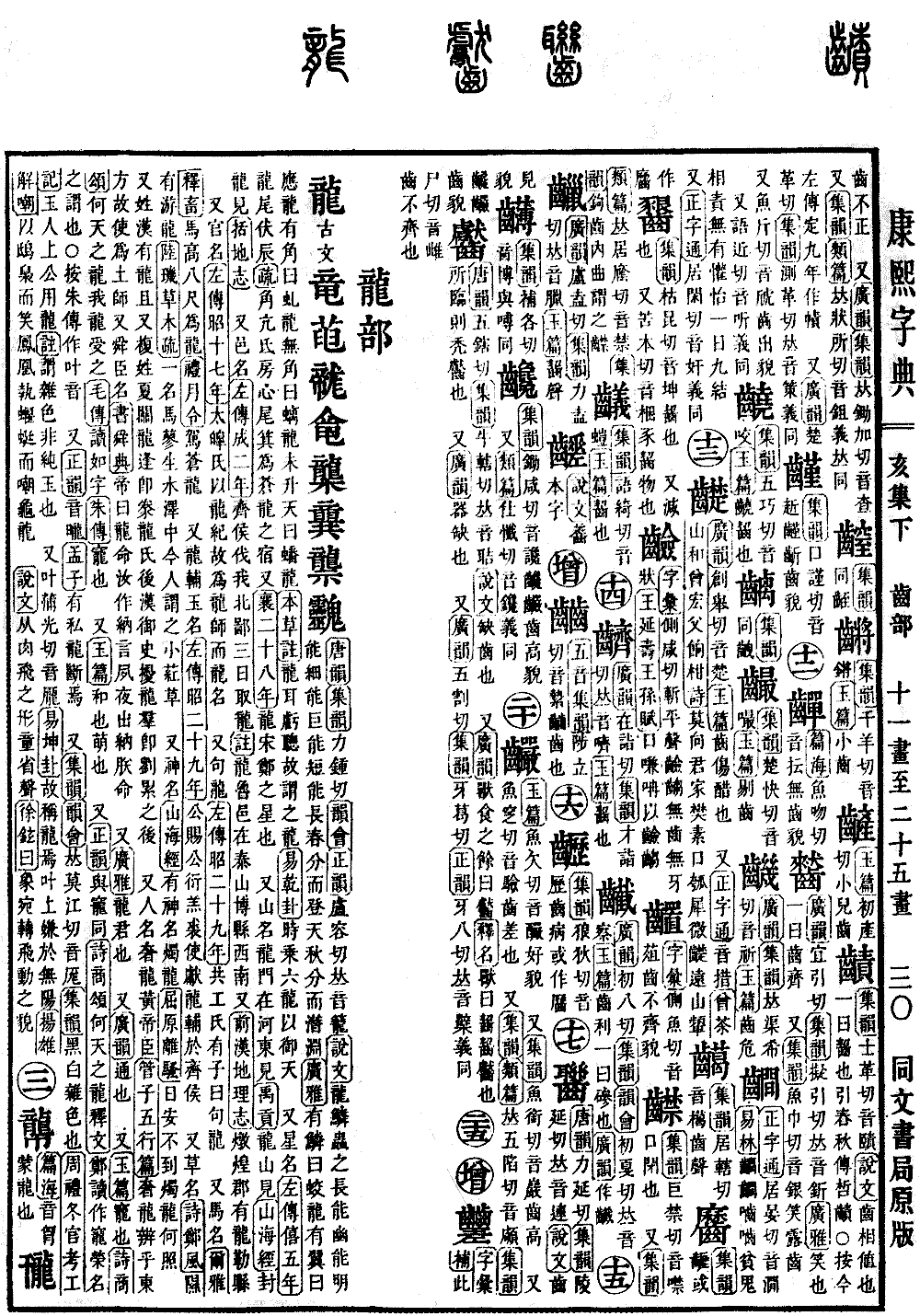
Hai Collection, Lower Volume
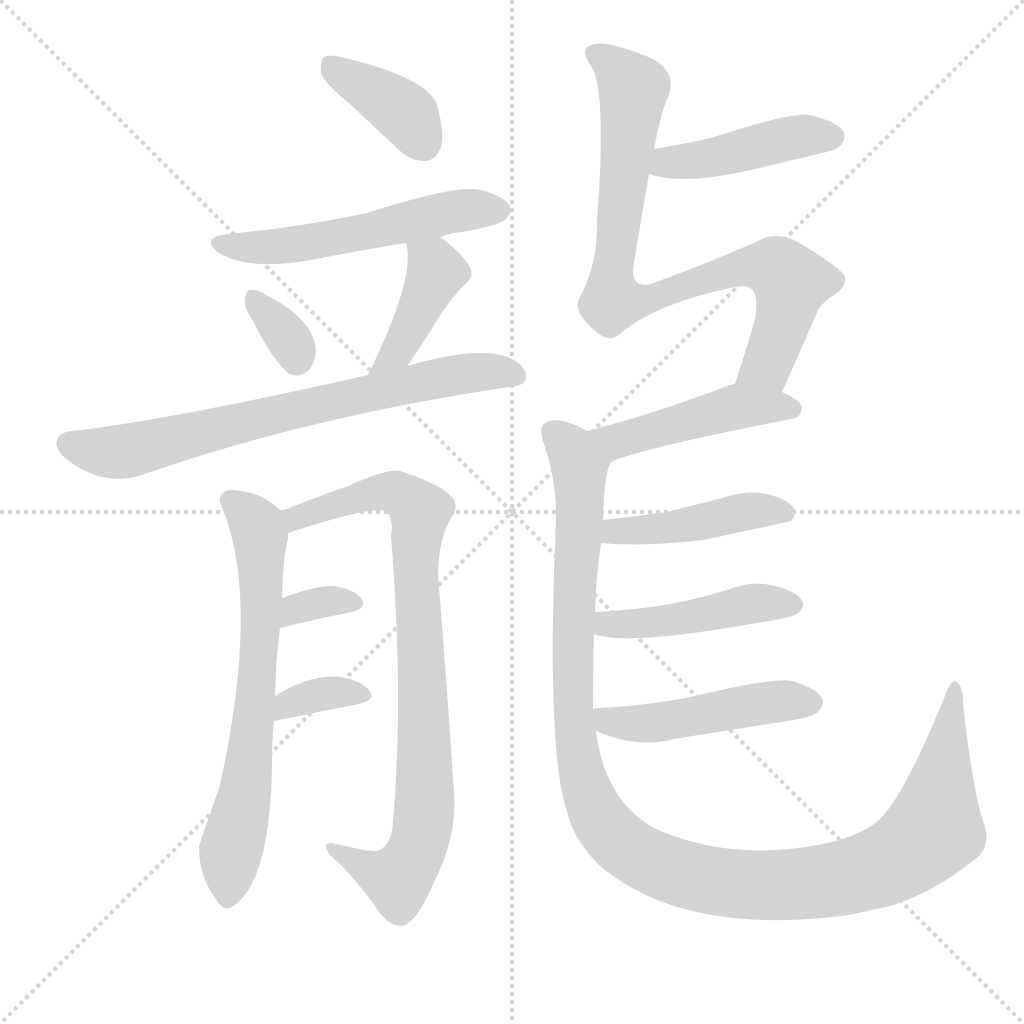
Radical: Dragon (lóng)
Page 1536, Entry 33
Ancient forms include two variant characters.
Pronounced long.
According to the Explaining Graphs and Analyzing Characters (Shuowen Jiezi), the dragon is the leader of all scaly animals. It has the ability to conceal itself or manifest, to become minute or gargantuan, and to shorten or lengthen its form. It ascends to the heavens at the vernal equinox and dives into the deep abyss at the autumnal equinox.
According to the Guangya, those with scales are called Jiao-dragons; those with wings are called Ying-dragons; those with horns are called Qiu-dragons; those without horns are called Chi-dragons; and those that have not ascended to the heavens are called Pan-dragons.
According to the Compendium of Materia Medica (Bencao Zhu), the ears of the dragon do not have keen hearing, which is why it is called dragon (lóng, a homophone for deaf).
Book of Changes (Yijing), Qian Hexagram: To ride six dragons at the proper time to patrol the heavens.
Also refers to a star constellation. In the Zuo Tradition (Zuo Zhuan), fifth year of Duke Xi: The dragon tail constellation remains hidden and does not appear. The commentary notes that the stars Jiao, Kang, Di, Fang, Xin, Wei, and Ji together form the seven mansions of the Azure Dragon. In the twenty-eighth year of Duke Xiang: The dragon star is the constellation associated with the states of Song and Zheng.
Also refers to mountain names. Longmen Mountain is in Hedong, as noted in the Tribute of Yu (Yu Gong). Long Mountain is noted in the Classic of Mountains and Seas (Shanhaijing). Fenglong Mountain is noted in the Universal Geography of the Imperial Archives (Kuodizhi).
Also refers to place names. In the Zuo Tradition, second year of Duke Cheng: The Marquis of Qi attacked our northern border and took the territory of Long in three days. The commentary notes that Long was a place name in the state of Lu, located southwest of Bo County in Mount Tai. According to the Former Han Geography Treatise (Qianhan Dilizhi), Longle County was established in Dunhuang Commandery.
Also refers to an official title. In the Zuo Tradition, seventeenth year of Duke Zhao: The Taihao clan used dragons to record events, thus establishing the Dragon Bureau and using dragon names for official titles.
Also refers to the name Julong. In the Zuo Tradition, twenty-ninth year of Duke Zhao: The Gonggong clan had a son named Julong.
Also refers to the names of horses. The Rites of Zhou (Zhouli), Overseer of Horses (Souren): Horses standing eight feet or more in height are called dragons. The Book of Rites (Liji), Monthly Ordinances (Yueling): Driving the dark-colored dragons.
Also refers to Longfu, a type of jade implement. In the Zuo Tradition, twenty-ninth year of Duke Zhao: Duke Zhao of Lu gave Gongyan a lambskin fur coat and instructed him to present the Longfu jade to the Marquis of Qi.
Also refers to a plant name. Book of Odes (Shijing), Odes of Zheng: In low-lying, wet areas, there is the Youlong (roaming dragon) grass. Lu Ji’s Commentary on Plants and Trees (Caomu Shu) notes this is also called Ma Liao (horse smartweed), growing in marshlands; people today call it small hong grass.
Also refers to the name of a deity. Classic of Mountains and Seas (Shanhaijing): There is a god named Zhulong (torch dragon). Qu Yuan’s Encountering Sorrow (Lisao): Where does the sun not shine? And where does the torch dragon illuminate?
Also refers to a surname. In the Han dynasty, there was Long Qie.
Also refers to compound surnames. Guan Longfeng of the Xia dynasty was a descendant of the Huanlong (dragon-rearing) clan. The Han dynasty censor Raolong Qun was a descendant of Liu Lei.
Also refers to a personal name. Shelong was an official under the Yellow Emperor. The Guanzi, Five Elements Chapter: Shelong could discern matters of the East, so he was appointed as Minister of Earth.
Also refers to the name of an official under Emperor Shun. Book of Documents (Shujing), Canon of Shun: Emperor Shun said, "Long, I appoint you as Minister of Communication to convey my orders morning and evening and report the opinions from below."
According to the Guangya, long means a sovereign. According to the Guangyun, it means to be thorough. According to the Yupian, it means to honor. Book of Odes (Shijing), Eulogies of Shang: Accepting the favor of Heaven. We receive it with honor. The Mao Commentary interprets it as the original pronunciation. Zhu Xi's commentary interprets it as "to favor."
According to the Yupian, it means to be harmonious or to sprout. According to the Zheng Yun, it is synonymous with the character for "favor" (chong). Book of Odes (Shijing), Eulogies of Shang, Exegesis on "He Tian Zhi Long": Zheng Xuan reads it as "chong," meaning glory or fame. Note: Zhu Xi's annotation treats this as a phonetic loan (ye yin).
According to the Zheng Yun, the pronunciation is long. Mencius: Some people privately monopolize (longduan) profits.
According to the Jiyun and Yunhui, pronounced pang. According to the Jiyun, it refers to a mottled black and white color. Rites of Zhou (Zhouli), Winter Bureau, Records of the Artificers: The jade artisan makes dragon-patterned jade for the Duke. The commentary notes that this refers to variegated jade, not pure-colored jade.
Also acts as a phonetic loan (ye yin) for pang. Book of Changes (Yijing), Kun Hexagram: Therefore it is called a dragon. This rhymes with the word yang (sun/light) in the preceding phrase "fearing the absence of light." Yang Xiong’s Dissing the Critics (Jiechao): Using an owl to ridicule a phoenix, or holding a gecko to mock the divine turtle and the flying dragon.
The Explaining Graphs and Analyzing Characters (Shuowen Jiezi) states the character shape resembles the form of flesh in flight, using the abbreviated form of the character "tong" as a phonetic indicator. Xu Xuan notes: It resembles a winding, flying motion.
Correction: The Erya, Interpreting Domestic Animals states that a horse eight feet high is a dragon. Careful research: The Erya actually writes this as the character for a horse of high stature, not the dragon character. This has been changed to cite the Rites of Zhou, Overseer of Horses, which records that horses standing eight feet or more in height are called dragons.