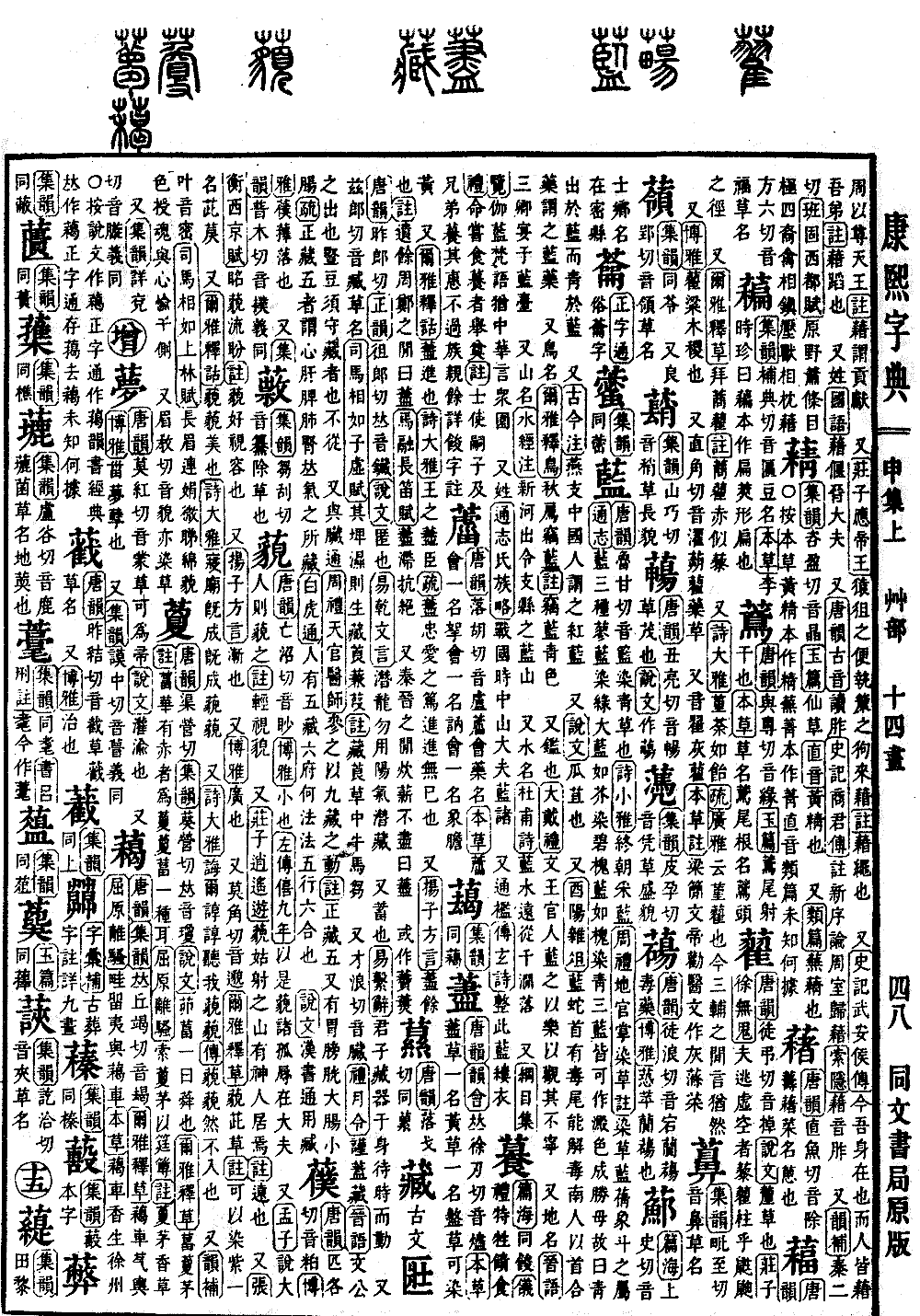
Shen Collection, Upper Volume
Radical: Grass (cǎo)
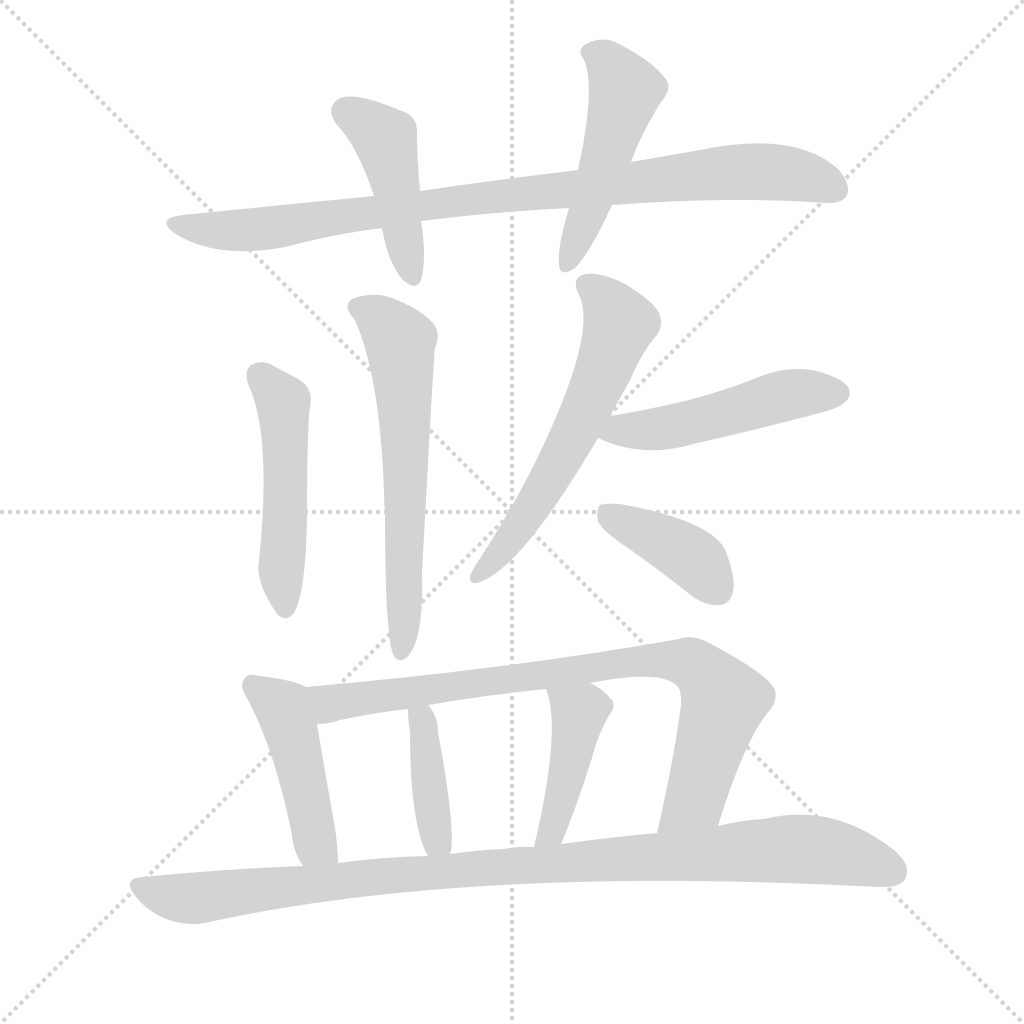
藍
Kangxi Stroke Count: 20
Page 1064, Entry 01
Tang Dynasty Rhyme Dictionary (Tangyun): Pronounced lan. A grass used for dyeing blue.
Book of Odes (Shijing), Lesser Odes (Xiaoya): "Harvesting blue all morning."
Rites of Zhou (Zhouli), Office of the Earth: Notes on the managers of dyeing plants. These grasses include blue and madder, belonging to the species of dou.
General Records (Tongzhi): There are three kinds of blue: smartweed blue dyes green, large blue (like mustard) dyes azure, and sophora blue (like the sophora tree) dyes blue. All three can be used to make dye sediment. The resulting color excels the original plant, hence the saying: "Blue comes from the indigo plant but is bluer than the plant."
Records of Ancient and Modern Times (Gujinzhu): The Chinese call rouge honglan (safflower).
Explaining Graphs and Analyzing Characters (Shuowen Jiezi): Also refers to the stalks of melons.
Miscellaneous Morsels from Youyang (Youyang Zazu): The blue snake has a poisonous head and a tail that acts as an antidote. Southerners use the head in medicine, calling it blue medicine.
Also a bird name. Literary Expositor (Erya), Explanations of Birds: The autumn swallow is called qielan. Commentary: Qielan is an azure color.
Also means to test or observe. Records of the Elder Dai (Dadai Liji): King Wen examined his officials, observing them through music to see if they were restless.
Also a place name. Discourses of the States (Jinyu): The three ministers feasted at the Blue Terrace.
Also a mountain name. Commentary on the Classic of Water (Shuijingzhu): The New River emerges from Blue Mountain in Lingzhi County.
Also a river name. Du Fu's Poetry: The Blue River flows from afar through a thousand rapids.
Comprehensive Mirror of the Outline of History (Gangmu Jilan): Qielan (Sangharama), a Sanskrit term, which in the Central Plains is referred to as a garden for the monastic community.
Also a surname. General Records (Tongzhi), Treatises on Clans and Lineages: In the Warring States period, there was an official of the Zhongshan State named Lan Zhu.
Also interchangeable with lan (ragged). Fu Xuan's Poetry: "Adjusting these ragged clothes."
Textual research: The original text also mentions "jian" (to test), but it has been corrected to "lan" (to observe) based on the commentary to the Records of the Elder Dai.