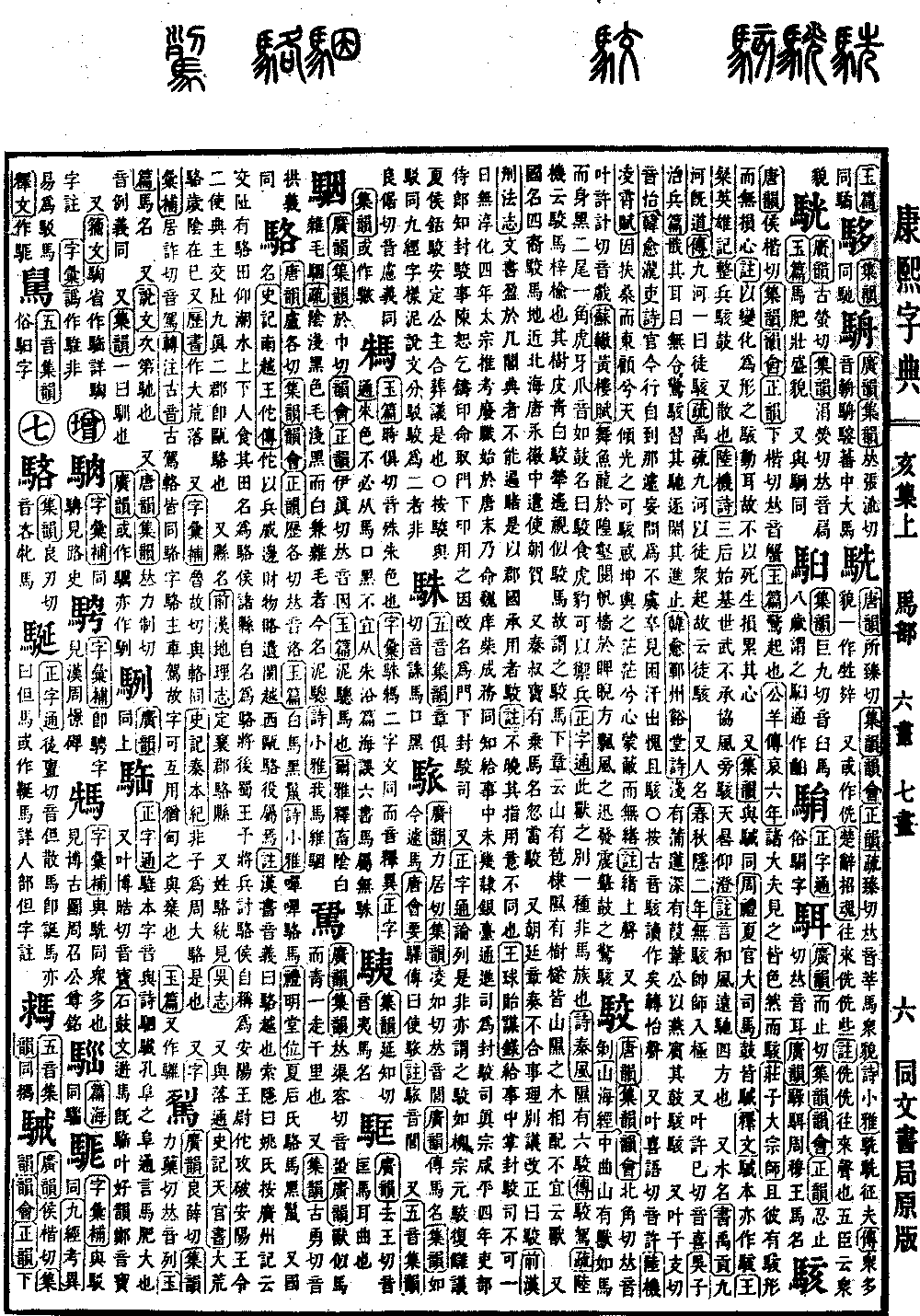
Hai Collection, Upper Volume
Radical: Horse (mǎ)
Entry: Luo
Kangxi stroke count: 16
Page 1438, Entry 01
Pronounced luò.
Yu Pian dictionary: A white horse with a black mane.
Book of Odes (Shijing): With panting, panting white horses with black manes.
Book of Rites (Liji): The Xia dynasty used white horses with black manes.
Also a state name. Records of the Grand Historian (Shiji), Biography of Zhao Tuo, King of Southern Yue: Tuo used military might to intimidate the border, using wealth and goods to bribe the Minyue, Western Ou, and Luo peoples, bringing them into submission. Commentary: The Han History Pronunciation and Meaning states that Luo refers to the Yue people. The Suoyin commentary states: Yao notes that according to the Guangzhou Record, Jiaozhi has Luo fields, which rely on the rising and falling of the tide. The people who eat from these fields are called Luo Lords; the various counties call themselves Luo Generals. Later, the King of Shu sent his general to attack the Luo Lords, proclaiming himself the King of Anyang. Zhao Tuo defeated the King of Anyang and sent two envoys to govern the two commanderies of Jiaozhi and Jiuzhen; these are the Ou Luo.
Also a county name. History of the Former Han Dynasty (Hanshu), Treatise on Geography: Luo County in Dingxiang Commandery.
Also a surname; Luo Tong, see Records of the Three Kingdoms, History of Wu (Wuzhi).
Also interchangeable with luò. Records of the Grand Historian (Shiji), Treatise on the Celestial Offices: The year Dahuangluo, when the yin energy is in the si position.
Also written as Dahuangluo in the Treatise on Calendars.
Also Zi Huibǔ: Pronounced lù, identical to the character for carriage. Records of the Grand Historian (Shiji), Annals of Qin: Feizi served Zhou Da Luo, this is it.
Also Zi Huibǔ: Pronounced jià. Collected Ancient Pronunciations: In ancient times, the characters for carriage (jià) and the carriage character (lù) were both identical to the character for Luo. As Luo pertains to the carriage and its team, the characters can be used interchangeably, much like the characters for royal hunting grounds (diàn) and carriages (shèng).
Yu Pian dictionary: Also written in a variant form.