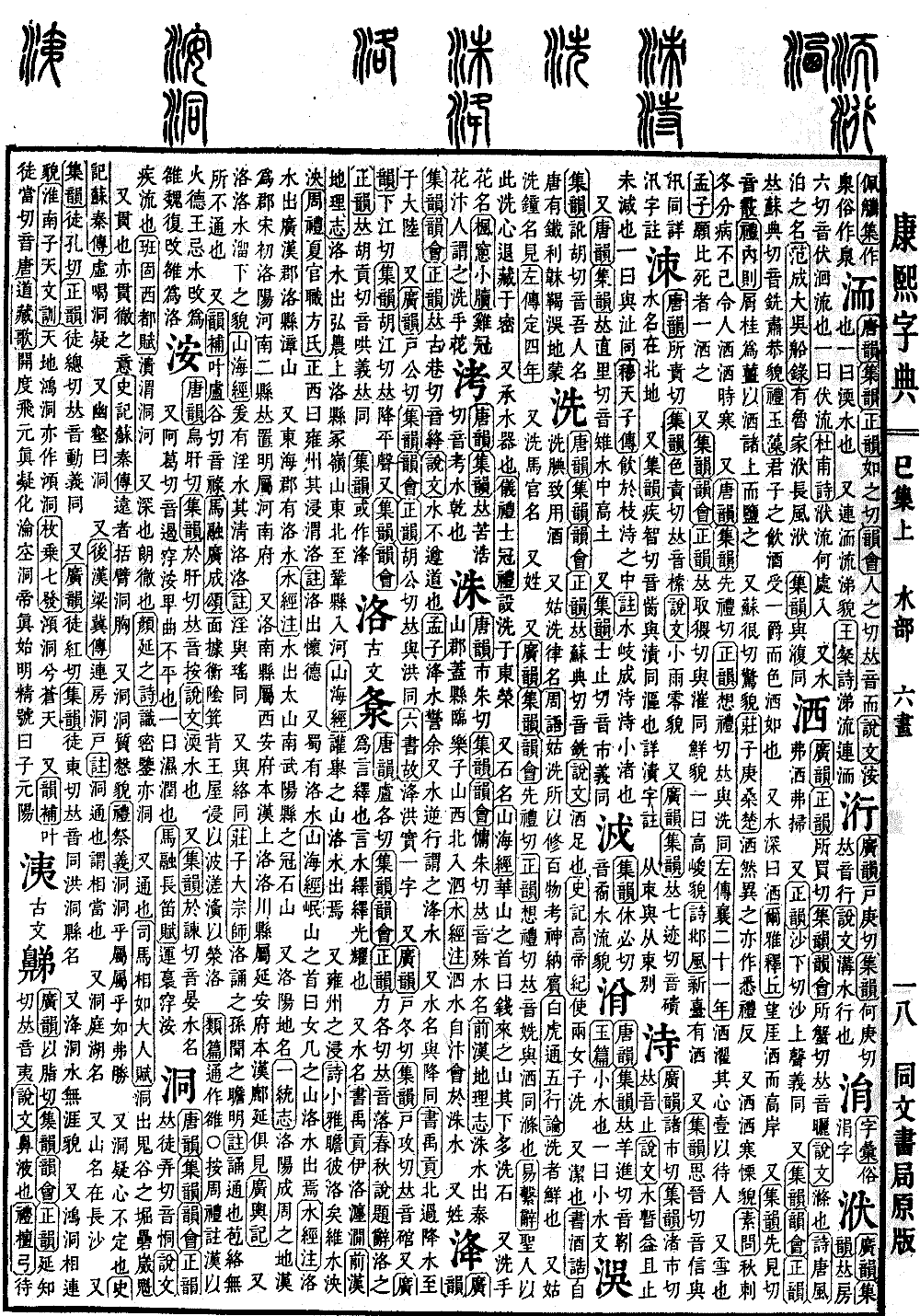
Si Collection, Upper Volume
Radical: Water (shuǐ)
Luo; Kangxi strokes: 10; Page 620, Entry 15
The ancient form is written as (luò). Pronounced luo. According to Collection of Rhymes (Jiyun), Rhyme Treasury (Yunhui), and Correct Rhymes (Zhengyun), it is pronounced luo, with the same sound as fall. According to Spring and Autumn: Explanatory Preface (Chunqiu Shuotici), the meaning of the character Luo is interpreted as continuous, describing the appearance of water flowing unceasingly and shimmering with light.
It is also the name of a river. Book of Documents (Shujing): Tributary of Yu (Yugong) records the Yi River, Luo River, Chan River, and Jian River. Former Han: Treatise on Geography (Qianhan Dilizhi) records: The Luo River originates from Zhongling Mountain in Shangluo County, Hongnong Commandery, and flows northeast to enter the Yellow River at Gong County. Classic of Mountains and Seas (Shanhaijing) records: Huanju Mountain is the source of the Luo River.
It is also a river marsh of Yong Province. Book of Odes (Shijing): Lesser Odes (Xiaoya) states: Look at that Luo River, how vast and mighty its surface is. Rites of Zhou (Zhouli): Summer Offices (Xiaguan) records: To the direct west is Yong Province, where the river marshes are the Wei River and the Luo River. Commentary: Indicates that the Luo River originates in Huaide.
Additionally, there is a Luo River in the Shu region. Classic of Mountains and Seas (Shanhaijing) records: The beginning of the Min Mountain range is Nuji Mountain, from which the Luo River originates. Commentary on the Water Classic (Shuijingzhu) records: The Luo River originates from Zhang Mountain in Luo County, Guanghan Commandery.
There is also a Luo River in Donghai Commandery. Commentary on the Water Classic (Shuijingzhu) records: This water originates from Guanshi Mountain in Nanwuyang County, Tai Mountain.
There is also Luoyang, a place name. Comprehensive Gazetteer (Yitongzhi) records: Luoyang is the location of Chengzhou. A commandery was established in the Han dynasty. In the early Song dynasty, Luoyang and Henan counties were established. During the Ming dynasty, it belonged to Henan Prefecture.
There is also Luonan County, which belongs to Xi'an Prefecture and was originally Shangluo County in the Han dynasty. Luochuan County belongs to Yan'an Prefecture and was originally the Fuyan region in the Han dynasty. Both are found in Record of Universal Geography (Guangyuji).
There is also the term luoluo, which describes water flowing downward. Classic of Mountains and Seas (Shanhaijing) states: Here is Yao Lake, the water is clear and flows down slowly. Commentary: The character yin is the same as the character yao.
It is also used interchangeably with the character (luò). Zhuangzi: Great and Venerable Teacher (Dazongshi) states: The descendants of the Luo-reciting one hear this and see clearly. Commentary: The character song means to understand. It encompasses everything and there is nothing it does not comprehend.
Also, according to Rhyme Supplement (Yunbu), it is pronounced lu, with the same sound as salary. Ma Rong: Ode to Guangcheng (Guangcheng Song) states: The front leans against the north side of Heng Mountain, and the back leans against Wangwu Mountain. It is moistened by the Bo River and Zhe River, and converges with the Ying River and the Luo River. Categorized Chapters (Leipian) explains that it is also written as (luò). According to the Commentary on the Rites of Zhou (Zhouli Zhu), because the Han dynasty considered the virtue of fire to be their governing principle, they avoided the water radical, so they changed Luo to (luò). During the Wei dynasty, it was changed back to Luo.