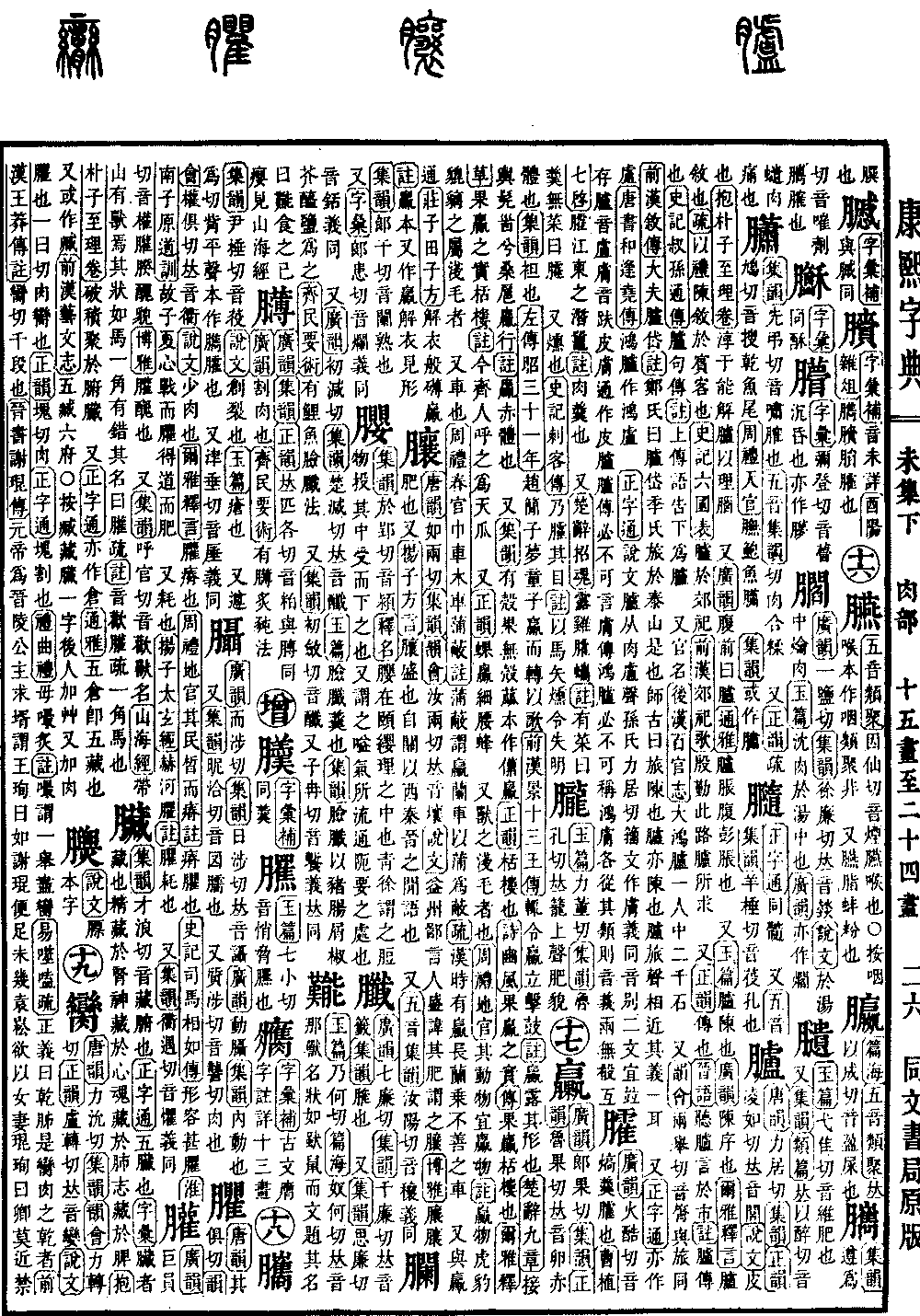
Wei Collection, Lower Volume
Radical: Meat (ròu)
Entry: Lu
Kangxi stroke count: 22
Page 998, Entry 01
Pronounced lu. According to the Shuowen Jiezi, it means skin. In the Baopuzi, it states that Chunyu could treat the skin to regulate the brain.
Also, according to the Guangyun, the front of the abdomen is called lu. In the Tongya, it mentions lu-zhang, meaning abdominal distension.
Also, according to the Yupian, lu means to arrange. According to the Guangyun, to arrange is to order. In the Erya, Shiyan, it states that lu means to narrate. The commentary explains this as arranging and narrating matters to guests according to ritual. In the Records of the Grand Historian (Shiji), it is written that it was arranged during the suburban sacrifices. In the Book of Han (Hanshu), it states that one must be sincere in seeking what is requested through these paths.
Also, according to the Zheng Yun, it means to transmit. In the Discourses of the States (Jin Yu), it says to listen to transmitted words in the market; the commentary explains that lu means to transmit. In the Records of the Grand Historian (Shiji), it mentions transmitting sentences; the commentary explains that for those above to transmit words to those below is called lu.
Also, a title for an official. In the Book of the Later Han (Hou Hanshu), it is recorded that there was one Grand Herald (Da Honglu), with a salary rank of two thousand piculs.
Also, pronounced lu (third tone), same as lu. In the Book of Han (Hanshu), it mentions the high official lu-dai. The commentary by Zheng says that lu-dai is equivalent to the Ji clan performing the sacrifice at Mount Tai. Shigu says that lu means to arrange, and lu also means to arrange; the sounds are similar and the meanings are the same.
Also, according to the Zhengzitong, it is also written as lu. In the Book of Tang (Tangshu), it is recorded that the Grand Herald was written as Honglu. The Zhengzitong notes that the Shuowen states that lu is derived from the meat radical with a phonetic component, and that the seal script form is written as fu. They share the same meaning but have different pronunciations; the two forms should both be kept. Lu is pronounced lu and fu is pronounced fu. Skin and lu are interchangeable, but transmission of lu cannot be called transmission of fu, and the Grand Herald cannot be called the Grand Fu. Each should follow its own classification so that the meanings are not confused.