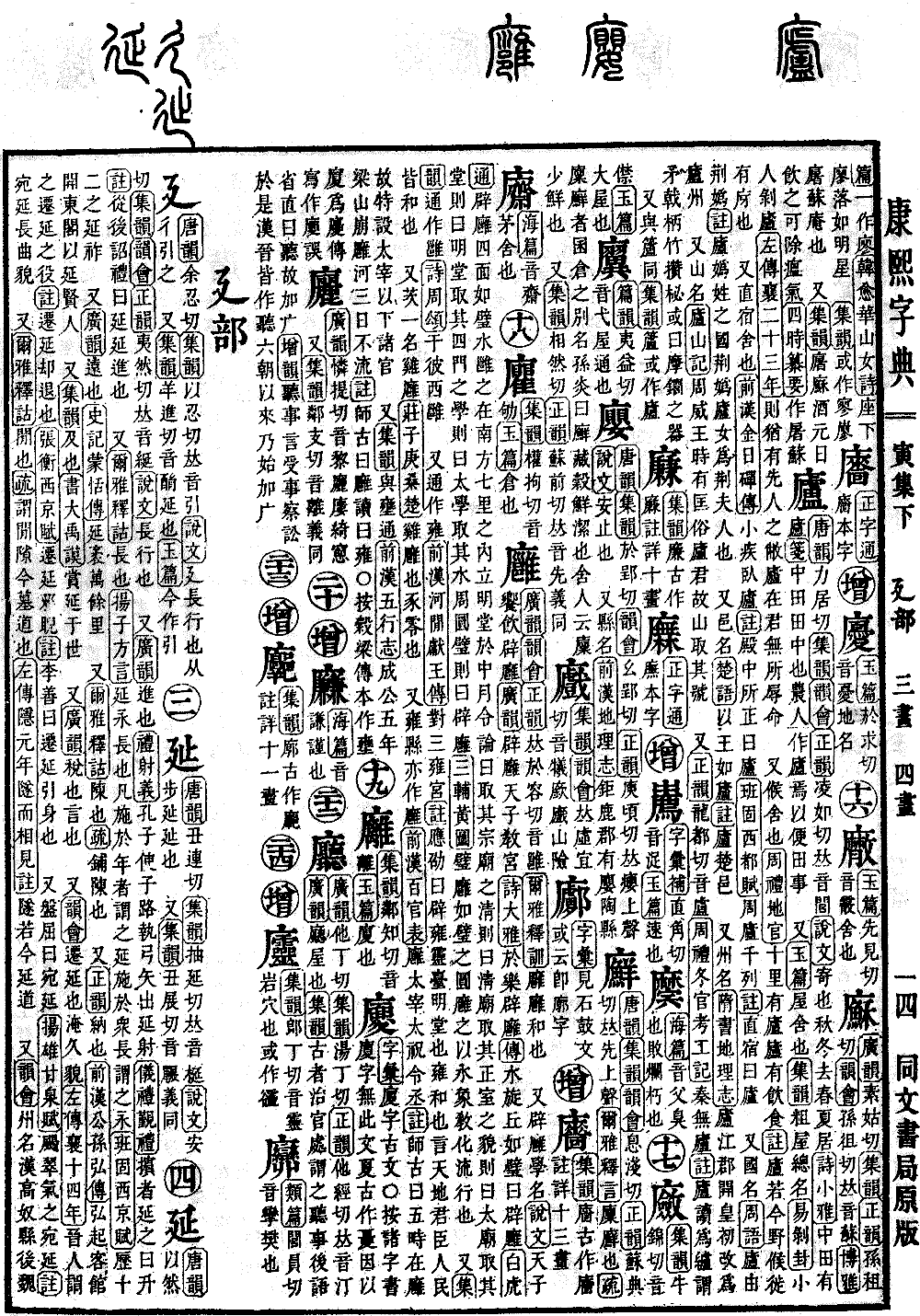
Yin Collection, Lower Volume
Radical: Broad (guǎng)
Kangxi Strokes: 19
Page 352, Entry 05
Pronounced lü. According to Tang Rhyme (Tangyun), Jiyun, Yunhui, and Zhengyun, the pronunciation is the same as the character lü.
Shuowen Jiezi defines this as a place of temporary residence. One leaves in the autumn and winter and resides there during the spring and summer.
Book of Odes (Shijing), Lesser Odes (Xiaoya): "In the middle of the fields are huts." The commentary by Zheng Xuan states: "Middle of the fields" refers to the center of the cultivated land. Farmers build huts there to facilitate their agricultural work.
Furthermore, Yupian defines it as a house or dwelling.
Jiyun defines it as a general term for simple, humble dwellings.
Book of Changes (Yijing), Bo Hexagram: "The petty man peels away the hut."
Zuo Commentary (Zuo Zhuan), Year 23 of Duke Xiang: "Since there is still a dilapidated hut left by my ancestors, I dare not trouble Your Majesty to deign to come here."
It also refers to an inn or lodging.
Rites of Zhou (Zhouli), Earth Offices: "Every ten li, there is a hut; the hut provides food and drink." The commentary states: "A hut is like the modern-day roadside station, a place for travelers to rest briefly."
It also refers to a dwelling for those on night watch or guard duty.
Book of Han (Hanshu), Biography of Jin Ridi: "Due to a minor illness, he lay in a hut." The commentary states: "The place where one sleeps while on night watch in the palace is called a hut."
Ban Gu's Western Metropolis Rhapsody (Xidu Fu) writes: "The night-watch huts are lined up in thousands." The commentary states: "The dwelling for night watch is called a hut."
It also refers to the name of a feudal state.
Discourses of the States (Guoyu), Discourses of Zhou: "Lu originated from Jing Gui." The commentary states: "Lu was a feudal state with the surname Gui; Jing Gui refers to a woman from the state of Lu who became a wife to the ruler of Chu."
It also refers to the name of a city.
Discourses of the States (Guoyu), Discourses of Chu: "Accompanied the king to Lu." The commentary states: "Lu was a city in the state of Chu."
It also refers to the name of a prefecture.
Book of Sui (Suishu), Treatise on Geography: "Lujiang Commandery was renamed Luzhou in the early Kaihuang era."
It also refers to the name of a mountain.
Account of Mount Lu (Lushan Ji) records: During the reign of King Wei of Zhou, there was a man named Kuang Su, known as Lord Lu, hence the mountain was named after him.
Pronounced lu. According to Zhengyun, this pronunciation is the same as the character lu.
Rites of Zhou (Zhouli), Winter Offices, Artificers' Record: "Qin has no lu." The commentary states: In this context, "lu" is pronounced like the word lü and refers to the part of the handle of a spear or halberd wrapped in bamboo strips for grip. Some say it refers to an implement for polishing weapons.
Also a variant form of the character lü (lu). Jiyun records: The character lü (lu) is sometimes written as this character.
Textual research: In the Book of Han (Hanshu), Biography of Jin Ridi, the text "Small illness, lay in the hut," with the commentary originally reading "The place where one is correct in the palace is called a hut," has been carefully corrected based on the original book to read "The place where one stops in the palace is called a hut."