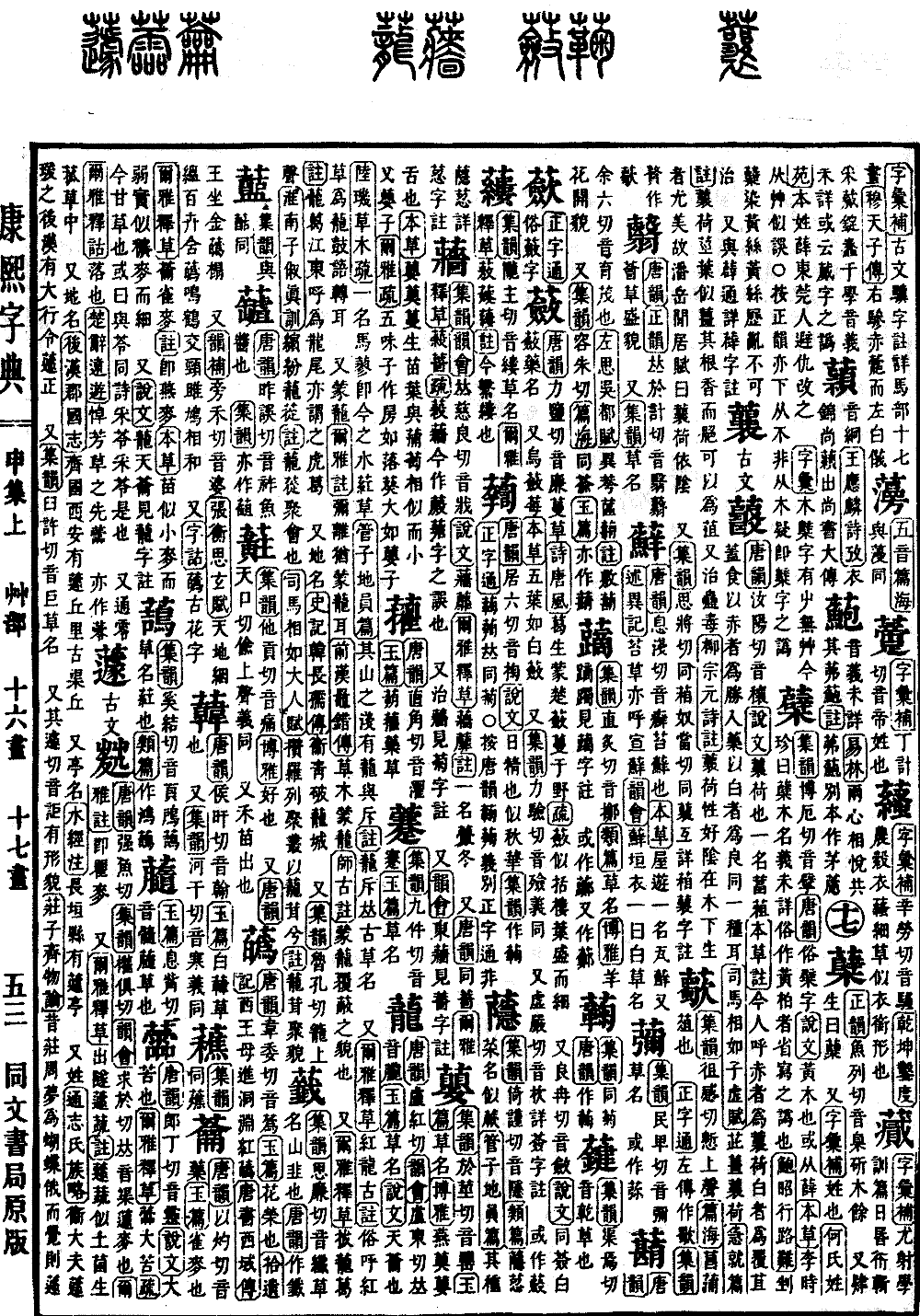
Shen Collection, Upper Volume
Radical: Grass (cǎo)
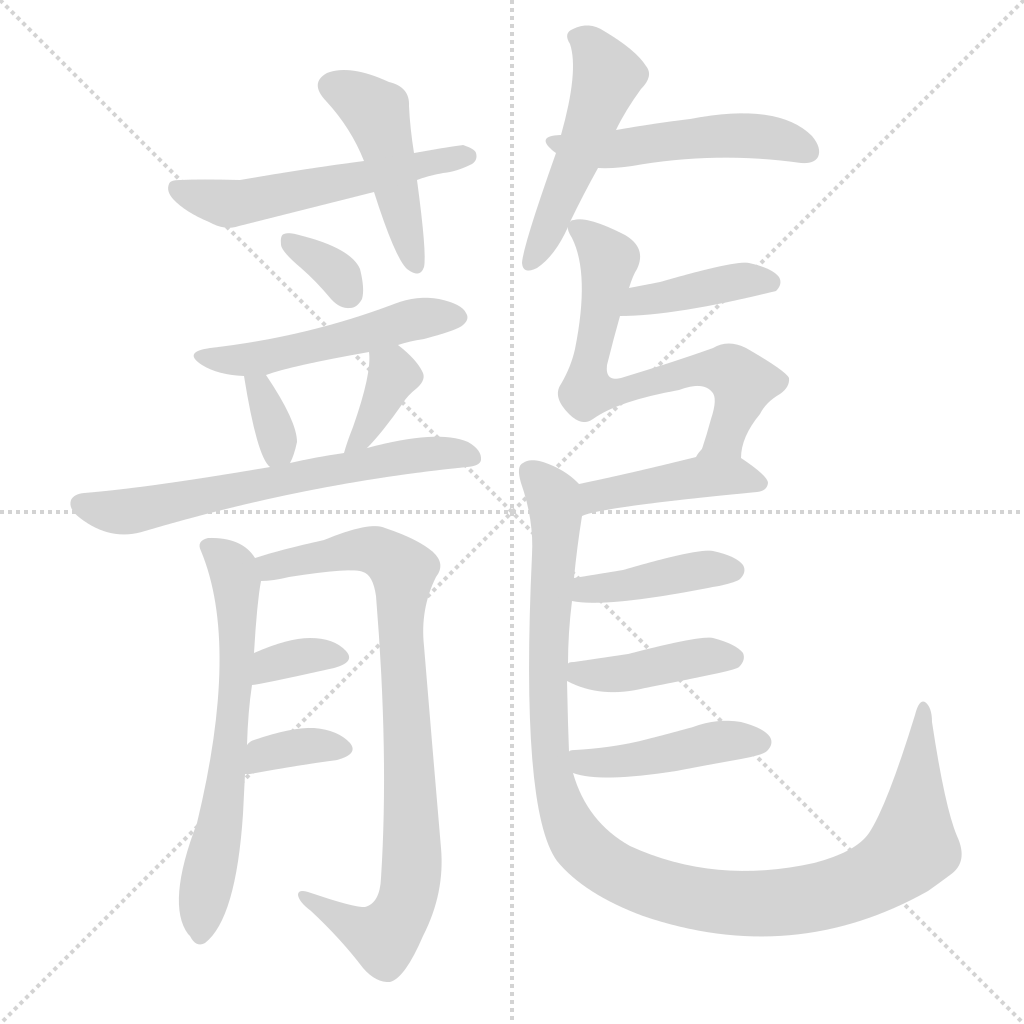
Long
Kangxi strokes: 23
Page 1069, Entry 28
Pronounced long
In the Jade Chapters (Yupian), the name of a plant.
In the Explanation of Writing (Shuowen), it refers to the plant known as tian yue.
In the Commentary on Plants and Trees (Caomu Shu) by Lu Ji, it is also known as horse knotweed (ma liao), which is the water knotweed (shui hong cao) of today.
In the Guanzi, Earth Personnel Section (Diyuan Pian): Where the mountain is shallow, there is long and chi. Commentary: Long and chi are ancient plant names.
In the Erya, Explaining Plants (Shicao): Hong, also known as long gu. Commentary: People commonly call the red plant long gu; the pronunciation has shifted.
Also meng long (luxuriant). In the Erya Commentary: Mili is the same as meng long.
In the History of the Former Han (Qianhan Shu), Biography of Chao Cuo: Plants and trees are meng long.
Commentary by Shigu: Meng long describes the appearance of being covered or obscured.
Also in the Erya, Explaining Plants: Ba is known as long ge. Commentary: Long ge is called long wei (dragon tail) in the Jiangdong region; it is also called hu ge (tiger creeper).
Also a place name. In the Records of the Grand Historian (Shiji), Biography of Han Changru: Wei Qing defeated Long City.
Also pronounced long (rising tone).
In the Huainanzi, Authentic Training (Chuzhen Xun): Fen long cong. Commentary: Long cong means gathered together.
In the Rhapsody on the Great Man (Daren Fu) by Sima Xiangru: Gathered, arranged, and clustered together in a long rong manner. Commentary: Long rong describes an appearance of being gathered.