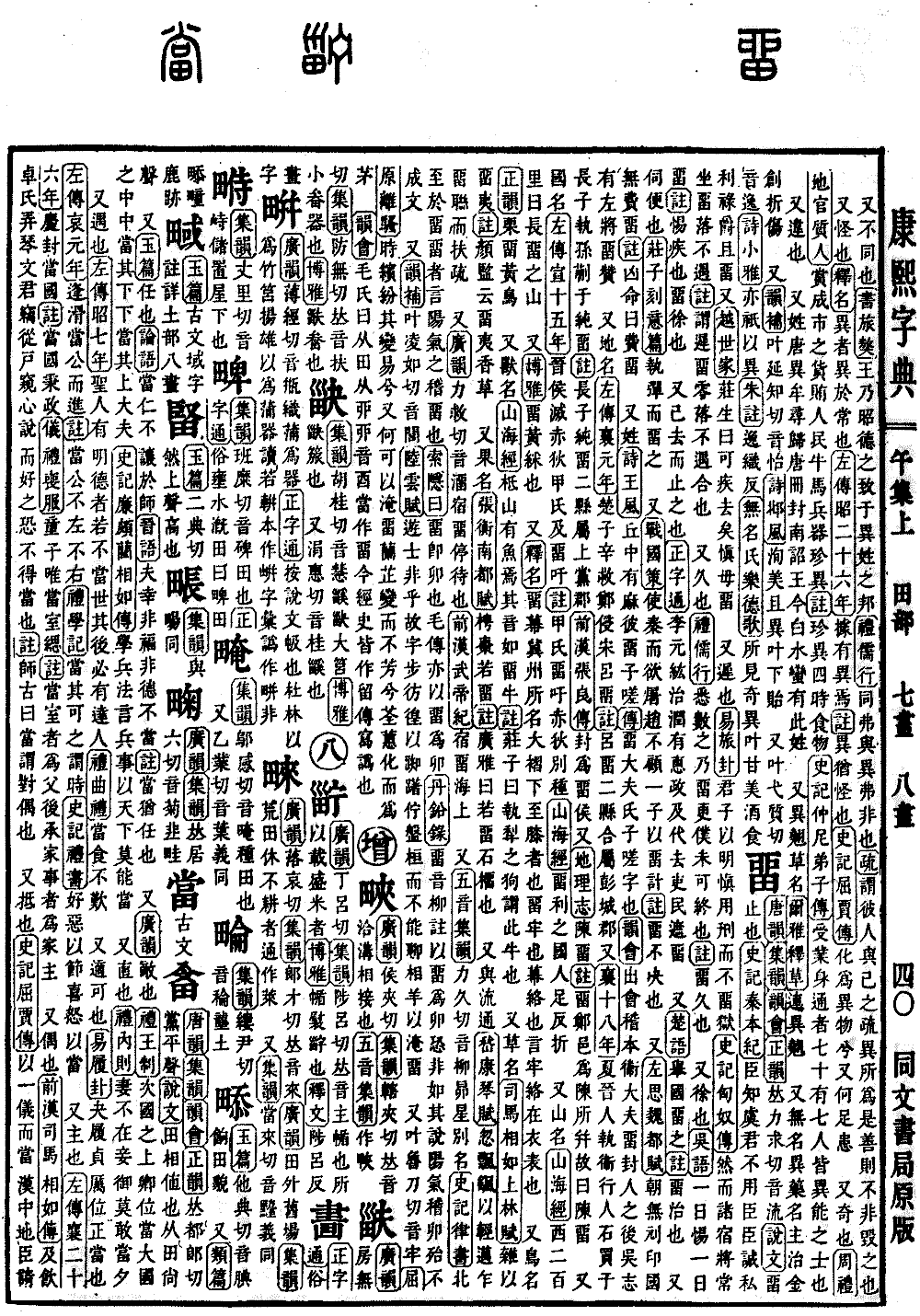
Wu Collection, Upper Volume
Radical: Field (tián)
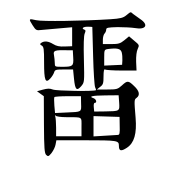
畱
Kangxi Stroke Count: 12
Page 764, Entry 01
Pronounced liu (rising tone).
From the Explaining Graphs and Analyzing Characters (Shuowen): to stop.
From Records of the Grand Historian (Shiji), Annals of Qin: I know that the Duke of Yu will not employ me, but I am sincerely greedy for salary and title, and thus I hesitate.
From Records of the Grand Historian, History of the Yue: Master Zhuang said, depart quickly and do not stay.
Also means to delay.
From Book of Changes (Yijing), Hexagram of the Traveler: The noble man uses his wisdom to be cautious and does not delay legal judgments.
From Records of the Grand Historian, Account of the Xiongnu: However, many veteran generals were frequently dismissed for lingering and failing to advance.
Commentary: This refers to lingering and failing to achieve success.
Also means a long time.
From Book of Rites (Liji), The Conduct of a Scholar: If we were to count them all, we would have to stay until the servants were changed, and we would still not be finished.
Commentary: This means a long time.
Also means slowly.
From Discourses of the States (Guoyu), Narratives of Wu: One day vigilant, one day slow.
Commentary: Vigilant means fast. Slow means moving leisurely.
Also to cause someone who has already left to stop.
From Explanatory Text of Standard Characters (Zhengzitong): When Li Yuanhong governed Runzhou, his administration was benevolent. When he was replaced and departed, the officials and commoners blocked his path to make him stay.
From Discourses of the States, Narratives of Chu: The entire state asked him to stay.
Commentary: To govern.
Also to wait for an opportunity.
From Zhuangzi, External Chapters: He held a slingshot and waited for it.
From Stratagems of the Warring States (Zhanguoce): He was sent to the Qin state intending to slaughter the Zhao state, and without concern for his son, he held back his plans.
Commentary: To be indecisive.
From Zuo Tradition (Zuozhuan), First Year of Duke Xiang: The Viscount of Chu, Zixin, went to rescue Zheng and invaded the Lu and Liu districts of the Song state.
Commentary: The two districts of Lu and Liu are currently under the jurisdiction of Pengcheng Commandery.
Also a surname.
From Book of Odes (Shijing), Odes of Wang: In the hills there are hemp plants; that is where Master Liu Zichao resides.
Commentary: Liu is the clan name of a high official. Zichao is his courtesy name.
From Collection of Rhymes (Yunhui): He emerged from Kuaiji and was originally a high official of the Wei state, a descendant of the enfeoffed people of Liu. The Records of Wu mention the General of the Left, Liu Zan.
Also a place name.
From Zuo Tradition, First Year of Duke Xiang: The Viscount of Chu, Zixin, rescued Zheng and invaded the Lu and Liu districts of the Song state.
Commentary: The two districts of Lu and Liu are currently under the jurisdiction of Pengcheng Commandery.
From Zuo Tradition, Eighteenth Year of Duke Xiang: In summer, the people of the Jin state captured the envoy of the Wei state, Shi Mai, at Changzi, and captured Sun Kuai at Chunliu.
Commentary: The two districts of Changzi and Chunliu are under the jurisdiction of Shangdang Commandery.
From History of the Former Han (Qianhan), Biography of Zhang Liang: He was enfeoffed as the Marquis of Liu.
From Geographic Treatise (Dilizhi): Liu.
Commentary: Liu was a fief of the Zheng state, which was annexed, hence it is called Liu.
Also a state name.
From Spring and Autumn Annals (Chunqiu), Sixteenth Year of Duke Xuan: The people of the Jin state exterminated the Jia clan of the Red Di, as well as Liuxu.
Commentary: The Jia clan and Liuxu are separate tribes of the Red Di.
From Classic of Mountains and Seas (Shanhaijing): The state of Liuli, where the people's feet are inverted.
Also a mountain name.
From Classic of Mountains and Seas: Two hundred li to the west is the mountain called Changliu.
Also from Broad Collection of Refined Expressions (Boya): A yellow color.
Also from Explaining Names (Shiming): A Liumu is a term used in Jizhou for a large robe that reaches the knees. Liu means to hold, Mu means to entwine. It means the garment is held and entwined on the body.
Also a bird name.
From Standardized Rhymes (Zhengyun): The Lvliu is a yellow bird.
Also a beast name.
From Classic of Mountains and Seas: There is a fish in Di Mountain, its sound is like a Liu cow.
Commentary: Zhuangzi says, the dog that catches the ox refers to this cow.
Also a grass name.
From Sima Xiangru, Rhapsody on the Shanglin Park: Mixed with Liuyi.
Commentary: Yan Jian says Liuyi is a fragrant herb.
Also a fruit name.
From Zhang Heng, Rhapsody on the Southern Capital: The Ying date and the Ruoliu.
Commentary: Broad Collection of Refined Expressions says: Ruoliu is the pomegranate.
Also used interchangeably with flow.
From Ji Kang, Rhapsody on the Zither: Suddenly drifting and floating, lightly moving; intermittently lingering, spreading out.
Also from Collection of Rhymes (Guangyun), pronounced liu (falling tone). Suoliu means to stop and wait.
From History of the Former Han, Annals of Emperor Wu: Waited for a long time on the sea.
Also from Five Sounds Collection of Rhymes (Wuyin Yunhui), pronounced liu (rising tone). Another name for the Mao star.
From Records of the Grand Historian, Treatise on Harmonics: In the north, it reaches up to the Liu. Liu refers to the lingering of the Yang energy.
Commentary: The Suoyin says: Liu is Mao. The Mao commentary also considers Liu to be Mao.
From Record of Vermilion (Danqian Lu): Liu, pronounced liu (rising tone). The commentary considers Liu to be Mao, which I fear is incorrect. If we follow this theory that the Yang energy lingers at Mao, it barely forms a coherent sentence.
Also from Rhyme Supplement (Yunbu), rhyming with lü (rising tone).
From Lu Yun's Rhapsody: The traveling scholar is not of the old characters, pacing hesitantly in indecision. Lingering and hovering, unable to leave, just wandering to delay the time.
Also rhyming with lao (rising tone).
From Qu Yuan, Encountering Sorrow (Lisao): The times are chaotic and changing; how can one linger here? The orchids and angelica change and lose their fragrance; the thoroughwort and wild ginger turn into weeds.
From Collection of Rhymes (Yunhui): Master Mao says: composed of Field and the character You, where You is the phonetic; it should be written as Liu. Currently, in classics and histories, it is all written as the character for flow. This is an error in transcription.