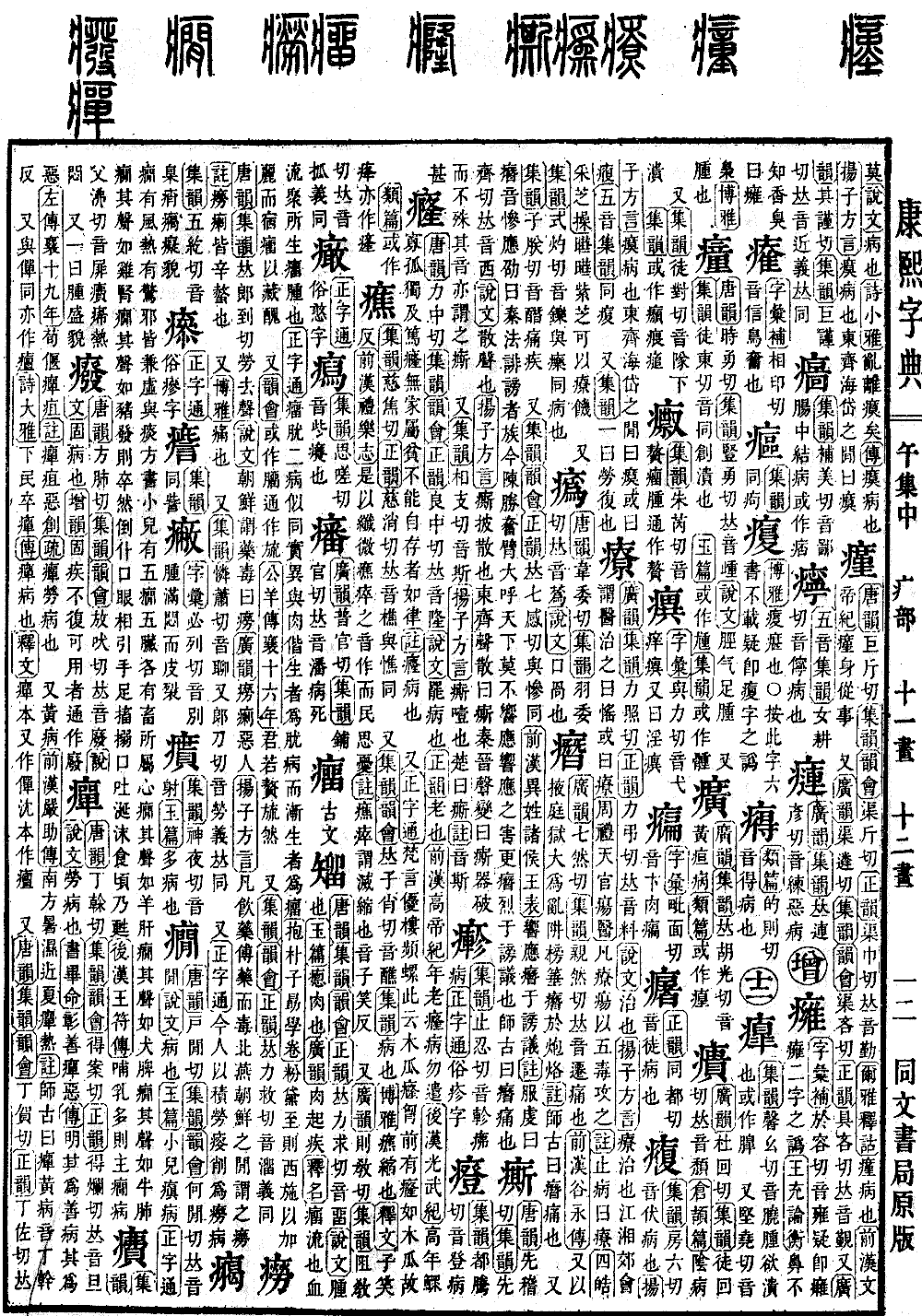
Wu Collection, Middle Volume
Radical: Sickness (bì)
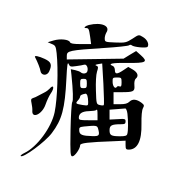
Entry: Liu
Kangxi Stroke Count: 17
Page 780, Entry 30
Ancient character. According to Tang Rhymes (Tangyun), Collected Rhymes (Jiyun), Rhyme Meetings (Yunhui), and Orthodox Rhymes (Zhengyun), it is pronounced liu. According to Explaining Graphs and Analyzing Characters (Shuowen), it means a swelling. According to Jade Chapters (Yupian), it is a polyp or fleshy growth. According to Extensive Rhymes (Guangyun), it is a disease where flesh rises. According to Explanations of Names (Shiming), liu means to flow; it is a swelling or growth where blood flows and gathers. According to General Dictionary of Characters (Zhengzitong), the two illnesses of liu and wart are similar in appearance but different in nature. That which grows along with the flesh is a wart, while that which develops as a result of illness is a liu. According to Master Baopu's Exhortation to Learning (Baopuzi Xuxue), when powder and black pigment are applied, the beauty of Xi Shi is enhanced, but the existing growth conceals her ugliness. Also, according to Rhyme Meetings (Yunhui), sometimes written as a variant form. Commonly used interchangeably with liu. According to Gongyang Commentary to the Spring and Autumn Annals (Gongyang Zhuan), 16th Year of Duke Xiang, the lord is like a dangling tassel. Also, according to Collected Rhymes (Jiyun), Rhyme Meetings (Yunhui), and Orthodox Rhymes (Zhengyun), it is pronounced liu (falling tone). The meaning is the same.
Textual verification: Also, according to Rhyme Meetings (Yunhui), it is written as a variant form. Commonly used interchangeably with liu. According to Gongyang Commentary to the Spring and Autumn Annals (Gongyang Zhuan), 16th Year of Duke Xiang, the lord is like a dangling tassel. Adjusted according to the original text, both instances of the character for tassel have been corrected to read liu.