Hai Collection, Lower Volume
Radical: Deer (lù)
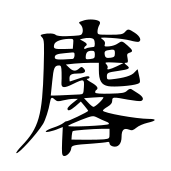
Lin (麐); Kangxi strokes: 18; Page 1510, Entry 13
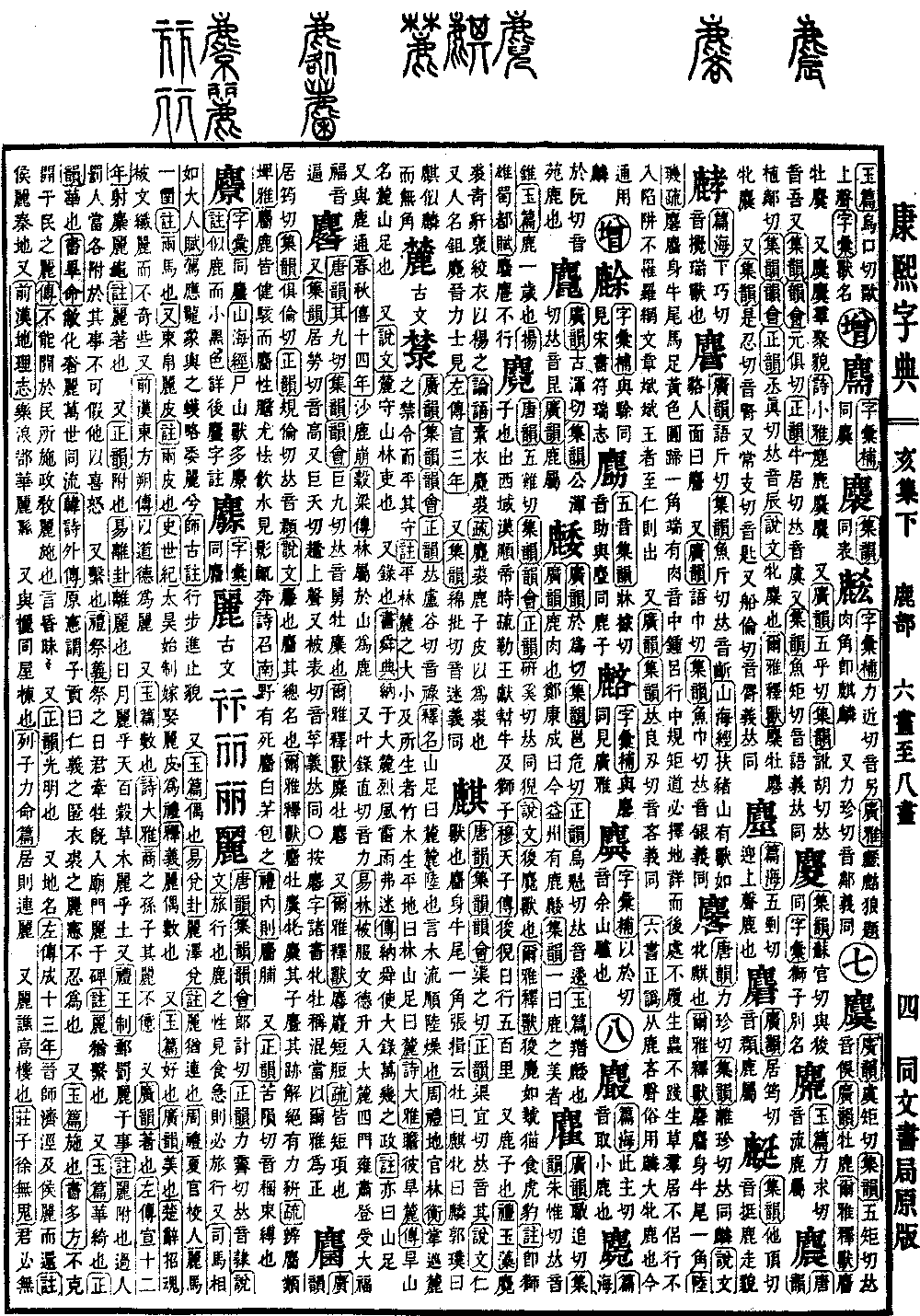
Pronounced lin. According to the Tang Rhyme (Tangyun) and Collected Rhymes (Jiyun), it is the same as lin. According to the Explaining Graphs and Analyzing Characters (Shuowen), it refers to a female qilin. In the Approaching Elegance (Erya), section on beasts, it states: Lin has the body of a muntjac, the tail of an ox, and one horn. Lu Ji's commentary states: Lin has the body of a muntjac, the tail of an ox, and the feet of a horse. It is yellow in color, with round hooves and a single horn with a fleshy tip. Its voice matches the musical pitch of zhong and lv, and its movements follow the rules of the compass and square. In traveling, it must choose its ground, acting only after careful consideration. It does not tread on living insects, nor does it step on living grass. It lives in a group but does not associate with others, and when walking, it does not fall into traps nor get caught in nets. Its markings are elegant and refined; it appears when a king attains perfect benevolence. Also, according to the Expanded Rhymes (Guangyun) and Collected Rhymes (Jiyun), it is pronounced lin (falling tone). The meaning is the same. According to The Six Scripts: Errors Rectified (Liushu zhenge), it is formed with the radical for deer and the phonetic element lin. It is commonly written as the variant character lin. It originally referred to a large female deer. It is now commonly used for the mythological creature lin.