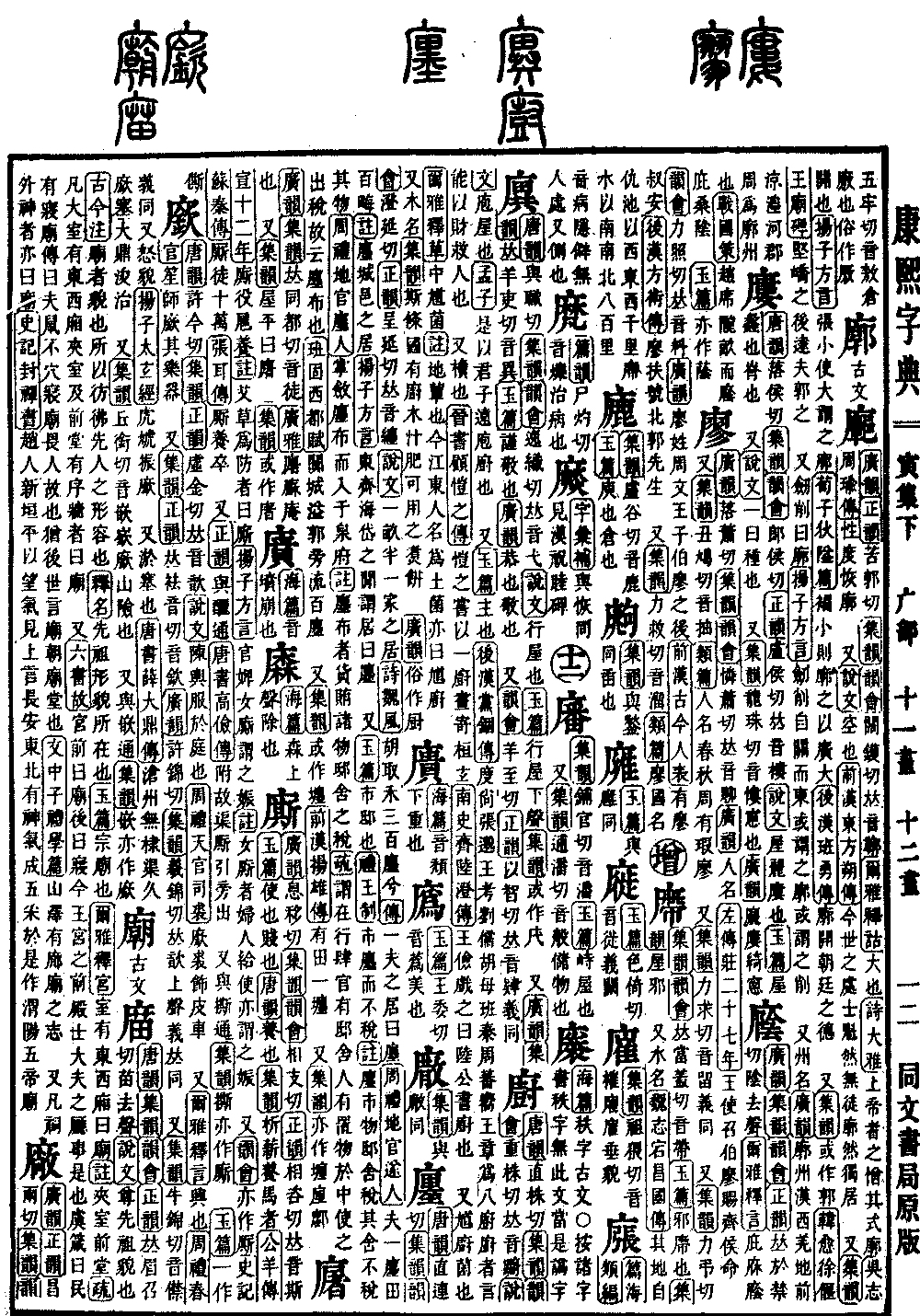
Yin Collection, Lower Volume
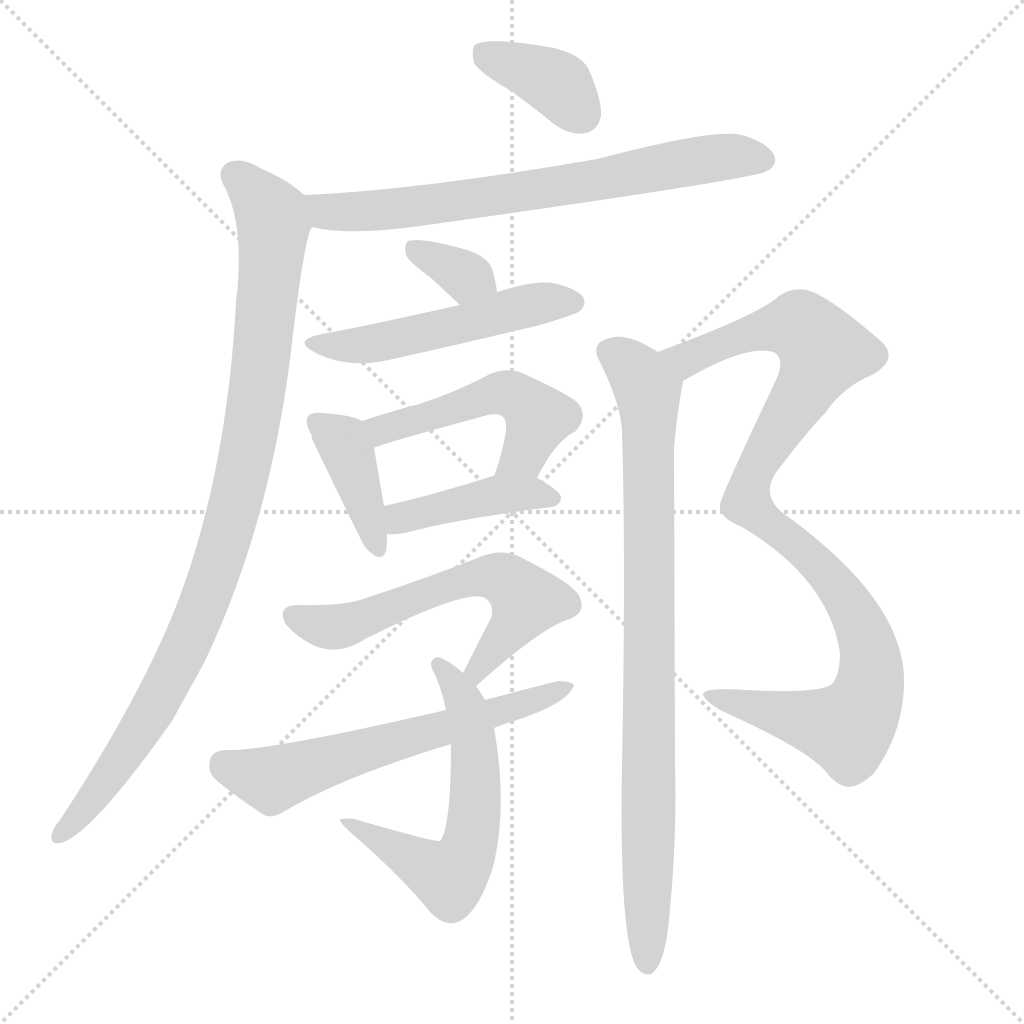
Radical: Wide (guǎng)
Kangxi strokes: 14
Page 350, Entry 01
Ancient character.
Pronounced kuo.
Pronounced kuo.
Pronounced kuo.
According to the Erya (Erya), a dictionary of definitions, it means great.
In the Book of Odes (Shijing), it is written: The Emperor of Heaven bestowed it upon him, and he hated those who made it grand.
In the Records of Wu (Wuzhi), specifically the Biography of Zhou Yu, it is written: His nature and tolerance were expansive and broad.
Also, according to the Shuo Wen (Shuowen Jiezi), a dictionary of characters, it means empty.
In the History of the Former Han (Qianhan Shu), specifically the Biography of Dongfang Shuo, it is written: The scholars of this age are prominent yet without followers, living in empty isolation.
Also, according to the Jiyun (Jiyun), it means to open.
In the Dialects (Fangyan), it is written: To stretch something small to make it large is called kuo.
In the Xunzi (Xunzi), specifically the section on Di Ai, it is written: If the Xunzi is narrow, restricted, and small, then expand it to be vast and great.
In the History of the Later Han (Houhan Shu), specifically the Biography of Ban Yong, it is written: To expand and open up the virtue of the imperial court.
Also, according to the Jiyun (Jiyun), it is sometimes written as the character guo.
In the writings of Han Yu, specifically the Temple of King Xu Yan, it is written: After the Jianqiao, the master reached the boundary.
Also, it refers to the scabbard of a sword.
In the Dialects (Fangyan), it is written: A sword scabbard, from the passes to the east, is sometimes called kuo or sometimes called xiao.
Also, the name of a prefecture.
According to the Guangyun (Guangyun), Kuo Prefecture was the land of the Western Qiang during the Han dynasty, served as Huanghe Commandery during the Former Liang, and became Kuo Prefecture during the Zhou dynasty.
Verification: In the Xunzi, Di Ai section, the original text reads: narrow, restricted, and small, then expand it to be vast and great. This has been corrected to match the original text: the Xunzi is narrow, restricted, and small, then expand it to be vast and great.