Yin Collection, Lower Volume
Radical: Broad (guǎng)
Kangxi Strokes: 14
Page 349, Entry 29
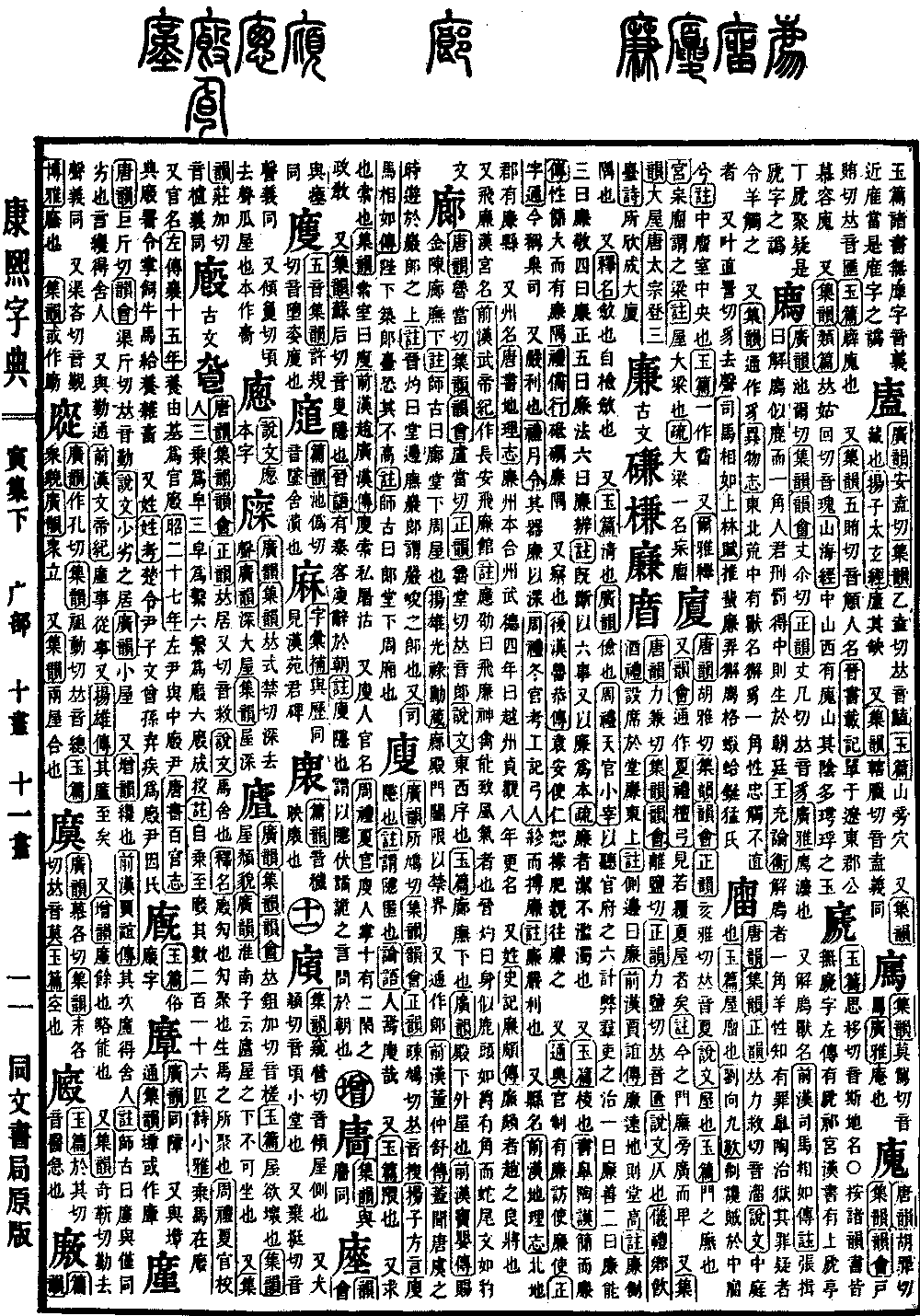
Pronounced qín. According to the Classic of Explaining Graphs and Analyzing Characters (Shuowen Jiezi), it refers to a simple or crude dwelling. The Broad Rhymes (Guangyun) defines it as a small hut. Additionally, the Expanded Rhymes (Zengyun) indicates the meaning of just or only just. In the Biography of Jia Yi from the History of the Former Han (Qianhan Shu), it is written: The next rank only just attained the status of a guest attendant. The commentary by Yan Shigu states: This is identical to the character for merely or barely. It denotes something meager or achieved with difficulty, meaning that one just barely qualified for the position of guest attendant. It is also interchangeable with the character for diligent. In the Annals of Emperor Wen from the History of the Former Han (Qianhan Shu), it is used in the sense of diligently attending to duties. It is also found in the Biography of Yang Xiong, where it implies that the efforts were extreme. Furthermore, the Expanded Rhymes states that the character can imply a surplus, suggesting something is roughly sufficient. According to the Collection of Rhymes (Jiyun), it is pronounced qìn, which is the departing tone of the character for diligent, with the same meaning. It is also pronounced jìn, a sound identical to that used for an audience with an emperor. The Elegant Anthology (Boya) defines this pronunciation as to cover or to shelter. The Collection of Rhymes notes it is sometimes also written in a variant form.