Hai Collection, Upper Volume
Radical: Horse (mǎ)
Kangxi Strokes: 15
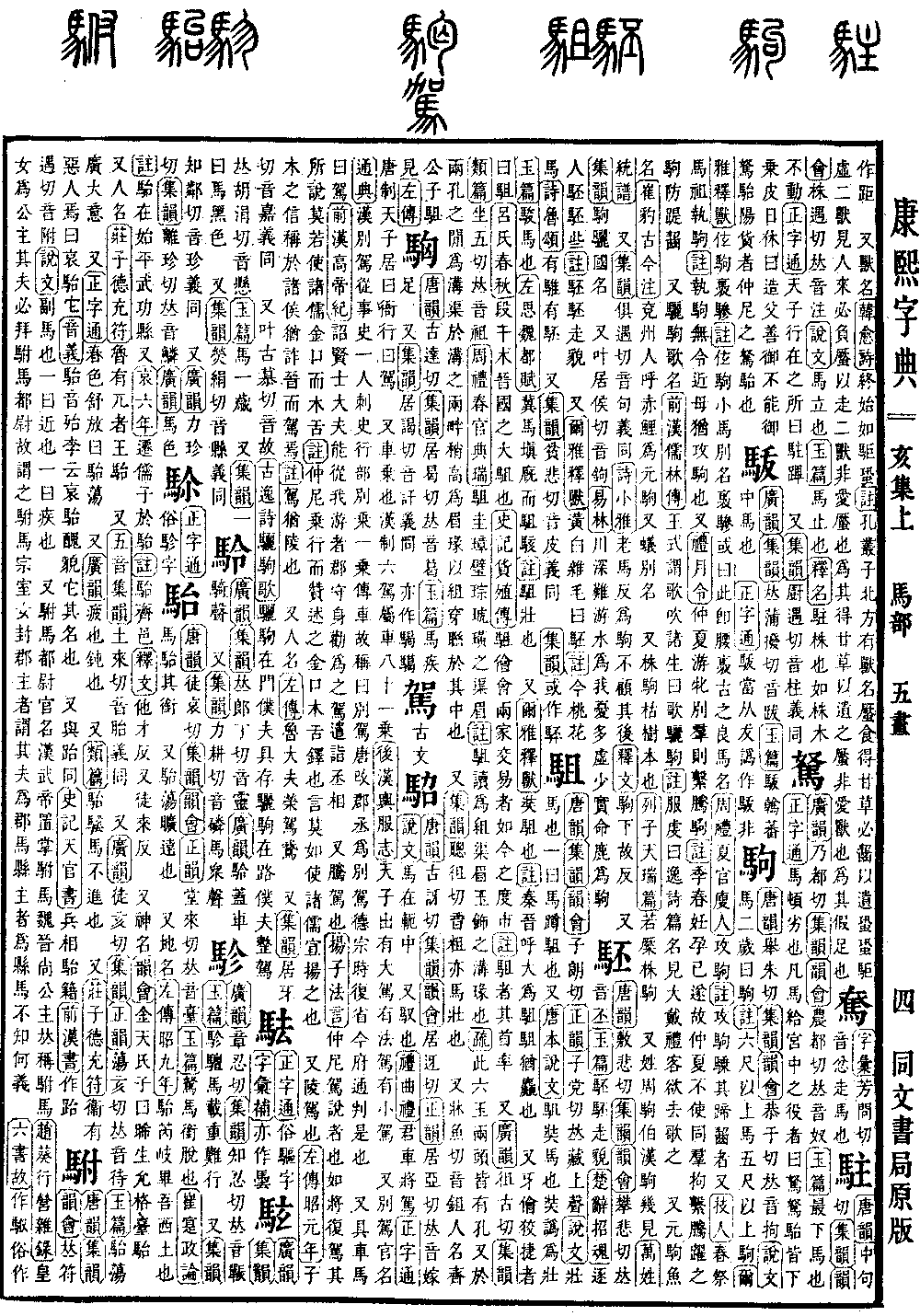
Page 1436, Entry 01
Pronounced ju. According to the Shuowen Jiezi (Explanation of Simple and Compound Characters), a horse two years of age is called a ju. Note: A horse over six feet tall is a horse, and one over five feet is a ju. In the Erya (Approaching Elegance), it is noted that a young horse is also called a niao-can. Some say this is also known as a yao-niao, a name for a fine horse in ancient times. According to the Zhou Rites (Zhouli), in the Ministry of Summer, the Shouren (officer in charge of horses) performs the castration of colts. The note explains that this means castrating those horses that are prone to kicking and biting. Furthermore, in the section on the Jiaoren (officer in charge of stable personnel) and the Yue Ling (Monthly Ordinances), it is noted that colts are restrained and kept away from their dams, which shares the same meaning as castration. According to the Book of Rites (Liji), in the second month of summer, dams are separated from other horses, and the lively young stallions are restrained. The note explains that since the dams are pregnant by the third month of spring, they are kept separate in the second month of summer to prevent the stallions from kicking and biting. It also refers to the Li-ju, which is the name of a song. In the History of the Former Han (Qian Hanshu), in the Biography of Confucian Scholars, Wang Shi told his students who were singing and playing music to sing the Li-ju. The note by Fu Qian states that this is a lost chapter of the Classic of Poetry (Shijing), also mentioned in the Book of Dai (Da Dai Liji), which was sung when a guest was preparing to depart. It is also the name of a type of fish, the yuan-ju. In the Gujin Zhu (Notes on Ancient and Modern Times) by Cui Bao, it is noted that people in Yanzhou call red carp yuan-ju. It is also a name for an ant. It also refers to zhu-ju, meaning a withered tree stump. In the Liezi, in the Tianrui chapter, it mentions objects resembling wooden posts and withered tree stumps. It is also a surname; in the Zhou Dynasty there was Ju Bo, and in the Han Dynasty there was Ju Ji, as seen in the Wanxing Tongpu (Comprehensive Register of Ten Thousand Surnames).
Pronounced ju. The meaning is the same. In the Classic of Poetry (Shijing), Small Odes section, it mentions an old horse being treated as a young horse, without regard for its future. In the Collected Commentaries, the character ju is rhymed with the departing tone.
Also pronounced ju-li, which is the name of a country.
Also pronounced gou. In the Yilin (Forest of Changes), it is written that the river is too deep to swim across, and the water brings me sorrow. Falsehoods are many and truths are few; a deer is appointed as a horse.
Textual Research: In the Zhou Rites, Ministry of Summer, the Technician (Jiren) section mentions the spring sacrifice to the horse ancestor and the restraining of colts. Based on the original text, Jiren has been corrected to Jiaoren. In the Book of Rites, Monthly Ordinances, in the second month of summer, the dams are separated from the herd and the leaping colts are restrained. Based on the original text, the character for restrained (xi) has been corrected to (zhi). According to the Shiwen (Explanation of Text), the pronunciation of ju is given as low-gu. I note that the character ju is pronounced ju, and the three characters low-gu do not apply. Only the rhyming note for the later character in the Collected Commentaries uses the pronunciation low-gu, which applies to the later character rather than the character ju itself. The text has been corrected to reflect the Collected Commentaries stating that for the character ju, the rhyme is in the departing tone.