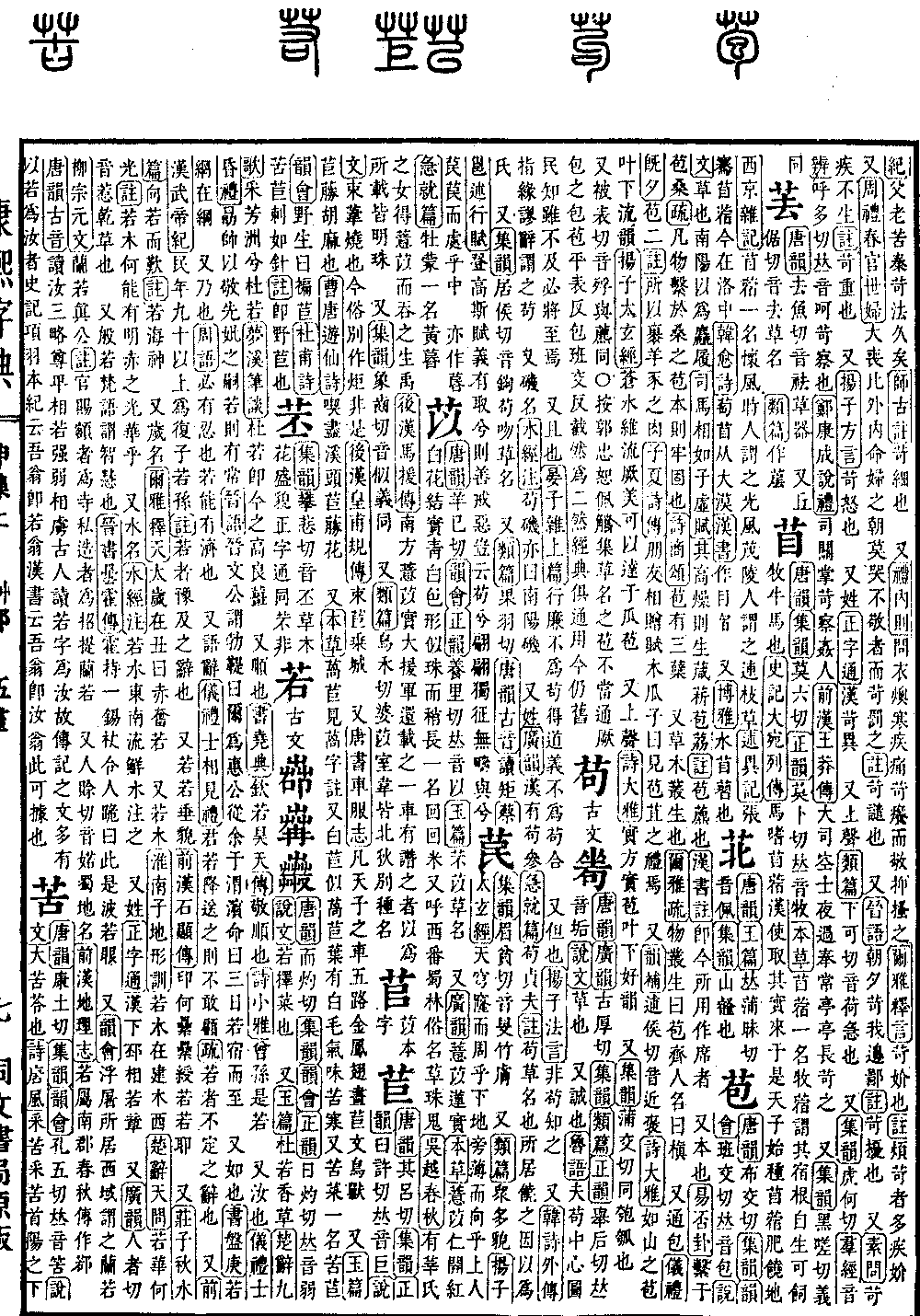
Shen Collection, Upper Volume
Radical: Grass (cǎo)
茍
Kangxi stroke count: 11
Page 1023, Entry 05
In ancient texts, according to Tang Rhyme (Tangyun) and Wide Rhyme (Guangyun), it is pronounced gou (falling tone). According to Collected Rhymes (Jiyun), Classified Chapters (Leipian), and Standard Rhymes (Zhengyun), it is pronounced gou (falling tone).
According to the Explaining Graphs and Analyzing Characters (Shuowen), it is the name of a type of grass. It also expresses sincerity.
In Discourses of the States (Luyu), it states: If one genuinely plans for the welfare of the people, even if wisdom is insufficient, one will certainly achieve the goal.
It also denotes a temporary state. In Master Yan’s Spring and Autumn Annals (Yanzi Chunqiu), it states: To behave with integrity and not acquire things indiscriminately, and to follow the path of righteousness and not conform indiscriminately.
It also denotes mere limitation. In Model Sayings (Fayan) by Yang Xiong, it states: It is not merely knowing alone.
According to Han School's Outer Traditions (Hanshi Waizhuan), it refers to far-fetched or forced rhetoric.
It is also the name of a rocky promontory. In Commentary on the Classic of Waterways (Shuijing Zhu), it mentions Gou Promontory, also known as Nanyang Promontory.
It is also a surname. According to Wide Rhyme (Guangyun), there was a person named Gou Can during the Han dynasty. In the Emergency Manual (Jijiupian), there is a mention of Gou Zhenfu. The commentary notes that Gou is a type of grass. Because the place of residence was abundant in this grass, it was adopted as a surname.
According to Collected Rhymes (Jiyun), it is pronounced gou (level tone). Gouwen is the name of a type of grass.
According to Classified Chapters (Leipian), it is pronounced ju (rising tone). According to Ancient Sounds of Tang Rhyme (Tangyun Guyin), it is read as ju (rising tone). In Cai Yong's Narrative Journey Rhapsody (Shuxing Fu), it states: Ascending high to record this composition, there is a captured meaning. Promoting good and warning against evil, how can one say this is done carelessly? Traveling far with lightness of heart, yet with no companion to follow.
茍
According to Wide Rhyme (Guangyun), it is pronounced ji (rising tone). According to Sea of Chapters (Pianhai), it is pronounced ji (entering tone). It signifies urgency. It is interchangeable with the character ji (urgent). It is distinct from the character gou.