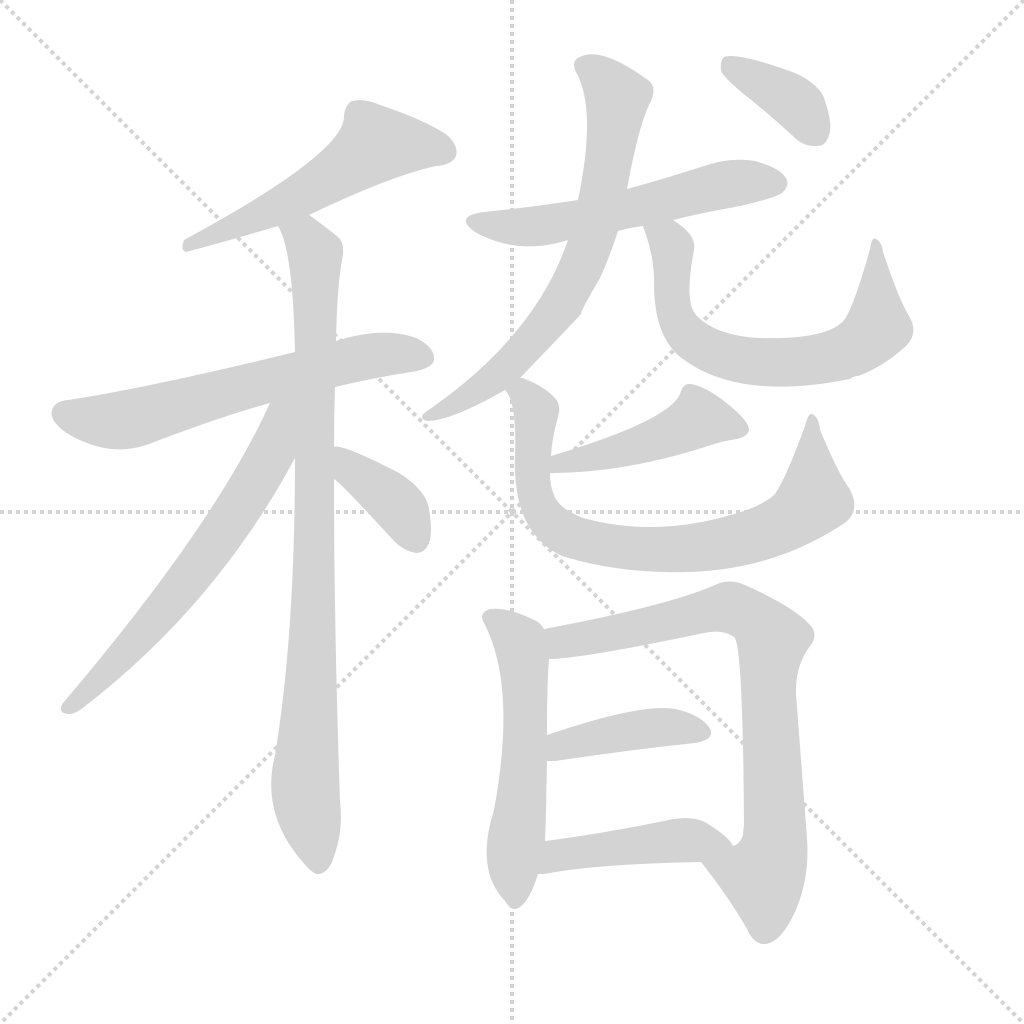
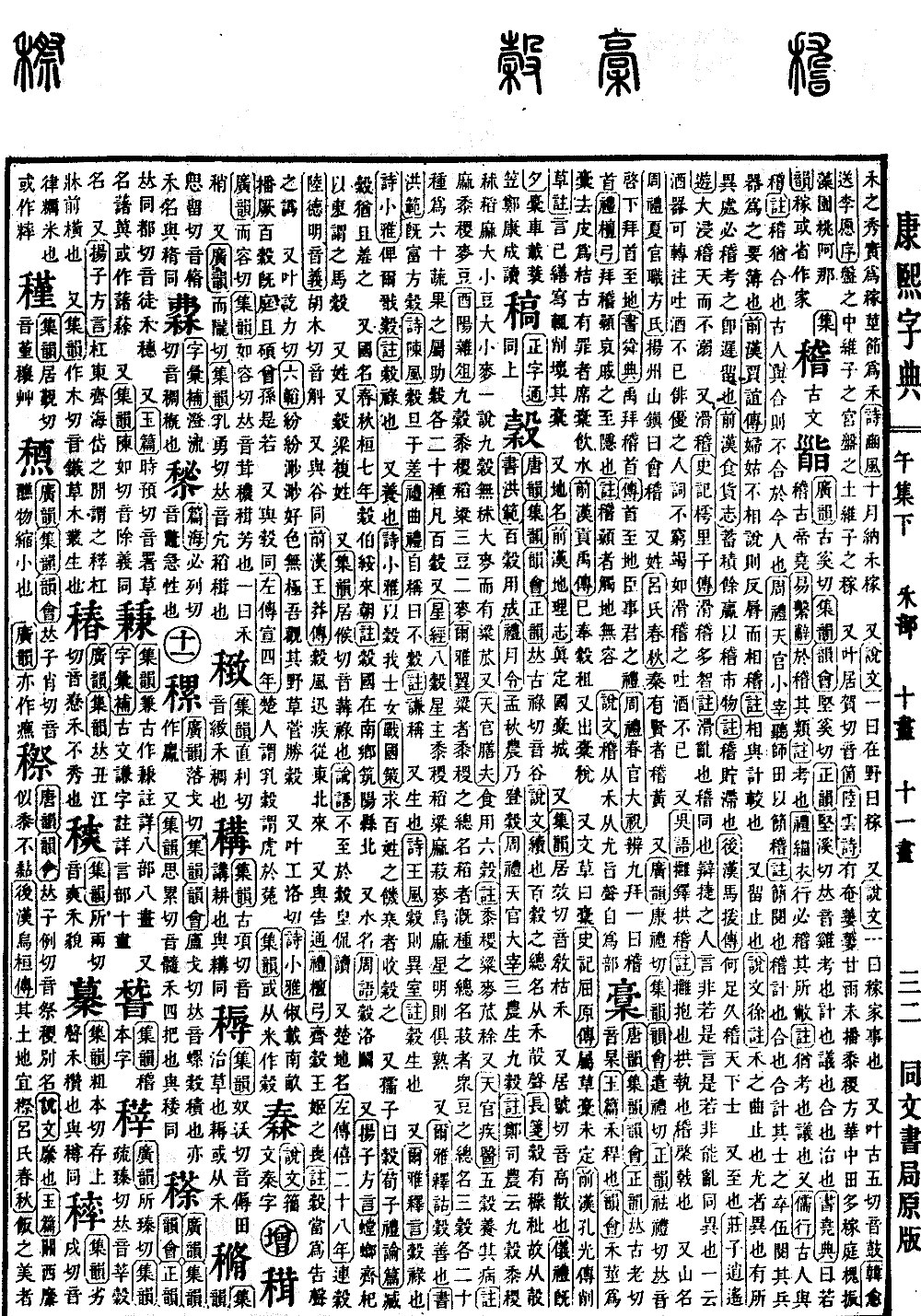
Wu Collection, Lower Volume
Radical: Grain (hé)
Kangxi Strokes: 15
Page 858, Entry 01
Ancient form. Pronounced ji. To examine, to calculate, to discuss, to join, to govern. Book of Documents (Shujing), Yao Canon: Said regarding examining the ancient Emperor Yao. Book of Changes (Yijing), Appended Statements: To examine their categories. Commentary: To examine. Record of Rites (Liji), Black Robes: Actions must be examined for their flaws. Commentary: Means to examine, to discuss. Also, Confucian Conduct: The ancients and those who agree. Commentary: Ji means to join; if one agrees with the ancients, then one does not agree with modern men. Rites of Zhou (Zhouli), Offices of Heaven, Small Steward: Listen to the military hunts in order to examine. Commentary: Examine means to review. Ji means to calculate and to join. To calculate the soldiers of the units and review their weaponry, making a summary register. History of the Former Han (Qianshu), Biography of Jia Yi: If the mother-in-law and daughter-in-law are not in accord, they bite back and argue with each other. Commentary: Arguing and calculating with one another. Also, to stay or stop. Xu’s Commentary on the Analytical Dictionary of Characters (Shuowen): The curvature and stopping of grain. The term refers to something being different. Where there is a difference, one must examine it, which leads to delay. History of the Former Han (Qianshu), Treatise on Food and Money: Storing the remaining surplus to accumulate market goods. Commentary: Ji means to store or stagnate. Book of the Later Han (Houhanshu), Biography of Ma Yuan: Why linger long among the scholars of the world. Also, to reach. Zhuangzi, Free and Easy Wandering: The great flood reached the sky but did not drown them. Also, gujī (witty/jocular). Records of the Grand Historian (Shiji), Biography of Chuli Zi: Witty and wise. Commentary: Hua means to confuse; ji means to unify. A person who is eloquent and quick-witted, saying what is wrong is right and what is right is wrong, able to confuse identity and difference. Another source says it refers to a wine vessel that can be turned to pour, indicating a jester whose words are inexhaustible, like the unending flow of wine. Also, Wu Sayings (Wuyu): Holding the bell. Commentary: Hold means to embrace. Arch means to grasp. Ji means a halberd. Also, the name of a mountain. Rites of Zhou (Zhouli), Summer Offices, Official Divisions: The mountain guardian of Yangzhou is called Kuaiji. Also, a surname. Annals of Lü Buwei (Lüshi Chunqiu): In the State of Qin, there was a virtuous man named Ji Huang.
Also, pronounced qi. To bow low with the head touching the ground. Book of Documents (Shujing), Shun Canon: Yu bowed and touched his head to the ground. Commentary: The head touching the ground is the ritual of a subject serving a ruler. Rites of Zhou (Zhouli), Spring Offices, Great Invoker: Differentiate the nine types of bowing, the first is called bowing with head to the ground. Record of Rites (Liji), Tan Gong: Bowing with the forehead touching the ground is the depth of sorrow and grief. Commentary: Touching the forehead to the ground means touching it to the earth without restriction. Analytical Dictionary of Characters (Shuowen): The character is composed of the radical for reaching and the sound component for intent, and constitutes its own section.